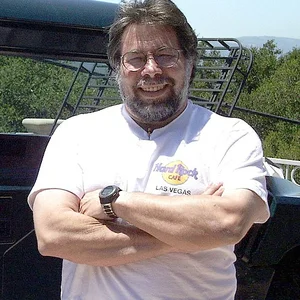

Engineer and co-founder of Apple, Steve Wozniak designed the Apple I and Apple II in the 1970s, laying the foundations of personal computing. Nicknamed “The Woz,” he is considered one of the pioneers of the digital revolution.
Steve Wozniak(1950 — ?)
Steve Wozniak
États-Unis, Pologne, Serbie
8 min read
Frequently asked questions
Famous Quotes
« Never trust a computer you can't throw out a window.»
« All the best things that I did at Apple came from (a) not having money and (b) not having done it before, ever.»
Key Facts
- 1976: co-founds Apple Computer with Steve Jobs and Ronald Wayne
- 1976: designs and builds the Apple I, the first computer sold as a kit
- 1977: launches the Apple II, the first commercially successful mass-market personal computer
- 1981: partially steps back from Apple following a plane crash
- 2014: receives the Presidential Medal of Freedom from Barack Obama
Works & Achievements
The first computer designed by Wozniak, sold as a kit for $666.66. It was one of the first machines to combine a microprocessor, memory, and a keyboard port on a single board, making personal computing accessible.
The true first commercial success of personal computing, the Apple II featured a built-in keyboard, color display, expansion slots, and a floppy disk drive. It sold several million units throughout the 1980s and became a fixture in schools across the United States.
Wozniak designed the hardware version of the arcade game Breakout in four nights for Atari, reducing the chip count to an absolute minimum. His elegant solution is still cited as a masterclass in engineering.
Designed in two weeks at Jobs's request, this floppy disk controller used a handful of chips where competing solutions required dozens. It is widely regarded as one of Wozniak's greatest engineering achievements.
A massive rock music festival organized by Wozniak in California to celebrate the convergence of technology and popular culture. Funded entirely out of his personal fortune, it drew hundreds of thousands of people and remains one of the largest concert events in American history.
After leaving Apple, Wozniak founded CL 9 and developed the first programmable infrared universal remote control, a forerunner of all modern home automation control systems.
Anecdotes
At 13, Steve Wozniak built his first computer from salvaged electronic parts, thanks to lessons from his father, an engineer at Lockheed. He even won a school science competition for a binary adder, earning him the nickname 'the genius' among his classmates.
In 1975, Wozniak attended meetings of the Homebrew Computer Club in a garage in Menlo Park, California. It was there that he decided to freely share the blueprints for his computer with all the members, convinced that technology should be accessible to everyone — a decision that shocked his future partner Steve Jobs.
To fund the production of the first Apple I computers in 1976, Wozniak sold his HP-65 calculator (worth around $500) and Jobs sold his Volkswagen van. Together, they assembled the first machines in the Jobs family garage in Los Altos, California.
In February 1981, Wozniak was involved in a plane crash near Santa Cruz. He survived but suffered temporary anterograde amnesia and could not remember the days following the accident. This trauma led him to return to his studies at Berkeley under the humorous pseudonym 'Rocky Raccoon Clark', which he chose to avoid being recognized.
In 1982, Wozniak personally funded the US Festival, a massive rock concert in California that drew hundreds of thousands of spectators and featured artists such as Fleetwood Mac and The Police. The festival cost him over $12 million, which he covered entirely out of his belief that music and technology should bring people together.
Primary Sources
"I designed the Apple I entirely by myself, for fun, without thinking of it as a commercial product. I just wanted to show what a single engineer could accomplish with a cheap microprocessor."
Club members freely exchange schematics and ideas about personal microcomputers, in the spirit that information should flow freely among enthusiasts.
Invention attributed to Stephen G. Wozniak describing the floppy disk controller for the Apple II, recognized for its minimalist design using a record-low chip count compared to competing solutions.
"I always believed education mattered more than money. Going back to finish my degree years after co-founding Apple felt like the most natural thing in the world to me."
Key Places
Steve Wozniak was born on August 11, 1950, in San Jose, at the heart of what would become Silicon Valley. His father, an engineer at Lockheed, introduced him to electronics from an early age.
It was in this suburban garage that Wozniak and Steve Jobs assembled the first Apple I computers in 1976, officially founding Apple Computer. The site has become a worldwide symbol of the American entrepreneurial spirit.
An informal club where computer enthusiasts gathered in an auditorium at SLAC (Stanford Linear Accelerator Center) starting in 1975. Wozniak presented the Apple I there and freely shared his circuit schematics with the group.
Wozniak briefly studied at Berkeley before co-founding Apple, then returned in the 1980s to complete his degree in electrical engineering and computer science, enrolling under the alias "Rocky Raccoon Clark."
Apple moved to Cupertino in the late 1970s. It was there that Wozniak worked as an engineer and designed successive versions of the Apple II, until his departure from the company in 1985.
Typical Objects

Essential electronic measuring instrument in Wozniak's workshop from his teenage years. He used it to visualize electrical signals and debug his homemade circuits.

A twenty-five-dollar chip chosen by Wozniak to design the Apple I in 1975. Its low cost was decisive: Intel or Motorola microprocessors were far too expensive for a hobbyist at the time.

A high-end programmable scientific calculator that Wozniak owned and sold for $500 to fund the production of the first Apple I units in 1976.

Wozniak's everyday tool for assembling each Apple I by hand. The first hundreds of machines were literally built by hand, component by component, in the family garage.

The Apple I was one of the first computers to include a standard keyboard port. Wozniak designed the interface to let users type commands directly, replacing the tedious toggle switches found on earlier machines.

A peripheral designed by Wozniak for the Apple II in just two weeks. Its design, using a minimum number of chips, was so elegant that it is still cited as a model of minimalist engineering.

The first Apple I units used an ordinary television set as a display screen. Wozniak developed the circuit enabling this connection to make the computer affordable for any American household.
School Curriculum
Vocabulary & Tags
Key Vocabulary
Tags
Daily Life
Morning
In the 1970s, Wozniak starts his day early, often after spending part of the night working on his circuits. He grabs a quick breakfast in the suburban neighborhoods of San Jose before heading to his engineer position at Hewlett-Packard, where he officially works full-time while developing the Apple I on the side.
Afternoon
In the afternoons at HP, Wozniak designs calculators and electronic systems, but simultaneously scribbles schematics for his own projects. During breaks, he swaps ideas with other passionate engineers, fostering a culture of technical collaboration typical of the nascent Silicon Valley.
Evening
In the evenings, Wozniak retreats to his makeshift workshop — often the Jobs family garage — to solder, test, and debug his circuits well into the night. The weekly Homebrew Computer Club meetings are the highlight of his social week, where he showcases his progress and picks up ideas from others.
Food
Like many engineers of his generation whose passion lay squarely in their work, Wozniak kept to a simple, no-frills diet: sandwiches, ordered pizzas, and sodas were the fuel behind those long nights of design. He would later admit he never placed much importance on food during those years of intense work.
Clothing
Wozniak wears the unspoken uniform of the California engineer in the 1970s: jeans, a t-shirt or plaid shirt, sneakers. Unlike Jobs, who already paid close attention to his image, Wozniak proudly claims complete indifference to appearance, favoring practicality and comfort.
Housing
Wozniak lives in a modest apartment or suburban house in the San Jose and Sunnyvale area, in the kind of standardized housing typical of California's middle class in the 1970s. His home environment looks more like an amateur lab than a decorated living space: cables, circuit boards, and technical manuals clutter every available surface.
Historical Timeline
Period Vocabulary
Liens externes & ressources
Références
Œuvres
Apple II
1977
Jeu Breakout pour Atari
1976
Disk II — contrôleur de disquette Apple
1978
US Festival
1982-1983
Télécommande universelle programmable CL 9
1987