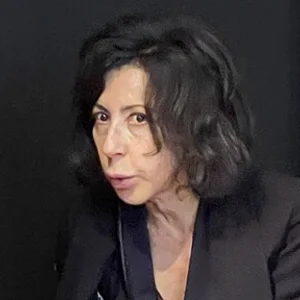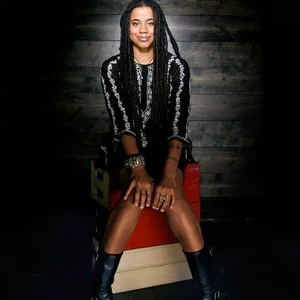

A pioneering American playwright, Suzan-Lori Parks was the first Black woman to win the Pulitzer Prize for Drama, for *Topdog/Underdog* in 2002. Her work explores African-American identity, collective memory, and history through experimental and poetic language.
Suzan-Lori Parks(1963 — ?)
Suzan-Lori Parks
États-Unis
9 min read
Frequently asked questions
Key Facts
- 1963: born at Fort Knox, Kentucky
- 1989: early off-Broadway plays, including *Imperceptible Mutabilities in the Third Kingdom*
- 2002: Pulitzer Prize for Drama for *Topdog/Underdog* — the first Black woman to receive this honor
- 2002–2003: the *365 Days/365 Plays* project, one play written every day for a year
- 2014: *Father Comes Home from the Wars* named a Pulitzer finalist, cementing her place as a major voice in American theater
Works & Achievements
Her first major work, created in Brooklyn, which won the Obie Award. In it, she already develops her experimental theatrical language to interrogate African-American identity and the traces of slavery in everyday life.
An allegorical play in which a Black gravedigger calls himself “the Great Man” and endlessly re-enacts Lincoln’s assassination for tourists. A dense meditation on race, history, and the invisibility of Black Americans in the national narrative.
A play devoted to Saartjie Baartman, a South African woman exhibited across Europe in the 19th century under the nickname “the Hottentot Venus.” Parks denounces the colonial exploitation of the Black female body with chilling irony.
A reimagining of Hawthorne’s *The Scarlet Letter* transposed into contemporary urban poverty, with a Black, homeless heroine. The play was a Pulitzer finalist and extends her exploration of social marginalization.
Her most celebrated play, which earned her the Pulitzer Prize in 2002. Two brothers, Lincoln and Booth, replay quintessentially American obsessions — competition, deception, death — in a poignant and deeply political two-hander.
An unprecedented artistic challenge: 365 plays written on 365 consecutive days. Performed simultaneously in over 700 theaters worldwide in 2006, the project became as much a global community event as a personal artwork.
An epic trilogy following Hero, an African-American slave enlisted in the Confederate army in exchange for a promise of freedom. Parks interrogates sacrifice, betrayal, and moral ambiguity through a reimagining of Homer’s *Odyssey*.
Anecdotes
During her studies at Mount Holyoke College in the 1980s, Suzan-Lori Parks took a literature course with James Baldwin, the great African American novelist. Baldwin, impressed by her short stories, told her she should write plays rather than fiction. This unexpected advice radically redirected her career and made her one of the most original voices in contemporary American theater.
Between November 2002 and November 2003, Suzan-Lori Parks set herself an extraordinary challenge: to write one play every day for a year. The result, “365 Days/365 Plays,” is a work comprising 365 short plays. In 2006, this project was performed simultaneously in more than 700 theaters around the world, in a vast collective celebration of dramatic creation.
In 2002, Suzan-Lori Parks became the first Black woman to win the Pulitzer Prize for Drama, for her play “Topdog/Underdog.” One of the most prestigious awards in the United States, it recognizes a work featuring two brothers named Lincoln and Booth playing cards while unwittingly reenacting the tragic history of America — a deliberately ambiguous title about who dominates and who suffers.
The daughter of a U.S. Army colonel, Suzan-Lori Parks spent her childhood moving from military base to military base, including time in Germany. This experience of constant uprooting deeply shaped her writing, which is obsessed with questions of identity, belonging, and memory. She would later say that growing up without fixed roots taught her to carry her history within herself.
Parks developed an entirely original theatrical language, including “spells” — moments of absolute silence notated in her scripts like musical scores. She conceives of theater as music: repetitions and variations (which she calls “Rep & Rev”) are never mere repetitions, but returns to the past that subtly transform it, like a rewriting of African American history through language itself.
Primary Sources
I'm not writing history plays. I'm writing Family Plays. […] The re-membering—and the un-membering—of history is central to my work. By 'Rep & Rev' I mean Repetition and Revision, a theatrical, musical and literary device which I use to create form and content in my plays.
Lincoln: Some days I go in there and the line is all the way out the door and down the street. Customers waiting. All of them wanting to take a shot at me. […] Booth: You enjoy it. Lincoln: Nope.
History is time that won't quit. And for Black Americans, history is not something you learned in a book; it's something that's in your blood, your body. My plays are about how we carry that history and what we do with it.
Every day I sat down and wrote a play. […] Some days it was the best thing in my life. Some days it was the hardest thing. […] The work made me feel connected to something larger than myself.
Key Places
The birthplace of Suzan-Lori Parks, this military base embodies from childhood her relationship with rootlessness and institutional America. She was born here in 1963 into a family shaped by discipline and service.
It is at this prestigious women's college that Parks studied under James Baldwin, who decisively steered her toward theater. This place is the cradle of her vocation as a playwright.
Parks settled in New York after her studies and built her career in Off-Broadway and Broadway venues. The city is the center of her professional life and the birthplace of most of her plays.
Parks premiered “Venus” there in 1996, at one of the most important theater institutions in the United States. Yale is also a place where she teaches and where her work is regularly presented.
Parks spent part of her childhood in Germany, where her father was stationed. This experience of living abroad, outside the American racial context, shaped her distinctive perspective on African American identity.
Typical Objects

Parks is known for her rigorous daily writing discipline — exemplified by her 365 plays in 365 days challenge. Her writing tool is the central instrument of her artistic practice, present at the very start of each working day.

Parks conceives her plays as scores: she notates "spells

In *Topdog/Underdog*, the three-card monte game is the central object around which all the tension between the two characters plays out. The cards symbolize fate, deception, and brotherly rivalry.

Parks draws extensively on the biblical tradition and on the works of Nathaniel Hawthorne, Harriet Beecher Stowe, and Toni Morrison. These books appear in her constant references and in the critical rereadings that underpin her writing.

Parks is also a musician and singer who performs with her band on stage. Music is inseparable from her theater: she sometimes composes songs that are woven directly into her plays.

The daughter of a career military officer, Parks lived in Germany and on numerous American bases, growing up in a culture of displacement. The passport symbolizes this nomadic identity that fuels her questioning of belonging and roots.
School Curriculum
Vocabulary & Tags
Key Vocabulary
Tags
Daily Life
Morning
Suzan-Lori Parks begins her day very early, often before dawn, to write in the silence. This morning discipline, which she has described in several interviews, lies at the heart of her practice: she sits down at her desk and writes without waiting for inspiration, convinced that regularity is the mother of creation.
Afternoon
Afternoons are often devoted to rehearsals, meetings with directors, and the back-and-forth between text and stage. When she teaches — notably at NYU's Tisch School of the Arts — she holds her classes in the afternoon and takes a hands-on role in training young playwrights.
Evening
Parks frequently spends her evenings at public readings, opening nights, or musical performances — she is also a musician and performs with her band. New York's nightlife, rich with experimental theater and live music, feeds her artistic world.
Food
Living in New York within the cosmopolitan urban landscape of the late twentieth century, Parks has access to a varied diet influenced by African American Southern cuisine (*soul food*) and New York eating habits. She makes no mention of any particular dietary regimen in her public interviews.
Clothing
Parks embraces a strong personal style, often colorful and expressive, in keeping with her artistic identity. She does not follow conventional academic dress codes and claims an aesthetic that blends contemporary African American influences with creative freedom.
Housing
She lives and works primarily in New York, in apartments or townhouses typical of the New York life of an established artist. Her work environment is described as personal and filled with books, scores, and creative materials.
Historical Timeline
Period Vocabulary
Liens externes & ressources
Références
Œuvres
Imperceptible Mutabilities in the Third Kingdom
1989
The America Play
1993
In the Blood
1999
Topdog/Underdog
2001
365 Days/365 Plays
2002-2003
Father Comes Home from the Wars (Parts 1, 2 & 3)
2014