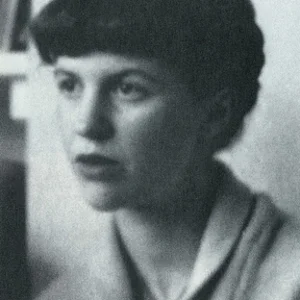

American poet and novelist (1932–1963), a major figure in confessional poetry. Author of The Bell Jar and the collection Ariel, she explores with striking intensity the themes of female identity, psychological suffering, and literary creation.
Sylvia Plath(1932 — 1963)
Sylvia Plath
États-Unis
9 min read
Frequently asked questions
Famous Quotes
« I took a deep breath and listened to the old brag of my heart: I am, I am, I am.»
« Dying is an art, like everything else. I do it exceptionally well.»
Key Facts
- Born on October 27, 1932, in Boston, Massachusetts, into a family of German and Austrian descent
- Won a scholarship to Smith College, then studied at Cambridge on a Fulbright scholarship (1955–1957)
- Published The Bell Jar in January 1963 under the pseudonym Victoria Lucas
- Died on February 11, 1963, in London, at the age of 30
- Awarded the Pulitzer Prize for Poetry posthumously in 1982 for her Collected Poems
Works & Achievements
Her first poetry collection published during her lifetime, in the United Kingdom. It already reveals her formal mastery and her obsessive themes: death, the mourning of her father, nature, and the construction of female identity.
An autobiographical novel published under the pseudonym Victoria Lucas just weeks before her death. It tells the story of a brilliant young woman's depression and hospitalization in 1950s America, and has since become a founding text of women's literature.
A collection of poems composed in the final months of her life, considered her masterpiece. Its confessional poetry, of shattering intensity, made her an icon of modern literature and second-wave feminism.
A collection of poems written between The Colossus and Ariel, revealing a crucial period of creative transition. It allows readers to trace Plath's evolution toward an increasingly visceral and personal style of writing.
Letters to her mother Aurelia Plath, presenting Sylvia's bright and enthusiastic public face — in striking contrast with the suffering revealed in her private journals and most intense poems.
Diaries kept from 1950 to 1962, an essential primary source for understanding her inner life, her literary ambitions, and the tensions between her dazzling public persona and her profound psychological distress.
Anecdotes
Sylvia Plath published her first poem at the age of eight in a Boston newspaper, the Boston Herald, in 1940. From childhood, she showed an extraordinary aptitude for writing and won numerous school prizes, reflecting an early and all-consuming literary ambition.
In 1953, after being rejected from a summer creative writing course at Harvard, Plath fell into a severe depression and attempted to take her own life by swallowing sleeping pills. She was found alive several days later and hospitalized, receiving electroshock treatments. This traumatic experience formed the autobiographical core of her novel The Bell Jar.
At a student party in Cambridge in February 1956, Sylvia Plath met the British poet Ted Hughes. According to accounts from the time, their first encounter was electric and tumultuous. They married four months later, in June 1956, forming one of the most celebrated literary couples of the twentieth century.
In the autumn of 1962, separated from Ted Hughes who had left her for another woman, Plath experienced a period of exceptional creativity. She would wake at four in the morning, before her two young children stirred, to write her poems. In just a matter of weeks, she composed nearly all the texts that would make up the collection Ariel, which would become her masterpiece.
Sylvia Plath moved with her children into a London apartment that had once belonged to the Irish poet W. B. Yeats, at 23 Fitzroy Road. She regarded this as a favorable literary omen and rejoiced at the symbolic coincidence in her final letters to her mother, shortly before her death in February 1963.
Primary Sources
I saw myself sitting in the crotch of this fig tree, starving to death, just because I couldn't make up my mind which of the figs I would choose. I wanted each and every one of them, but choosing one meant losing all the rest, and, as I sat there, unable to decide, the figs began to wrinkle and go black, and, one by one, they plopped to the ground at my feet.
Dying is an art, like everything else. I do it exceptionally well. I do it so it feels like hell. I do it so it feels real. I guess you could say I've a call.
I want to write because I have a thirst for excellence — an ardent desire to give and to create — and I am terribly jealous of anyone who writes better than I do. I want to live and feel all the shades, tones, and variations of mental and physical experience possible.
I am so happy here, so full of work and new ambitions. Cambridge is a magical place, full of brilliant young people and heated discussions. I feel I am building myself a whole life.
Every woman adores a Fascist, the boot in the face, the brute brute heart of a brute like you. You stand erect like a man of God, your chin unworthy, your Aryan moustache, your Aryan eye bright blue.
Key Places
Birthplace of Sylvia Plath, born on October 27, 1932. Her childhood in the Boston suburbs shaped her earliest experiences of postwar American life, caught between academic ambition and social conformity.
Plath attended on a full scholarship (1950–1955). It was here that she suffered her first serious depression and first hospitalization, an experience that lies at the heart of *The Bell Jar*.
On a Fulbright scholarship, Plath studied literature at Cambridge from 1955 to 1957. There she met Ted Hughes and flourished intellectually in one of England's most stimulating academic environments.
A large country house where Plath and Ted Hughes lived from 1961 to 1962. It was here that she kept beehives and wrote many of the poems in *Ariel*, before the couple's painful separation.
Plath's final home, where she moved in the winter of 1962–1963 with her two children. The flat had once belonged to W. B. Yeats, which Plath took as a sign. It was here that she died on February 11, 1963.
Typical Objects

Plath used a portable typewriter to compose her poems and novel, often under difficult conditions. Typing was, for her, an act of creative discipline and a professional commitment to writing.

Plath kept journals from adolescence onward, recording her reflections, anxieties, and literary ambitions. These handwritten notebooks are an exceptional primary source on her inner life and working methods, published posthumously as *The Journals of Sylvia Plath*.

At Court Green in Devon, Plath and Ted Hughes kept bees. Bees became a recurring poetic symbol in *Ariel*, particularly in the 'bee poems' sequence, evoking female community, hierarchy, and the quiet violence of nature.

A voracious reader, Plath steeped herself in the great modern poets — W. B. Yeats, Dylan Thomas, Ted Hughes, T. S. Eliot. Her personal library, annotated in her own hand, reveals her literary influences and her meticulous work as a scholar-reader.

In the 1950s and 1960s, antidepressants and sleeping pills were the primary treatments for mental disorders. Medication holds a symbolic place in Plath's biography and in *The Bell Jar*, as an emblem of both care and the social control of women.

Plath maintained a steady correspondence with her mother, friends, and publishers. These hundreds of carefully typed and proofread letters attest to her mastery of every written form and constitute, alongside her journals, an epistolary autobiography.
School Curriculum
Vocabulary & Tags
Key Vocabulary
Tags
Daily Life
Morning
In her final months in London (autumn 1962 – winter 1963), Plath rose at four or five in the morning, before her children Frieda and Nicholas woke up. She wrote her poems by candlelight or lamplight in a freezing apartment, making the most of those hours of absolute silence for her most intense creative work.
Afternoon
Afternoons were devoted to the children, errands, and household tasks. Plath looked after her two young children entirely on her own, prepared meals, and tried to keep a stable family routine — all while dealing with mounting exhaustion and psychological fragility made worse by the exceptionally harsh winter of 1963.
Evening
Evenings might be spent reading, writing letters to her mother and friends back in the United States, or revising her poems. Socially isolated in a cold city, she kept her ties to America alive through correspondence and read voraciously to continue feeding her poetic world.
Food
Plath cooked simply and practically, constrained by the precariousness of her life in London. Her journals and letters mention tea, toast, and scrambled eggs — a modest diet that reflected her limited finances as a freelance writer raising her children alone.
Clothing
Plath dressed neatly and without excess, in the feminine style of the 1950s: fitted dresses, skirts, jumpers, and raincoats. She followed the respectable dress codes of her era, though her letters show a careful attention to clothing for important occasions — a sign of her constant concern for image and social standing.
Housing
In London in 1962–1963, Plath lived in a flat in Primrose Hill at 23 Fitzroy Road — a two-storey home with a small garden, which she rented after discovering it had once belonged to Yeats. The flat was cold and uncomfortable through the winter of 1962–1963, one of the harshest in England in the twentieth century, with frequent heating failures.
Historical Timeline
Period Vocabulary
Liens externes & ressources
Références
Œuvres
The Colossus and Other Poems
1960
La Cloche de verre (The Bell Jar)
1963
Ariel
1965, posthume
Crossing the Water
1971, posthume
Letters Home — Correspondance 1950-1963
1975, posthume
The Journals of Sylvia Plath (Journaux)
1982, posthume