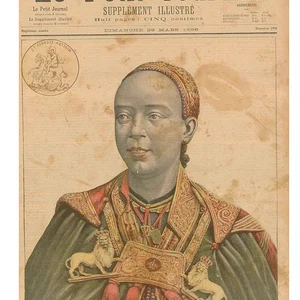

Empress of Ethiopia and wife of Menelik II, Taytu Betul was a major political and military figure of the late 19th century. Born into the Amhara tradition, she played a decisive strategic role in the Battle of Adwa in 1896, which repelled Italian colonization.
Taytu Betul(1851 — 1918)
Taytu Betul
Éthiopie
8 min read
Frequently asked questions
Famous Quotes
« "I will not sign a treaty that would turn Ethiopia into a foreign province." (words attributed by tradition during the negotiations of the Treaty of Wuchale)»
Key Facts
- Born around 1851 into a noble Amhara family in Ethiopia (partial written records)
- Wife of Menelik II, Negus Negast (King of Kings) of Ethiopia from 1889
- Played a key role in resisting the clauses of the Treaty of Wuchale (1889) imposed by Italy
- Actively participated in the military campaign and the Ethiopian victory at the Battle of Adwa (March 1, 1896)
- Died in 1918; her memory is preserved through oral traditions and Ethiopian court chronicles
Works & Achievements
Taytu personally chose the location and gave the new Ethiopian capital its name, meaning 'new flower' in Amharic. This decision lastingly shaped the political geography of the Ethiopian Empire.
Taytu led a corps of troops during the decisive battle against Italy, contributing to the encirclement of enemy forces. Her victory stands as a symbol of African resistance to European colonization.
Taytu was among the first to identify and publicly denounce the manipulation of Article 17 of the Treaty of Wuchale, which would have made Ethiopia an Italian protectorate. Her opposition led to the treaty's annulment.
Taytu composed poetic songs in Amharic celebrating military victories and Ethiopian greatness, passed down orally by court musicians. These works form part of Ethiopia's oral literary heritage.
Taytu oversaw the construction and organization of the Guébi (imperial palace), defining the political and symbolic architecture of the new Ethiopian capital.
Anecdotes
At the Battle of Adwa in March 1896, Taytu Betul did not stay behind the lines: she personally commanded a corps of troops and helped encircle the Italian forces. Her presence on the battlefield galvanized the Ethiopian soldiers, who achieved one of the greatest African victories against a European colonial power.
It was Taytu Betul who chose the site of the future Ethiopian capital. In 1886, during an expedition with Menelik II into the highlands of Entoto, she discovered hot springs and declared: 'I want a house here.' She named the place Addis Ababa, meaning 'new flower' in Amharic. The city became the capital of the Empire.
Taytu was renowned for her political intelligence and mastery of diplomatic negotiations. During the preliminary talks leading to the Treaty of Wuchale in 1889, she was among the first to detect the fatal ambiguity between the Amharic and Italian versions of the text — a discrepancy that purported to make Ethiopia an Italian protectorate, something Ethiopia categorically refused.
After the death of Menelik II in 1913, Taytu attempted to retain political influence, but was gradually pushed aside from power by the regents. She nonetheless continued to be revered as a symbol of resistance and national pride until her death in 1918, at around the age of 67.
Taytu was also a recognized poet and musician at the imperial court. She composed songs in Amharic celebrating military victories and the greatness of Ethiopia. Some of these songs were passed down orally and are still known today in the Ethiopian musical tradition.
Primary Sources
Ethiopian court singers and griots passed down hymns celebrating Taytu Betul as 'mother of victory', describing her bravery at Adwa and her role in the rout of the Italian armies.
Article 17 of the Amharic version states that Ethiopia 'may' use Italy as an intermediary for its foreign relations, while the Italian version states that it 'must' do so — a discrepancy that Taytu was among the first to denounce publicly.
Several European envoys, including the Frenchman Alfred Ilg, noted in their reports that Empress Taytu actively participated in military and diplomatic councils, sometimes with greater firmness than the Emperor himself.
The oral traditions of Ethiopian women fighters describe Taytu as the one who 'carried water and spirit' on the battlefields, supplying the troops and sustaining morale throughout the Adwa campaign.
Key Places
Capital city founded at Taytu Betul's initiative in 1886 — she chose its location and gave it its name, meaning 'new flower.' She lived there until her death and held her imperial court there.
Site of the decisive Battle of Adwa on March 1, 1896, where Taytu commanded a corps of troops. This victory over Italy is regarded as a defining symbol of African resistance to colonization.
Former royal site where Menelik II first established his court before Addis Ababa was founded. Taytu wielded considerable political influence there from her earliest days as a royal consort.
The region where Taytu's family originated, and the heartland of Amhara and Ethiopian Coptic culture. The monasteries on the islands of Lake Tana are tied to the spirituality that shaped her entire life.
The city where Ethiopian forces gathered before the Battle of Adwa. Taytu accompanied the imperial army there during the 1895–1896 campaign.
Typical Objects

A hand-woven white cotton garment trimmed with colorful borders, worn as a mark of dignity and status at the imperial court. Taytu wore netelas featuring patterns and embroidery reserved exclusively for the imperial family.

An Orthodox religious symbol carried during ceremonies, the Ethiopian cross with its intricate geometric forms accompanied Taytu in her ritual duties as empress and a leading figure of the Ethiopian Orthodox Church.

A traditional glass or clay vessel used to serve tej, the Ethiopian honey wine consumed at imperial banquets. Taytu presided over grand gatherings where tej was passed around as a sign of alliance and celebration.

A curved blade with a gilded hilt, serving as an emblem of military command. At the Battle of Adwa, Taytu was depicted carrying such a sword as a symbol of her authority over the troops under her command.

A stamp engraved with the Ethiopian coat of arms, used to authenticate official documents. Taytu had her own personal seal, a testament to her independent decision-making power within the imperial court.

A single-stringed bowed instrument played by azmari (court musicians) to sing the praises of the imperial family. Taytu, herself the author of poetic songs, was surrounded by musicians who kept her compositions alive.
School Curriculum
Vocabulary & Tags
Key Vocabulary
Tags
Daily Life
Morning
Taytu rose at dawn for Orthodox prayer, a central tradition of Ethiopian imperial life. She attended liturgical services in Ge'ez alongside the court priests, before receiving the first diplomatic or military audiences in the palace's private apartments.
Afternoon
Afternoons were devoted to affairs of state: receiving ambassadors, reviewing diplomatic correspondence written in Amharic, and taking part in military councils alongside Menelik II. She was directly involved in strategic decisions concerning borders and alliances.
Evening
Evenings at the imperial court brought together nobles and dignitaries for a grand meal served on the mesob. Taytu presided over banquets where tej was passed around, listened to azmari singers praise her and the Empire, and continued the informal political conversations that shaped Ethiopian policy.
Food
Ethiopian court cuisine was centered on injera, a large fermented teff flatbread that served as both plate and utensil. Dishes included wot (spiced stews) of meat, lentils, and vegetables. Tej, a honey wine brewed with gesho, was the prestige drink of the imperial court.
Clothing
Taytu wore the netela, a large white cotton shawl with borders embroidered in gold and vivid colors, reserved for imperial rank. Her silk and cotton gowns were adorned with Ethiopian goldsmith jewelry: gold bead necklaces, finely worked bracelets and earrings, and an Orthodox cross worn as a pendant.
Housing
Taytu resided at the Gebi, the imperial palace of Addis Ababa that she herself had helped design. The imperial apartments were decorated with embroidered hangings, Orthodox icons painted in the Ethiopian style with large expressive eyes, and lion and leopard skins symbolizing royal power.
Historical Timeline
Period Vocabulary
Visual Style
Style impérial éthiopien de la fin du XIXe siècle : costume amhara blanc brodé d'or, bijoux traditionnels, décors de palais ornés d'icônes orthodoxes éthiopiennes et de peaux de léopard.
Sound Ambience
Ambiance sonore de la cour impériale éthiopienne : percussions ceremoniales, chants orthodoxes en guèze, musique de masenko, et rumeurs de la vie diplomatique à Addis-Abeba.
Liens externes & ressources
Références
Œuvres
Fondation d'Addis-Abeba
1886
Commandement militaire à la bataille d'Adoua
1er mars 1896
Dénonciation du traité de Wuchale
1889-1893
Chants et poèmes de cour amhara
1880-1910
Construction du palais impérial d'Addis-Abeba
1890-1900