 flip
flipThor's Roasted Goats with Juniper and Honey
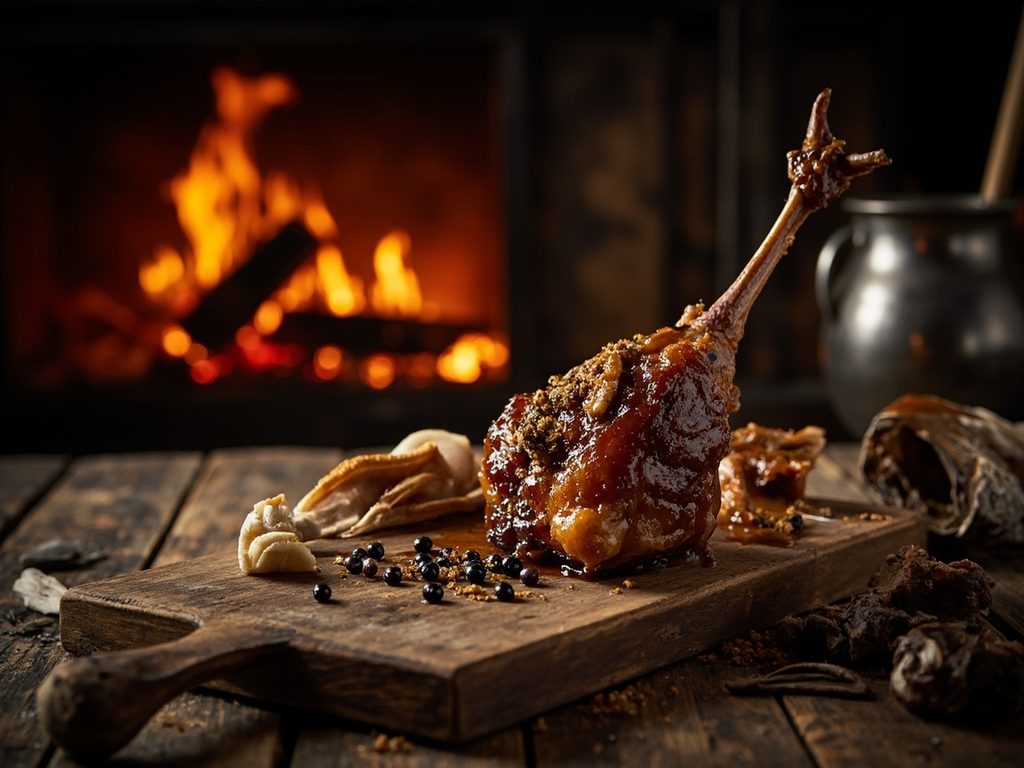
Thor's Roasted Goats with Juniper and Honey
Why this dish? Thor's chariot is pulled by two goats, Tanngrisnir and Tanngnjóstr ('Tooth-Gnasher' and 'Tooth-Cracker'). At evening, the god slaughters and eats them; in the morning, he raises Mjölnir over the skins and intact bones, and the goats revive, ready to continue the journey. No dish resembles this more: the roast meat of the feast where care is taken not to break the bones.
A leg and ribs of goat (or lamb) rubbed with salt, crushed juniper berries, and honey, roasted slowly near the fire until the crust caramelizes. The tender meat falls from the bones, which are kept whole, as in the myth.
Approach, mortal, and fear not the thunder in my voice! When evening falls on the road, I slay my two goats, I skin them carefully and throw the flesh on the embers — remember well: never break a bone, not even for the marrow, for at dawn I raise Mjölnir and my beasts rise again, alive! Rub the meat with juniper berries and a little honey from the forests, and let the fire do its work, slowly, like the patient lightning in the cloud. Eat large, drink strong, and raise the horn to the health of Ásgard!
- •Quarter of goat or ram (leg and ribs, whole bones) — a fine piece for the company (master meat of the feast)
- •Juniper berries — a handful, crushed (resinous scent of the North)
- •Wild honey — a few spoonfuls (glaze and caramelization)
- •Sea salt — by hand (seasoning and firmness)
- •Wild onion and wild thyme — as gathered (aromatics)
Thor's Roasted Goats with Juniper and Honey
A leg and ribs of goat (or lamb) rubbed with salt, crushed juniper berries, and honey, roasted slowly near the fire until the crust caramelizes. The tender meat falls from the bones, which are kept whole, as in the myth.
Why this dish? Thor's chariot is pulled by two goats, Tanngrisnir and Tanngnjóstr ('Tooth-Gnasher' and 'Tooth-Cracker'). At evening, the god slaughters and eats them; in the morning, he raises Mjölnir over the skins and intact bones, and the goats revive, ready to continue the journey. No dish resembles this more: the roast meat of the feast where care is taken not to break the bones.
Approach, mortal, and fear not the thunder in my voice! When evening falls on the road, I slay my two goats, I skin them carefully and throw the flesh on the embers — remember well: never break a bone, not even for the marrow, for at dawn I raise Mjölnir and my beasts rise again, alive! Rub the meat with juniper berries and a little honey from the forests, and let the fire do its work, slowly, like the patient lightning in the cloud. Eat large, drink strong, and raise the horn to the health of Ásgard!
Ingredients (period version)
- Quarter of goat or ram (leg and ribs, whole bones) — a fine piece for the company (master meat of the feast)
- Juniper berries — a handful, crushed (resinous scent of the North)
- Wild honey — a few spoonfuls (glaze and caramelization)
- Sea salt — by hand (seasoning and firmness)
- Wild onion and wild thyme — as gathered (aromatics)
Ingredients
- Leg of goat or lamb — 1.2 kg (master meat)
- Juniper berries — 2 tbsp, crushed (resinous scent)
- Liquid honey — 3 tbsp (glaze)
- Coarse salt — 2 tsp (seasoning)
- Onion — 1, sliced (aromatic)
- Thyme — 4 sprigs (aromatic)
- Butter — 30 g (basting)
Method
- Mix the crushed juniper, salt, and thyme leaves, then rub all over the meat. Let rest 1 hour at room temperature.
- Preheat oven to 160°C. Place the leg on a bed of onion in a dish, add butter and a splash of water.
- Roast for 2 to 2.5 hours, basting regularly with the juices.
- 30 minutes before the end, brush generously with honey to get a golden, caramelized crust.
- Let rest 15 minutes, then serve by pulling the meat from the bones — kept whole, faithful to the myth.
How it was made : In the Viking Age, large game and livestock were spit-roasted or roasted in pits near the central fire of the hall. Honey, the only available sweetener, was used both for glazing and preserving. Whole bones had ritual value: they were counted, made into tools, and the myth of the resurrected goats gives them sacred meaning.
The contemporary twist : Arrange the bones neatly on a rough wooden board, as if Thor were about to resurrect them with a hammer blow at dawn.
Sources : Snorri Sturluson, Edda (Gylfaginning), 13th century — episode of Thor's goats · Daniel Serra & Hanna Tunberg, An Early Meal: A Viking Age Cookbook, 2013
Thor · Charactorium