
Primordial Babylonian goddess personifying the salt ocean and original chaos. In the Enuma Elish, the Mesopotamian creation epic, she is defeated by the god Marduk, whose body is used to create the sky and the earth.
Tiamat
Tiamat
7 min read
Frequently asked questions
Key Facts
- Tiamat is one of the oldest deities in the Mesopotamian pantheon, rooted in the Babylonian tradition
- She is mentioned in the Enuma Elish, a creation epic composed around the 12th century BCE in Akkadian and preserved on cuneiform tablets
- According to this myth, Tiamat united with Apsu (the primordial freshwaters) to give birth to the first gods
- She is defeated by Marduk, the patron god of Babylon, who splits her body in two to form the sky and the earth
- Her name is etymologically linked to the Semitic word for sea (Hebrew: tehom, meaning 'abyss')
Works & Achievements
The foundational text of Babylonian cosmogony, written on 7 cuneiform tablets, in which Tiamat is the central figure of creation. This text is one of the most important sources for understanding the religious and cosmological thought of ancient Mesopotamia.
A related myth in which Marduk, after his victory over Tiamat, creates humans from the blood of Tiamat's general, Kingu. This narrative illustrates how Tiamat's defeat shapes the very existence of humanity in Babylonian thought.
Earlier texts, predating the Enuma Elish, presenting Tiamat as the original mother of all the gods. These texts trace the evolution of Tiamat's status — from a benevolent creative deity to a force of chaos that must be defeated.
Annual rituals during which the Enuma Elish was solemnly recited, symbolically reenacting Marduk's victory over Tiamat. These ceremonies ensured cosmic regeneration and affirmed the legitimacy of the Babylonian king.
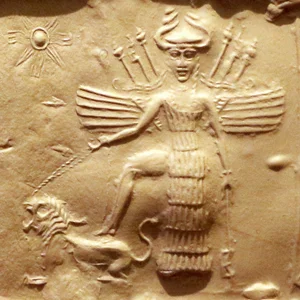
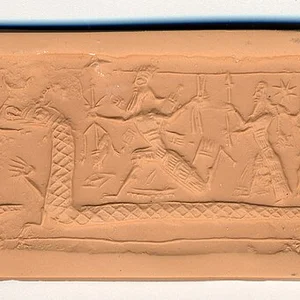
A body of visual depictions of Tiamat as a sea dragon found on thousands of Babylonian and Assyrian cylinder seals. These images are a valuable iconographic source for understanding how this deity was perceived and portrayed.
Anecdotes
Tiamat is one of the oldest deities in the Mesopotamian pantheon. Her name literally means 'sea' or 'abyss' in Akkadian, reflecting her role as goddess of the primordial salt waters. She represents the chaos that existed before creation — a central concept in Babylonian religious thought.
In the Enuma Elish, Tiamat creates an army of terrifying monsters to avenge the death of her companion Apsu, who was slain by the younger gods. Among these creatures were venomous serpents, roaring dragons, and furious demons — a true army of chaos arrayed against the forces of divine order.
After her defeat at the hands of the god Marduk, Tiamat's body is put to an extraordinary use: Marduk splits her corpse in two, like the shell of a clam. One half becomes the sky, the other the earth. Her eyes give rise to the Tigris and Euphrates, the two great rivers of Mesopotamia.
Tiamat is often depicted as a giant dragon or sea serpent, symbolizing the power of uncontrollable waters. This image influenced many later mythological traditions, including the combat against the dragon in the Hebrew Bible (the Leviathan), suggesting a cultural transmission between the civilizations of the ancient Near East.
The Tablet of Destinies plays a crucial role in the myth: Tiamat entrusts it to her general Kingu, granting him supreme authority over the gods. Marduk seizes it after his victory, consolidating his power over the universe — illustrating the symbolic importance of writing and clay tablets in Babylonian culture.
Primary Sources
When the skies above had not yet been named, and the earth below had not yet been given a name, Apsu the primordial, their father, and Tiamat the mother of both, mingled their waters together.
Tiamat, the deep mother, rose up to do battle. She marshaled her army and gathered her creatures. She made her weapons gleam, weaving sharp serpents.
The priest recites: 'He split Tiamat in two halves, like a dried fish. One half he raised up and made into the sky.'
Marduk, who defeated Tiamat and established eternal kingship, whose name is spoken in the heavens as on earth.
Key Places
The main city where the cult of Marduk, conqueror of Tiamat, was central. The Esagila temple and the Etemenanki ziggurat were the sites where the Enuma Elish was recited during the Babylonian New Year festival.
The repository of the cuneiform tablets containing the Enuma Elish. It was here that 19th-century British archaeologists discovered the best-preserved copies of the Tiamat myth.
A major religious center of ancient Mesopotamia where numerous mythological tablets were found. Nippur was the seat of the god Enlil and a hub for the transmission of sacred Mesopotamian texts.
The salt waters of the Persian Gulf represented, for the Babylonians, the earthly extension of Tiamat. This sea surrounding Mesopotamia symbolized the primordial abyss at the edge of which civilization had emerged.
Liens externes & ressources
Références
Œuvres
Enuma Elish (Épopée de la création)
IIe millénaire av. J.-C.
Création de l'humanité à partir du sang de Kingu
IIe millénaire av. J.-C.
Mythe de la naissance des dieux (théogonie akkadienne)
IIIe millénaire av. J.-C.
Textes du rituel Akitu (Nouvel An babylonien)
Ier millénaire av. J.-C.
Représentations iconographiques sur sceaux-cylindres
IIIe–Ier millénaire av. J.-C.