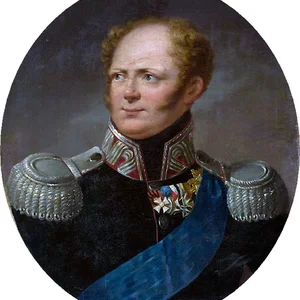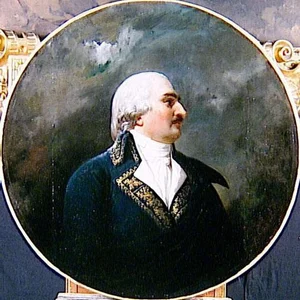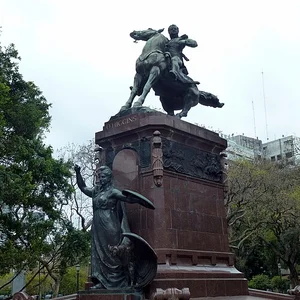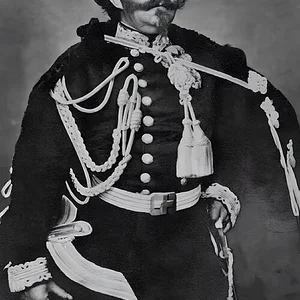

King of Sardinia and then first King of unified Italy (1861), Victor Emmanuel II was the monarch who, allied with Cavour and Garibaldi, brought the Risorgimento to completion. He reigned until his death in 1878, embodying Italian national unity.
Victor Emmanuel II(1820 — 1878)
Victor Emmanuel II
royaume d'Italie
9 min read
Frequently asked questions
Famous Quotes
« Italy is made; now we must make Italians.»
Key Facts
- 1820: born in Turin into the House of Savoy
- 1849: becomes King of Sardinia following the abdication of his father Charles Albert
- 1855–1856: commits Piedmont to the Crimean War alongside France in order to win allies
- 1861: proclaimed first King of unified Italy on 17 March
- 1878: dies in Rome, capital of the Kingdom of Italy
Works & Achievements
By refusing to abolish the constitution after the defeat at Novara, despite Austrian pressure, Victor Emmanuel II preserved the Piedmontese liberal model that later served as the constitutional foundation of unified Italy.
The secret Plombières Agreement with Napoleon III triggered the Second War of Independence, resulting in the annexation of Lombardy and the central Italian duchies through popular plebiscite.
The founding act of unified Italy, voted by the Parliament of Turin, which made Victor Emmanuel II the first king of a united Italy for the first time since Roman Antiquity.
Through an alliance with Bismarck's Prussia during the Austro-Prussian War, Italy gained Venetia despite its military defeats at Custoza and Lissa, significantly expanding the national territory.
The breach of Porta Pia allowed Italian troops to enter Rome, ending the Pope's temporal power and completing unification. Rome became the capital of the Kingdom of Italy in 1871.
Together with Cavour, Victor Emmanuel II transformed Piedmont into a modern state equipped with a railway network, a reformed army, and liberal institutions that were extended across all of Italy after unification.
Anecdotes
In October 1860, Victor Emmanuel II met Garibaldi near the village of Teano, in Campania. The hero of the Thousand, who had just conquered the Kingdom of the Two Sicilies, greeted the king with a simple “I salute you, first King of Italy!” and handed over the conquered territories, refusing any personal honours. This handshake between the king and the revolutionary symbolised the reconciliation of the two forces that had brought about Italian unification.
Victor Emmanuel II was nicknamed “il Re galantuomo,” the “gentleman king,” because he refused to repudiate the Statuto Albertino after the defeat at Novara in 1849. Austria pressured both his abdicating father and the young king himself to abolish constitutional liberties as the price of peace, but he held firm, thereby preserving Piedmont’s liberal institutions and his reputation among Italian patriots.
The king was so passionate about hunting that his ministers struggled to reach him whenever he slipped away to his mountain estates. Cavour himself sometimes had to dispatch urgent couriers all the way to the forests of the Val d’Aoste to obtain the royal signature on treaties of the utmost diplomatic importance.
In July 1859, Napoleon III signed the Armistice of Villafranca with Austria without informing Victor Emmanuel II, abandoning Venetia halfway through the campaign. The king, furious at this betrayal, reportedly declared that Italy could clearly count only on itself. This episode led him to pursue unification without placing too much faith in French promises.
Victor Emmanuel II maintained a long-standing relationship with Rosa Vercellana, nicknamed “la Bella Rosina,” the daughter of a Piedmontese non-commissioned officer. After the death of his official wife in 1855, he married her in a morganatic union in 1869. This marriage, scandalous at court, illustrates the king’s unpretentious character — he felt far more at ease among soldiers and hunters than amid the formalities of palace life.
Primary Sources
Abbiamo risoluto di accordare e di sanzionare il presente Statuto fondamentale della Monarchia [...] per essere una legge fondamentale perpetua ed irrevocabile della Monarchia.
We proclaim to have taken the title of King of Italy [...] In proclaiming at this hour Italy constituted as a State, we fulfill the wish of twenty-five generations.
His Majesty the King of Sardinia consents to the territories of Savoy and the district of Nice being united to France, on the express condition that the populations shall be consulted.
Piedmont, in upholding its constitutional institutions, offers Italy the model of a free and orderly government, respectful of the rights of all and guarantor of public order.
I owe it to my peoples and to myself not to conceal how deeply painful this unexpected armistice is to me; Venetia remains under the Austrian yoke and the work of national unification remains unfinished.
Key Places
Capital of Piedmont-Sardinia and birthplace of the Risorgimento, Turin was home to the Parliament that proclaimed Italian unification in 1861. Victor Emmanuel II resided there until the capital was moved to Florence and then Rome.
After the capture of Rome in 1870, Victor Emmanuel II took up residence at the Quirinal, the former papal palace that became the royal residence. It was there that he died in January 1878, with the unification of Italy complete.
It was near this village, on 26 October 1860, that Victor Emmanuel II met Garibaldi, who handed over to him the territories of the Mezzogiorno he had just liberated. This scene came to symbolise the union of the two great forces of the Risorgimento.
Site of the decisive battle of 24 June 1859 against Austria, in which Victor Emmanuel II fought in person. The horrors of this battlefield inspired Henry Dunant and led to the founding of the International Red Cross.
The ancient Roman monument became the mausoleum of the Italian monarchy. Victor Emmanuel II is buried there, and his tomb remains to this day a site of patriotic pilgrimage for Italian monarchists.
Typical Objects

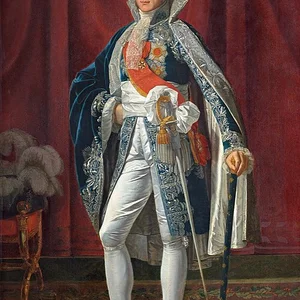
Victor Emmanuel II almost always wore military uniform rather than court dress, personally commanding his troops on the battlefield. He took part in the fighting at Goito in 1848 and in the campaigns of 1859.

This constitutional document granted by his father in 1848 was upheld by Victor Emmanuel II after the defeat at Novara, despite Austrian pressure. It symbolized his liberal commitment and served as Italy's constitution until 1948.

Passionate about hunting to the point of devoting entire weeks to it, the king never parted with his guns during stays at his mountain estates in the Aosta Valley and Piedmont.

Worn on great state occasions and military reviews, this sword symbolized his dual role as constitutional king and supreme commander of the Risorgimento armies.

Passionate about military strategy, Victor Emmanuel II personally tracked troop movements using topographic maps during war councils, particularly during the campaigns of 1859 and 1866.

The supreme order of the Santissima Annunziata, the highest distinction of the House of Savoy, adorned his chest at ceremonies. He used it to reward his most loyal diplomatic and military allies.
School Curriculum
Vocabulary & Tags
Key Vocabulary
Daily Life
Morning
Victor Emmanuel II rose very early, a habit ingrained since his military youth. He began his day with a horse ride or an inspection of the guards before receiving his aides-de-camp and reviewing diplomatic dispatches. He preferred these active mornings to the ceremonial levées inherited from royal tradition.
Afternoon
Afternoons were devoted to official audiences, cabinet meetings, and discussions with Cavour, whom he often received several times a week. The king took an active part in strategic decisions, focusing primarily on military and diplomatic affairs rather than the details of day-to-day administration.
Evening
When not on campaign, the king's evenings were typically simple: dinner with family or a few close military companions, a card game, or reading staff reports. He avoided grand court receptions and strongly preferred the company of soldiers and hunters to refined aristocratic circles.
Food
The royal table reflected his plain Piedmontese tastes: roasted meats — often game he had hunted himself —, polenta, risotto, and wines from his region. He ate heartily, in the manner of a soldier, with little concern for courtly gastronomy. He had a particular fondness for Piedmontese red wines, barolo and barbaresco.
Clothing
Almost always dressed in military uniform, Victor Emmanuel II had little use for embroidered court attire or wigs. He wore the general's uniform with his decorations, most notably the Supreme Order of the Annunciation. His famous handlebar moustache — thick and upswept — was his most recognizable physical feature.
Housing
He resided mainly at the Royal Palace in Turin, then at the Palazzo Pitti in Florence when the capital was moved there in 1865, and finally at the Quirinal in Rome from 1871 onward. These palaces were richly furnished, but the king preferred his sober private apartments and his hunting lodges, such as Stupinigi or Racconigi in Piedmont.
Historical Timeline
Period Vocabulary
Liens externes & ressources
Références
Œuvres
Maintien du Statuto Albertino
1849
Alliance franco-piémontaise et campagne de 1859
1858-1859
Proclamation du Royaume d'Italie
17 mars 1861
Annexion de la Vénétie
1866
Prise de Rome et achèvement de l'unité italienne
20 septembre 1870
Modernisation de l'armée et des institutions piémontaises
1849-1861