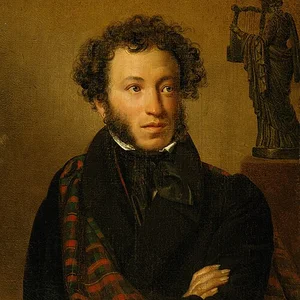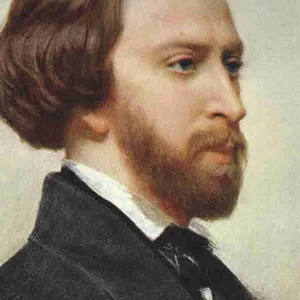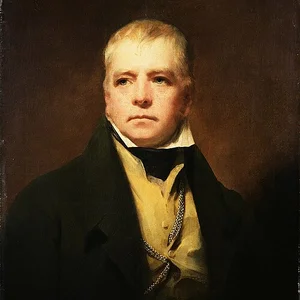

Scottish writer and poet (1771–1832), Walter Scott is the father of the modern historical novel. Works such as *Ivanhoe* and *Waverley* popularized the Romantic vision of the Middle Ages across Europe.
Walter Scott(1771 — 1832)
Walter Scott
Royaume-Uni, royaume de Grande-Bretagne
8 min read
Frequently asked questions
Famous Quotes
« Oh, what a tangled web we weave, when first we practise to deceive!»
Key Facts
- Born on 15 August 1771 in **Edinburgh**, Scotland
- Publication of *Waverley* in **1814**, the first major modern historical novel
- Publication of *Ivanhoe* in **1820**, a landmark work of European Romanticism
- Knighted in **1820**, becoming Sir Walter Scott
- Died on 21 September **1832** at Abbotsford, leaving behind a vast body of work
Works & Achievements
A long epic poem drawing on the legends of the Scottish Borders, which introduced Scott to the general public. Its spectacular success made him the most widely read poet in England even before Lord Byron.
A narrative poem set in the Scottish Highlands during the age of the clans, whose publication triggered a surge of tourism to Scotland. It notably inspired Rossini's opera *La donna del lago* (1819).
Scott's first historical novel, published anonymously, which launched the genre of the modern historical novel. The action unfolds during the Jacobite uprising of 1745, deftly weaving fictional characters together with real events.
A novel centred on the famous Scottish outlaw Rob Roy MacGregor, who had become a legendary figure. Scott explores the tensions between the Highland clans and English authority in the early eighteenth century.
Scott's masterpiece, transposing the historical novel to twelfth-century medieval England, complete with Norman and Saxon knights and tournaments. Translated throughout Europe, it became the archetype of the Romantic chivalric novel and influenced generations of writers and composers.
A historical novel set at the court of Louis XI of France, which enjoyed considerable success in France itself. Victor Hugo and Alexandre Dumas both acknowledged Scott's influence on their own work.
A monumental nine-volume biography of Napoleon, written to pay off Scott's debts. It bears witness to his interest in contemporary history every bit as much as in the medieval past.
Anecdotes
As a child, Walter Scott contracted polio, which left him with a permanent limp in his right leg. Sent to recover at his grandparents' home in the Scottish Borders, he discovered the local legends, ballads, and historical tales that would go on to nourish his entire body of work. Far from holding him back, this disability forged his passion for the past and popular culture.
The novels of the 'Waverley' series were published anonymously for years under the sole designation 'By the Author of Waverley'. This literary secret became one of the great mysteries of the age: all of Europe speculated about the author's identity. Scott finally revealed himself to be that author in 1827 at a public dinner in Edinburgh, triggering a memorable standing ovation.
In 1826, the collapse of his publisher Constable left Scott personally indebted to the tune of nearly £130,000 — a colossal sum. Flatly refusing to declare bankruptcy, he imposed on himself an exhausting writing schedule to repay his creditors to the last penny. He died in 1832 before settling the full amount, but his debt was repaid in full through the posthumous royalties from his works.
In 1822, Scott organised King George IV's visit to Scotland — the first royal visit since 1651. He staged a grand spectacle in which nobles and commoners alike were invited to wear their clan tartan. This theatrical display helped reinvent and popularise Scottish national identity, as well as Highland culture, much as we know it today.
Scott was one of the first authors to earn royalties on a large scale and to manage his career as a literary enterprise. He had the grand mansion of Abbotsford built in the neo-Gothic style he favoured, filling it with an extraordinary collection of medieval weapons, manuscripts, and historical relics. But the exorbitant cost of this architectural 'folly' was one of the main causes of his financial ruin.
Primary Sources
I have suffered much, but I have borne it well. The want of money is not the worst evil that has befallen me; the loss of independence is worse.
The author of Waverley was often pressed to say whether there was a real historical foundation for the tales he delivered to the public under that name. He was at length induced to give this general preface, which may serve as a key to the whole series.
I can work twelve hours a day and think nothing of it. The pen is the plough that turns the stubborn soil of ignorance.
The title of Ivanhoe was suggested by an old rhyme. To my own countrymen I may perhaps be allowed to say that the tale was composed to introduce a description of English customs and manners in the middle ages.
Key Places
A neo-Gothic mansion that Scott had built from 1812 on the banks of the River Tweed, in the Scottish Borders. This castle is at once his architectural masterpiece, the setting of his family life, and the symbol of his ambition — and his financial ruin.
Scott's birthplace, where he studied law and worked as an advocate. The medieval Old Town and its castle, visible from his window, fed his historical imagination from childhood.
The borderland between Scotland and England where Scott spent his childhood convalescing and first discovered local ballads and legends. This landscape of hills and ruined abbeys forms the implicit backdrop of many of his early works.
The medieval fortress dominating the city of Edinburgh, which Scott helped to elevate symbolically during the visit of George IV. For him, this monument embodied the history and enduring identity of Scotland.
A 12th-century Cistercian Gothic ruin near Abbotsford, which inspired Scott's many descriptions of medieval settings in his novels. The heart of Robert the Bruce is said to have been buried there — a legend that Scott helped to popularise.
Typical Objects

Scott rose at dawn to write for several hours before breakfast, filling page after page each morning with his goose quill. This instrument was his tool of relentless toil, especially during the years he spent paying off his debts.

Scott assembled an impressive collection of medieval swords, shields, helmets, and armour at Abbotsford. These objects served as direct inspiration for his descriptions of battles and equipment in his historical novels.

Tartan, the checked fabric whose colours belong to each Scottish clan, is closely associated with Scott, who helped popularise its use. He had it worn during the royal visit of 1822, transforming the cloth into a powerful symbol of Scottish national identity.

Scott methodically consulted chronicles, notarial records, and medieval texts to document his novels with precision. His library at Abbotsford contained more than 9,000 volumes of history and literature.

Despite his disability, Scott was a passionate horseman who rode through the Borders every day. These rides through Scotland's wild landscapes fuelled his imagination and allowed him to recharge between writing sessions.

Scott often worked by candlelight in his early years, before his house at Abbotsford was fitted with gas lighting. That flickering light accompanied his late-night readings of historical texts.
School Curriculum
Vocabulary & Tags
Key Vocabulary
Tags
Daily Life
Morning
Scott invariably rose before dawn, often as early as five in the morning. He would begin writing alone in his study, in silence, producing several pages before breakfast — an iron discipline he maintained even during the darkest moments of his financial ruin.
Afternoon
The afternoon was devoted to practical affairs: managing his Abbotsford estate, voluminous correspondence with publishers, readers, and public figures, and long rides across the Borders. Scott enjoyed overseeing the work on his farm and conversing with his tenants.
Evening
Evenings at Abbotsford were lively and festive: Scott readily welcomed guests from all over Europe, told stories by the fireside, read aloud, and played cards. His table was renowned for its generous hospitality — which also contributed to his financial difficulties.
Food
Scott enjoyed traditional Scottish cuisine: haggis (stuffed sheep's stomach), roast mutton, fish from local rivers, and oats in every form. He drank whisky in moderation and claret (red Bordeaux wine), a beverage then common in well-to-do Scottish households.
Clothing
As a country gentleman, Scott wore thick woollen coats, riding boots, and occasionally Scottish tartan for ceremonial occasions. He cared little for London elegance, preferring sturdy clothing suited to his walks on foot and on horseback.
Housing
Historical Timeline
Period Vocabulary
Liens externes & ressources
Références
Œuvres
Le Lai du dernier ménestrel (The Lay of the Last Minstrel)
1805
Ivanhoé (Ivanhoe)
1819
Quentin Durward
1823
Les œuvres complètes de Napoléon Bonaparte (biographie)
1827