
A New Zealand Māori activist, Whina Cooper dedicated her life to defending her people's land rights. In 1975, at the age of 80, she led the great Māori Land March from Te Hapua to Wellington. Regarded as the 'Mother of the Nation' of the Māori people, she remains a symbol of peaceful resistance.
Whina Cooper(1895 — 1994)
Whina Cooper
Nouvelle-Zélande
8 min read
Frequently asked questions
Key Facts
- 1895: born in Hokianga, in the Northland region of New Zealand
- 1951: founded the Māori Women's Welfare League
- 1975: at 80 years old, led the Māori Land March from Te Hapua to Wellington, covering more than 1,000 km
- 1981: appointed Dame Commander of the Order of the British Empire (DBE)
- 1994: died at the age of 98, leaving a major legacy for indigenous rights
Works & Achievements
The first national Māori women's organization, founded by Whina Cooper to defend the social, educational, and healthcare rights of Māori communities. She served as its founding president.
A protest march of over 1,000 km from Te Hapua to Wellington, organized to denounce the dispossession of Māori land. The event marked a decisive turning point in the struggle for indigenous rights in New Zealand.
A document signed by more than 60,000 people, presented to Parliament at the end of the march. This petition directly contributed to the establishment of the Waitangi Tribunal that same year.
A permanent judicial body tasked with examining violations of the Treaty of Waitangi. The pressure exerted by Whina Cooper and the movement she embodied was instrumental in bringing it into existence.
Whina Cooper actively supported the movement to revitalize the Māori language and culture, contributing to the recognition of Māori as an official language of New Zealand in 1987.
Anecdotes
In 1975, at the age of 80, Whina Cooper led the great Māori Land March, walking more than 1,000 kilometres from Te Hapua to Wellington. The photograph of her holding her granddaughter's hand at the start of the march has become one of the most iconic images in New Zealand history.
In 1951, Whina Cooper founded the Māori Women's Welfare League (Ngā Rōpū Wāhine Māori Toko i te Ora), the first national organisation for Māori women. She became its founding president and used the network to fight inequalities in housing, health, and education affecting Māori communities.
Born in Hokianga in 1895, Whina Cooper was one of the first Māori women to attend a mission school, where she learned to read and write in both Māori and English. Her father, Te Tai, instilled in her from an early age a pride in her heritage and a sense of duty to stand up for her people's rights — planting the seeds of her lifelong activism.
The petition presented to Parliament in November 1975 carried more than 60,000 signatures calling for the protection of Māori land. This act of civic mobilisation was one of the factors that led the New Zealand government to establish the Waitangi Tribunal that same year, the body tasked with examining breaches of the 1840 Treaty.
In 1981, Whina Cooper was appointed Dame Commander of the Order of the British Empire (DBE) in recognition of her dedication to her people. Far from seeing this honour as a conclusion, she continued to be an active voice for indigenous rights until her death in 1994 at the age of 98.
Primary Sources
"We, the undersigned, urgently call on the government to cease the alienation of Māori lands and to return those that have been taken illegally under the terms of the Treaty of Waitangi."
"E kore e taea e tātou te noho ki raro i a rātou. Ko tō tātou whenua ko tō tātou oranga." (We cannot remain under their rule. Our land is our life.)
"I am 80 years old and I march because if I don't, who will? My children and my children's children need to know that someone fought for their future."
"The lands do not belong to us — we belong to the lands. This is what our ancestors taught us, and this is what we must pass on."
Key Places
A village in the far north of the North Island, and the starting point of the great Land March for Māori land rights in 1975. This place symbolizes the origins of contemporary Māori resistance.
The final destination of the 1975 march, where Whina Cooper presented the petition to the government. This solemn moment marked a turning point in the recognition of Māori rights.
Whina Cooper's home region, in the northwest of the North Island. This deeply Māori territory shaped her identity and her profound connection to ancestral land.
The symbolic site of the signing of the Treaty of Waitangi in 1840, the legal foundation of all Māori land claims. Whina Cooper took part in many commemorative ceremonies held there.
New Zealand's largest city, where a large share of the urbanized Māori population was concentrated during the 1950s–1970s. It was a key area of activity for the Māori Women's Welfare League.
Typical Objects

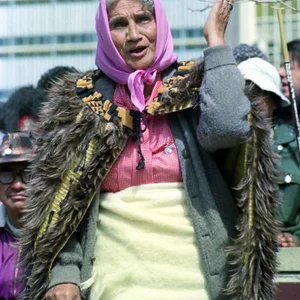
A Māori ceremonial garment woven from feathers, worn by respected figures. Whina Cooper wore one at major gatherings, symbolizing her status as a leader and her connection to the ancestors.

A traditional Māori weapon that became a symbol of authority and resistance. Present at ceremonies, it evokes the warrior dignity of the Māori people in their non-violent struggle for their rights.

The scroll of signatures gathered throughout the 1975 march became a tangible symbol of popular mobilization. It was solemnly presented to the Prime Minister in Wellington.

An indispensable companion to Whina Cooper during the 1975 march, this stick became a symbol of her unwavering determination despite being 80 years old.

A woman of Catholic faith, Whina Cooper drew strength for her activism from prayer. The Bible translated into Māori also symbolizes the dual cultural identity of evangelized Māori women.

A central political tool in the 1970s, maps illustrating the dramatic loss of Māori land since 1840 were used to raise awareness and mobilize public opinion.
School Curriculum
Vocabulary & Tags
Key Vocabulary
Tags
Daily Life
Morning
Whina Cooper began her day with prayer, blending Catholic faith and Māori spirituality. She rose at dawn in her Northland home, taking time to listen to the land and gather her thoughts before the day's community activities began. Mornings were often spent welcoming members of the community who came seeking advice.
Afternoon
Afternoons were devoted to practical matters: correspondence with authorities, organising meetings of the Māori Women's Welfare League, or working with legal teams on land claim files. During the 1970s, she travelled the country rallying Māori communities around the struggle for land rights.
Evening
Evenings were often spent in the wharenui — the communal meeting house — gathered around a shared meal. Night-time was for storytelling, the oral transmission of genealogies (whakapapa), and traditional songs (waiata). Whina Cooper played her role as keeper of collective memory.
Food
Traditional Māori foods held an important place in her diet: kūmara (sweet potato), fresh fish from rivers and the sea, and vegetables from the garden. Cooking was communal, prepared in large quantities to feed visitors — hospitality (manaakitanga) being a core value.
Clothing
In everyday life, Whina Cooper wore modest, practical clothing suited to an active, on-the-ground existence. For ceremonies and important occasions, she donned the kōrowai — the traditional Māori feather cloak — marking her status as a respected elder. Her white hair, often tied back, added to her image as a dignified matriarch.
Housing
Whina Cooper lived in a modest house in Northland, within her community. At the heart of the village stood the marae, a ceremonial space comprising the wharenui and an open-air gathering ground. Life unfolded largely outdoors, in the gardens and on the land whose protection was the driving purpose of her entire existence.
Historical Timeline
Period Vocabulary
Visual Style
Style visuel ancré dans les paysages et l'art maori traditionnel : teintes de terre chaudes et verts profonds de la forêt néo-zélandaise, motifs koru et géométrie tukutuku, lumière douce et résolue.
Sound Ambience
Ambiance sonore de la Nouvelle-Zélande rurale maorie des années 1950-1975 : nature sauvage du Northland, chants traditionnels et sons d'une communauté en marche pour sa survie.
Liens externes & ressources
Références
Œuvres
Fondation du Māori Women's Welfare League
1951
Te Hikoi ki Waitangi — La Marche pour les terres maories
1975
Pétition pour la protection des terres maories
1975
Contribution à la création du Tribunal de Waitangi
1975
Engagement pour la renaissance de la langue māori
1970-1990