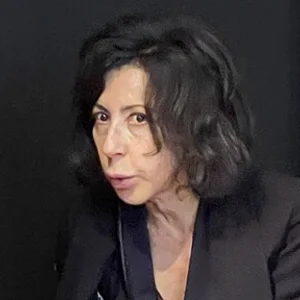

French playwright, novelist, and actress born in 1959, Yasmina Reza made her mark with *Art* (1994), a philosophical comedy about friendship and the value of art. Her plays, translated into more than 35 languages, sharply examine the cracks in human relationships and social hypocrisies.
Yasmina Reza(1959 — ?)
Yasmina Reza
France
8 min read
Frequently asked questions
Key Facts
- Born on 1 May 1959 in Paris, to an Iranian father and a Hungarian pianist mother
- 1987: first acclaimed play, *Conversations After a Burial*, Molière Award
- 1994: *Art* triumphs in Paris then worldwide, translated into 35 languages
- 2006: *The God of Carnage* wins the Molière Award for Best Author, later adapted for film by Polanski (2011)
- Her plays have been performed on Broadway, where she won the Tony Award
Works & Achievements
Reza's first notable play, awarded the Molière Prize for Best Author. It lays the foundations of her theatre: a family gathering under tension, grief revealing hidden fractures between those closest to one another.
Her most celebrated play, translated into more than 35 languages and performed in over 50 countries. An expensive white canvas triggers an existential crisis among three friends, exposing their disagreements about value, art, and friendship.
An experimental play offering three different outcomes from the same opening scene. Reza explores the accidents of fate and the masks worn in bourgeois married life.
Two sets of parents meet after a fight between their children. Within ninety minutes, every veneer of civilisation shatters. A worldwide success, adapted for the screen by Roman Polanski in 2011.
A literary account drawn from several months spent alongside Nicolas Sarkozy during his presidential campaign. A hybrid text blending political portrait, journalism, and literature, widely debated upon its release.
A short novel with a cutting tone, narrated by a father who observes his son with an affection tinged with cruelty. Reza's first novelistic success, praised for its dark humour and psychological precision.
A novel awarded the Prix Renaudot, recounting a murder in a Parisian apartment building and the disintegration of neighbourly bonds. Reza confirms her talent as a novelist shaped by her playwright's eye.
Anecdotes
Yasmina Reza claims to have written *Art* in just a few weeks, almost in a single breath. Premiered at the Comédie des Champs-Élysées in 1994 with Pierre Vaneck, Fabrice Luchini and Pierre Arditi, the play won the Molière Award for Best Author in 1995 and ran for several consecutive years — a record in the French theatrical landscape of the time.
Born to an engineer father of Iranian and Jewish descent and a violinist mother of Hungarian and Jewish origin, Yasmina Reza grew up in a cultivated, cosmopolitan Parisian milieu. This cultural blend deeply nourishes her work, where characters with conflicting values confront one another without ever finding common ground.
In 1998, *Art* won the Tony Award for Best Play on Broadway with Alan Alda, Victor Garber and Alfred Molina — an exceptionally rare distinction for a play originally written in French. Reza thus became one of the most performed living playwrights in the English-speaking world, with her work translated into more than 35 languages.
To write *L'Aube le soir ou la nuit* (2007), Yasmina Reza followed Nicolas Sarkozy for several months during his presidential campaign, attending his private meetings and public rallies. This half-literary, half-journalistic account sparked fierce controversy in France: some saw it as a hagiography, others as a clinical dissection of power.
Roman Polanski adapted *Le Dieu du carnage* for the screen in 2011 under the title *Carnage*, with Jodie Foster, Kate Winslet, Christoph Waltz and John C. Reilly. Reza co-wrote the screenplay herself, and the film was selected for the official competition at the Cannes Film Festival, cementing the international reach of her work.
Primary Sources
MARC: Look at this painting. What do you see? SERGE: A white background with white diagonal lines. MARC: And that's worth two hundred thousand francs? SERGE: Yes.
Véronique: We think we're civilized people. Michel: That's the problem. We think we're civilized and underneath we're savages exactly like everyone else.
He is ahead of himself. He chases something he has not yet reached. Victory is never great enough, never conquered quickly enough.
Death brings people together, but for how long? It forces them to reunite, to look at each other, sometimes to hate each other with a frankness they would never have dared otherwise.
I don't write to prove anything. I write to observe. What interests me is the way people talk to each other without really talking, how they hurt each other without meaning to — or meaning to very well.
Key Places
Yasmina Reza was born and raised in Paris in a cultivated, upper-middle-class environment. The French capital lies at the heart of her work: her plays stage Parisian couples and friends from the upper-middle classes, set against the tensions of Haussmann-era apartments.
It was on this prestigious stage that *Art* had its world premiere in 1994, with Pierre Vaneck, Fabrice Luchini, and Pierre Arditi. The venue remains associated with Reza's first major theatrical success.
The London production of *Art* (1996) and later *God of Carnage* (2008) made this West End theatre an iconic symbol of Reza's international reach in the English-speaking world.
It was on this Broadway stage that *God of Carnage* triumphed in 2009, winning the Tony Award for Best Play. Reza thereby became one of the very few European playwrights to have won two Tony Awards.
Yasmina Reza studied sociology here before turning to theatre and writing. This intellectual training lastingly shaped her way of observing social behaviour with an analytical, detached eye.
Typical Objects

At the heart of the play, an entirely white painting purchased for 200,000 francs triggers a friendship crisis. This fictional object embodies the central question of Reza's work: what has value, and who gets to decide?

Reza observes her contemporaries with an almost ethnographic precision, noting their words, silences, and contradictions. Her theatrical dialogues, renowned for their surgical sharpness, bear witness to a meticulous daily practice of listening.

During her immersion in Nicolas Sarkozy's presidential campaign, Reza used a dictaphone to capture speech and atmosphere. This quasi-journalistic practice fed directly into her writing about real life.

Reza works closely with directors and actors during rehearsals. Her texts carry annotations that attest to a living form of writing, constantly adjusted to the demands of the stage.

Her plays have been staged in the greatest Parisian venues and on the world's biggest stages (West End, Broadway). These programs form a material record of her exceptional international career.

Reza writes her texts in solitude and concentration. Her plays, very short (often 1h15 with no intermission), are the product of stripped-down writing where every word is weighed — the result of an intense process of rewriting.
School Curriculum
Vocabulary & Tags
Key Vocabulary
Daily Life
Morning
Yasmina Reza devotes her mornings to writing, in the quiet of her Parisian apartment. She jealously guards this solitary time — the most conducive to concentration — keeping her schedule free of appointments and obligations until the afternoon. Her writer's routine structures a day organized entirely around creative work.
Afternoon
Afternoons are given over to reading, to rehearsals when one of her plays is in production, or to meetings with editors and directors. Reza follows the staging of her texts closely and maintains an ongoing dialogue with the artistic teams involved.
Evening
Parisian evenings — theater, dinners out, gallery openings — fuel her observation of the bourgeois and intellectual world she puts on stage. She moves in a circle of artists and intellectuals whose conversations, tensions, and social niceties serve as raw material for her dramaturgy.
Food
Living in Paris in a comfortable, cosmopolitan milieu, Reza shares the dining habits of the cultivated Parisian upper-middle class: restaurants, French and Mediterranean cuisine, convivial meals that are, for her, as much an opportunity to observe human relationships as to eat.
Clothing
Yasmina Reza pays careful attention to her appearance, favoring a quiet elegance in keeping with the aesthetic of the contemporary Parisian woman of letters. She eschews the bohemian look expected of the artist in favor of a sober, urban style consistent with the image of her characters.
Housing
She lives in Paris in a bourgeois apartment — a setting that directly inspires the domestic worlds of her plays and novels. The Parisian apartment, with its tense dinner parties and its revealing drawing rooms, is almost a recurring character in her theater.
Historical Timeline
Period Vocabulary
Liens externes & ressources
Références
Œuvres
Conversations après un enterrement
1987
Trois versions de la vie
2000
L'Aube le soir ou la nuit
2007
Une désolation
1999
Babylone
2016