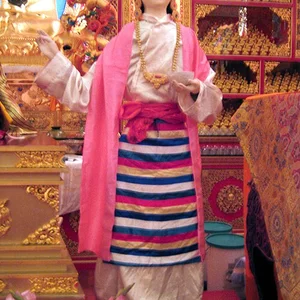

An 8th-century Tibetan princess, disciple and spiritual companion of Padmasambhava, she is venerated in the Vajrayana Buddhist tradition as one of Tibet's first enlightened female masters. A semi-mythical figure of the Tibetan people, she embodies feminine wisdom in Tantric Buddhism.
Yeshe Tsogyal(757 — 817)
Yeshe Tsogyal
7 min read
Frequently asked questions
Famous Quotes
« "The nature of mind is luminosity, without beginning or end." (saying attributed by Tibetan tradition)»
Key Facts
- According to Tibetan tradition, born around the 8th century in Imperial Tibet during the reign of King Trisong Detsen
- Presented in texts as the principal disciple of Padmasambhava, the 'Guru Rinpoche' who introduced Vajrayana Buddhism to Tibet
- Tradition credits her with transcribing and concealing sacred texts (termas) intended to be rediscovered by future generations
- Venerated as a dakini (enlightened feminine being) and as an embodiment of wisdom in Tibetan Buddhism
- Her historical existence is debated: she is considered semi-mythical, blending biographical and legendary elements passed down through oral tradition
Works & Achievements
Yeshe Tsogyal is credited with memorizing and transcribing the entirety of Padmasambhava's teachings, encoding them as hidden terma for future generations. This monumental work formed the foundation of the Nyingma canon of Tibetan Buddhism.
She concealed hundreds of sacred texts and objects in caves, lakes, and the minds of chosen disciples, intended to be rediscovered by tertöns (treasure revealers) in the centuries to come. This body of work constitutes a major part of Tibet's literary and spiritual heritage.
Yeshe Tsogyal is regarded as the principal author of this monumental biography of her spiritual master. The work remains the primary source on the life and miracles of Padmasambhava.
Spiritual poems in archaic Tibetan attributed to Yeshe Tsogyal, expressing her experience of awakening and her instructions to disciples. These songs are among the oldest examples of female spiritual poetry in the Buddhist tradition.
Yeshe Tsogyal received and transmitted the complete lineage of Vajrakilaya, a yidam (meditation deity) associated with a powerful tantric practice aimed at removing obstacles. This transmission remains active in the Nyingma school to this day.
Anecdotes
According to Tibetan traditional accounts, Yeshé Tsogyal was first offered in marriage to King Trisong Detsen, then given to Padmasambhava as a ritual offering. Far from being an act of submission, Tibetan Buddhists interpreted this as the beginning of an extraordinary spiritual partnership that would transform Tibet.
It is said that Yeshé Tsogyal attained enlightenment after years of solitary ascetic practice in Himalayan caves, enduring extreme cold, hunger, and inner demons. Her perseverance became a model for practitioners of Vajrayana Buddhism, both men and women alike.
Yeshé Tsogyal is credited with memorizing and transcribing the entirety of Padmasambhava's teachings, then concealing these sacred texts — known as terma — in caves, lakes, and even in the minds of chosen disciples, to be rediscovered centuries later by masters destined for that purpose.
In several hagiographic texts, she is said to have resurrected a young man who had died unjustly by performing advanced tantric rituals, demonstrating her complete mastery over the forces of life and death according to Tibetan Buddhist cosmology.
Unlike most religious figures of her time, Yeshé Tsogyal took disciples herself and transmitted teachings in her own name. She is thus recognized as one of the first female lineage holders in Tibetan Buddhism — a remarkable fact in a largely patriarchal society.
Primary Sources
She was born in the Kharchen region, gifted with exceptional beauty and intelligence. From an early age, she displayed signs of spiritual birth, and her coming into the world was accompanied by auspicious omens.
Padmasambhava said to Yeshe Tsogyal: 'You are the mother of all buddhas of the three times. Through your practice, you open the door of liberation to all sentient beings of Tibet.'
I am emptiness, the great equality. I am primordial wisdom, beyond birth and death. Those who seek awakening must look into their own mind.
Yeshe Tsogyal, the woman of Kharchen, received all initiations and transmissions from Guru Rinpoche. She became his only disciple to attain full realization within her lifetime on Tibetan soil.
Key Places
The region where Yeshe Tsogyal was born according to tradition. This territory in present-day central Tibet remains associated with her family lineage and the earliest accounts of her life.
Tibet's first great monastery, founded around 775, where Yeshe Tsogyal received her foundational initiations from Padmasambhava. A central site for the transmission of Vajrayana Buddhism in Tibet.
A meditation cave in the Tidro valley where Yeshe Tsogyal is said to have practiced years of intense solitary asceticism. The site remains a pilgrimage destination for Tibetan Buddhists to this day.
A sacred lake in Tibet where, according to tradition, Yeshe Tsogyal concealed certain terma (spiritual treasures). A highly symbolic place associated with dakinis and feminine wisdom in Tibetan Buddhism.
A complex of retreat caves situated above Samye, where Padmasambhava and his disciples — including Yeshe Tsogyal — undertook extended meditative retreats. A major site for the transmission of Nyingma teachings.
Typical Objects

This double-headed hourglass-shaped drum, often made from wood or human bone, was used in tantric rituals. Yeshe Tsogyal used it to invoke spiritual energies and accompany her songs of realization.

An emblematic attribute of Vajrayana masters, this ornate staff symbolizes mastery of the three energy channels of the subtle body. It also represents the bond between Yeshe Tsogyal and Padmasambhava in Tibetan iconography.

Made of 108 bodhi wood or bone beads, the mala was used to count mantras recited during meditative practices. Yeshe Tsogyal is often depicted holding one as she recited millions of mantras.

A bowl fashioned from a human skull, used in advanced tantric rituals to offer sacred substances to deities. It symbolizes the transcendence of the fear of death, a central theme in Yeshe Tsogyal's practice.

Manuscripts written on palm leaves or Tibetan paper recording the teachings received from Padmasambhava. Yeshe Tsogyal is credited with transcribing and concealing hundreds of these sacred texts.

A white cotton cloth worn during tummo (inner heat) practices, which Yeshe Tsogyal is said to have mastered in the icy caves of the Himalayas as proof of her spiritual realization.
School Curriculum
Vocabulary & Tags
Key Vocabulary
Daily Life
Morning
Yeshé Tsogyal would wake before dawn for intensive meditative practices, beginning with ritual prostrations and the recitation of mantras to the rhythm of the damaru drum. During her cave retreats, she had no human companions and devoted the first hours to visualization of tantric deities.
Afternoon
During stays at Samyé, she participated in Padmasambhava's teaching sessions, taking notes or memorizing entire texts. She also performed healing rituals for members of the monastic community and laypeople who came to seek her guidance.
Evening
Evenings were dedicated to transmitting teachings to her own disciples, often through spontaneous songs or spiritual dialogues. Before sleep, she practiced dream yoga, considered in the Vajrayana tradition to be an essential practice on the path to enlightenment.
Food
During her ascetic retreats, Yeshé Tsogyal practiced chöd (the offering of the body) and ate with extreme frugality: tsampa (roasted barley flour) mixed with yak butter, salted butter tea, and sometimes wild mountain herbs. According to hagiographic texts, she is said to have survived for months on minimal food through her mastery of vital energies.
Clothing
Outside of rituals, she wore the simple garments of Tibetan practitioners: a long thick wool robe (chuba) in deep burgundy or dark blue, a cloth belt, and a white cotton shawl for tummo practices. For tantric ceremonies, she adorned herself with symbolic ornaments of bone and metal representing the attributes of the dakinis.
Housing
Yeshé Tsogyal alternated between isolated meditation caves in the Himalayan cliffs and the monastic buildings of Samyé. Her caves were adorned with a few hand-painted thangkas, butter lamps, and minimal ritual offerings, creating a sacred space within the bare austerity of the rock.
Historical Timeline
Period Vocabulary
Visual Style
Style thangka tibétain archaïque du VIIIe siècle, aux pigments minéraux profonds sur fond indigo, avec Yeshé Tsogyal représentée en dakini lumineuse entourée de symboles vajrayana et de paysages himalayens stylisés.
Sound Ambience
Une atmosphère de haute montagne tibétaine du VIIIe siècle, mêlant le silence des grottes de méditation, les chants tantriques et le vent de l'Himalaya autour des monastères naissants.
Liens externes & ressources
Références
Œuvres
Transcription des enseignements de Padmasambhava
vers 775-810
Terma (trésors spirituels cachés)
vers 800-817
Biographie de Padmasambhava (Pema Kathang)
attribué au VIIIe-IXe siècle, révélé au XIVe siècle
Chants de réalisation (doha)
vers 790-817
Transmission de la lignée Vajrakilaya
vers 800