
King of Mycenae and supreme commander of the Greek forces during the Trojan War. A central figure in Homer's Iliad and Aeschylus's Oresteia, his tragic fate — from the sacrifice of Iphigenia to his murder by Clytemnestra — makes him an archetype of hubris and fatality.
Agamemnon
Agamemnon
8 min read
Frequently asked questions
Famous Quotes
« I am the king of kings, and you will obey me. (Iliad, Book I)»
Key Facts
- King of Mycenae, he leads the Greek coalition besieging Troy for ten years (Iliad, ~8th century BCE)
- He sacrifices his daughter Iphigenia at Aulis to secure favorable winds for the Greek fleet
- His quarrel with Achilles over Briseis is the central subject of the Iliad
- Upon his return from Troy, he is murdered by his wife Clytemnestra and her lover Aegisthus
- His death triggers the cycle of vengeance of the Atreidae, at the heart of Aeschylus's Oresteia (458 BCE)
Works & Achievements
Homer's epic poem in 24 books, centered on the wrath of Achilles. Agamemnon appears as supreme commander of the Greeks, a contested authority figure whose hubris nearly brought about their defeat.
In the Underworld, Odysseus encounters the shade of Agamemnon, who recounts his own murder and warns him against the treachery of women. This passage had a lasting influence on the image of the betrayed king.
A trilogy by Aeschylus and the only complete Greek trilogy to survive. It traces Agamemnon's fate from his triumphant return home to his murder, then follows Orestes' act of revenge and his trial before Athena.
A tragedy by Euripides exploring Agamemnon's moral dilemma: sacrifice his daughter for the greater good, or resist the pressure of the Greek commanders. A work of unparalleled psychological depth.
Sophocles' tragedy centered on Agamemnon's daughter, who waits for vengeance to be exacted for her murdered father. The figure of the dead king takes on an almost sacred dimension.
Euripides' version of the same story, more realistic and psychologically unsettling: Orestes' act of vengeance is presented as an ambiguous crime as much as an act of justice.
Anecdotes
Before sailing for Troy, Agamemnon was forced to sacrifice his own daughter Iphigenia to the goddess Artemis in exchange for favorable winds. The Greek fleet had been stranded at Aulis for weeks, and the oracle demanded this terrible price. In some versions of the myth, Artemis, at the very last moment, substituted a deer for the young girl and carried Iphigenia away to Tauris.
At the height of the Trojan War, Agamemnon seized Briseis, the captive prize of Achilles, unleashing the fury of the greatest Greek warrior. Achilles withdrew from battle, refusing to fight for a king he considered greedy and unjust. This quarrel, which opens Homer's Iliad, nearly cost the Greeks their victory and shows how a leader's hubris can bring an entire army to its knees.
On his triumphant return to Mycenae after ten years of war, Agamemnon was welcomed by his wife Clytemnestra, who rolled out a purple carpet — a color reserved for the gods — to lead him to the palace. The king accepted this gesture despite his superstitious misgivings, and in doing so revealed his arrogance: walking on purple was an affront to the gods. He was murdered by Clytemnestra and her lover Aegisthus while bathing.
Agamemnon brought back from Troy the prophetess Cassandra, daughter of King Priam, as a spoil of war. Cassandra, cursed by Apollo never to be believed, had foretold the fall of Troy and now warned them both of their imminent deaths. No one listened, and she perished alongside the king in the palace of Mycenae, another victim of Clytemnestra's revenge.
Agamemnon's fate is bound up in the curse of the Atreides, a dynasty damned ever since his ancestor Tantalus had served his own son Pelops as a meal to the gods. His father Atreus had himself invited his brother Thyestes to a banquet made from Thyestes' own children. This chain of family crimes, which the Greeks called miasma (pollution), illustrates the tragic concept of inherited guilt.
Primary Sources
The quarrel flared between Agamemnon son of Atreus, king of men, and godlike Achilles. Which god cast them into this bitter strife? The son of Leto and Zeus.
The shade of Agamemnon said: 'What misery! Zeus willed my ruin through a woman's treachery. Beware, Odysseus — never tell your wife everything you know.'
Clytemnestra: 'I struck him twice. He let out two groans, then his limbs went slack. As he fell, I gave him a third blow — a thank-offering to Zeus, lord of the dead.'
Agamemnon: 'Alas! Let my daughter be brought forth. Artemis demands what she demands, and all of Greece forces my hand.'
Electra: 'My father was slaughtered by those who shared his very bed — without pity, without honor. I will never cease to mourn.'
Key Places
Agamemnon's royal city, dominated by the Lion Gate and richly decorated tholos tombs. The center of Mycenaean power and the setting of his murder by Clytemnestra.
The port where the Greek fleet assembled before setting sail for Troy. It was here that Agamemnon sacrificed his daughter Iphigenia to appease the goddess Artemis and win favorable winds.
The fortified city of Asia Minor besieged for ten years by the Greeks under Agamemnon's command. Its archaeological site corresponds to Hisarlik in modern-day Turkey.
A city closely linked to the legend of Agamemnon in certain versions of the myth. Aeschylus's Oresteia places the palace of the Atreides and Orestes's act of vengeance there.
A distant land where Artemis is said to have taken Iphigenia after the sacrifice at Aulis, making her a priestess in her temple. The setting of a second family tragedy, according to Euripides.
Typical Objects

The Iliad describes a scepter forged by Hephaestus and given by Zeus to the line of Atreus. A symbol of supreme power passed down from god to king, it grants Agamemnon authority over all the Greek chieftains.

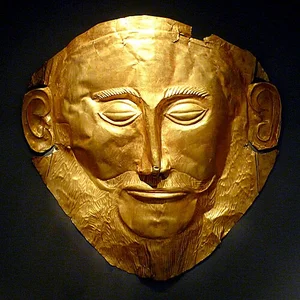
Discovered at Mycenae by Schliemann in 1876, this gold mask once covered the face of a Mycenaean king. Although it predates the legendary figure, it has become the defining archaeological symbol of Agamemnon in the popular imagination.

In the Iliad, Agamemnon is described donning a breastplate adorned with blue enamel serpents and a gorgoneion, fitted with twenty bands of tin. It reflects the wealth and military power of the king of kings.

In Aeschylus's Oresteia, Clytemnestra kills Agamemnon by entangling him in a net or a sleeveless robe before striking him down. This object symbolizes the trap laid by the vengeful wife for her husband.

Upon his return, Clytemnestra has a purple carpet — the color of the gods — laid before Agamemnon for him to walk upon. Agamemnon hesitates, aware of the presumption, yet relents: a symbolic act of hubris that foreshadows his downfall.

Ritual feasts marked the lives of Mycenaean kings. At military banquets, Agamemnon would pour libations to the gods and seal alliances and military decisions over wine shared in golden cups.
School Curriculum
Vocabulary & Tags
Key Vocabulary
Tags
Daily Life
Morning
Agamemnon rises at dawn in his megaron (great throne room), attended by servants who help him don his bronze armor. He pours a libation of wine to the gods — Zeus first — before inspecting the troops assembled on the plain of Troy. Oracles and celestial omens are consulted before any major military decision.
Afternoon
The afternoon is devoted to war councils gathering the allied kings — Achilles, Odysseus, Ajax, Nestor. Agamemnon mediates disputes, distributes spoils, and coordinates assaults on the Trojan walls. He may himself fight on the front line, as Homer describes in Book XI of the Iliad, where he performs numerous feats of valor.
Evening
In the evening, a ritual banquet is held in the royal tent: roasted meat, barley bread, and wine mixed with water in golden cups. Bards sing of the heroes' deeds. Agamemnon receives delegations, settles disputes among the chiefs, and plans the next day's operations by torchlight.
Food
A typically Mycenaean and heroic diet: beef, mutton, and pork roasted on spits, barley bread, cheese, olives, and figs. Wine, always diluted with water, is ever-present at rituals and banquets. Royal meals also included fish and honey on great occasions.
Clothing
In peacetime, Agamemnon wears a fine wool tunic (chiton) dyed purple or scarlet — a mark of royalty — fastened with bronze fibulae. A chlamys (cloak) completes the outfit. In war, he dons finely crafted bronze plate armor, greaves (cnémides), a crested helmet, and carries his large round shield.
Housing
The palace of Mycenae is a Cyclopean fortress with massive stone walls, dominated by the Lion Gate. Inside, the megaron — a great hall with a central hearth — is the heart of palace life: throne, banquets, and royal audiences. The walls are adorned with frescoes depicting scenes of war and hunting, the floors finished in painted stucco.
Historical Timeline
Period Vocabulary
Visual Style
Style art mycénien tardif avec influences de la céramique à figures noires et des fresques palatiales. Palette chaude et sombre, or bruni, bronze oxydé, rouge sang — une esthétique de grandeur tragique.
Sound Ambience
Un paysage sonore oscillant entre la violence du champ de bataille troyen et l'atmosphère oppressante du palais mycénien où se trame la vengeance. Bruits de bronze, vent marin et chants rituels.
Liens externes & ressources
Références
Œuvres
Iliade
VIIIe siècle av. J.-C.
Odyssée — Chant XI (Nekyia)
VIIIe siècle av. J.-C.
Orestie (Agamemnon, Choéphores, Euménides)
458 av. J.-C.
Iphigénie à Aulis
405 av. J.-C.
Électre
Vers 410 av. J.-C.
Électre
413 av. J.-C.