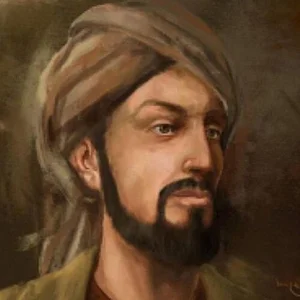

Engineer and inventor of the 12th–13th century active in Mesopotamia (Jazira), al-Jazari is famous for his treatise on automata and hydraulic machines. His major work describes more than fifty ingenious mechanical devices, making him one of the fathers of medieval mechanics.
Frequently asked questions
Key Facts
- Born around 1136 in Jazira (present-day Turkey/northern Syria)
- Chief engineer at the court of the Artuqids of Diyarbakir for 25 years
- In 1206, wrote his treatise ‘Kitab fi maʼrifat al-hiyal al-handasiyya’ (Book of Knowledge of Ingenious Mechanical Devices)
- Describes more than 50 machines including musical automata, water clocks, and hydraulic pumps
- Died around 1206; his treatise is illustrated with detailed miniatures that influenced European engineering
Works & Achievements
An encyclopedic masterpiece in six categories describing fifty illustrated mechanical machines. It is the most comprehensive work of mechanical engineering from the Islamic Middle Ages, and would go on to influence Renaissance European engineers through Latin translations.
A monumental water clock in the shape of an elephant carrying a castle, a dragon, a phoenix, and human automatons representing the great civilizations. It measures time by regulating water flow and strikes the hours through a ball mechanism.
A large hydraulic clock in the shape of a fortified tower, featuring doors that open automatically, horsemen that emerge at fixed hours, and a lunar disc. It is one of the most spectacular achievements described in his treatise.
A water-lifting machine using two alternating cylinders driven by a crankshaft, delivering a continuous uninterrupted flow. It stands as one of the earliest documented descriptions of a double-acting piston pump in the history of technology.
A group of four automaton musicians placed on a boat on an artificial lake, playing music according to a preset program via pegs on a rotating cylinder. It is one of the earliest known reprogrammable mechanisms in history.
Anecdotes
Al-Jazari designed an elephant-shaped clock blending Indian, Chinese, Arabic, and African symbolism: an Eastern dragon activated the mechanisms, while an Arabic figurine struck a drum every half-hour. This water clock embodied the universal vision of knowledge characteristic of the Islamic Golden Age, where the wisdom of multiple civilizations was synthesized into a single work.
Al-Jazari describes in his treatise a fully automated hand-washing machine: a mechanical servant poured water, offered a towel, and then presented soap — all without any human intervention. This hygiene robot, designed for the Artuqid ruler, reflects a remarkable consideration of automated service as early as the 13th century.
His masterwork was written on the order of the Artuqid prince Nāsir al-Dīn Maḥmūd, after the latter had watched al-Jazari work at his court for twenty-five years. The ruler wished to preserve his engineer's inventions for posterity — without this royal command, the work might never have been written.
Al-Jazari is among the first to accurately describe the crankshaft-connecting rod mechanism, which converts rotary motion into reciprocating linear motion. This principle lies at the heart of every piston engine today; he applied it to hydraulic pumps designed to irrigate the palace gardens of al-Jazira.
His treatise describes a mechanical orchestra floating on an artificial lake: four automaton musicians played flutes and drums according to a preset program, controlled by interchangeable pegs on a rotating cylinder. This device is considered one of the earliest known examples in the world of a system with a reprogrammable program.
Primary Sources
This treatise describes fifty mechanical devices organized into six categories: water and candle clocks, vessels and figures for bloodletting, ewers and basins for ritual ablutions, automatic fountains and musical instruments, water-raising machines, and miscellaneous devices.
This thirteenth-century copy contains color illustrations detailing al-Jazari's mechanisms. The miniatures are exceptional visual documents that allow scholars to reconstruct the machines described in the text.
One of the illuminated copies of al-Jazari's treatise held in Europe, particularly valuable for the study of illustrations depicting water clocks and hydraulic pumps.
The first complete scholarly translation of the Kitāb al-ḥiyal into English, accompanied by rigorous technical analysis that has enabled modern engineers to reproduce several of al-Jazari's machines.
Key Places
Capital of the Artuqid sultanate where al-Jazari spent most of his career as chief of the mechanical artisans. It is here that he designed the majority of his machines and wrote his encyclopedic treatise.
A historical region between the Tigris and Euphrates rivers, corresponding to northern present-day Syria, northeastern Iraq, and southeastern Turkey — the region from which al-Jazari takes his name. It is in this cultural cradle that he was born and trained.
A town in the Jazira region on the banks of the Tigris, frequently cited as the most likely birthplace of al-Jazari. It lent its name to the surrounding region and, by extension, to the engineer himself.
Abbasid capital and a great center of Islamic learning in the 12th century. Baghdad's intellectual tradition — embodied by its House of Wisdom — formed the cultural context in which al-Jazari's work is fully rooted.
Typical Objects

Al-Jazari is among the first to describe and use the crankshaft-connecting rod mechanism to convert rotary motion into reciprocating linear motion. This principle, applied in his double-acting hydraulic pumps, lies at the heart of every piston engine today.

His water clocks did not merely measure time — they displayed it through automata animated by water reservoirs with regulated flow. The castle clock and the elephant clock are the most celebrated examples described in his treatise.

Al-Jazari describes several water-raising machines, including pumps driven by water wheels fitted with a double-acting piston mechanism. His refinements made it possible to irrigate gardens and supply the fountains of Artuqid palaces.

To illustrate his treatise, al-Jazari used finely cut reed pens and plant- and mineral-based inks in a range of colours. The miniatures in his manuscript are remarkable for both their technical precision and their artistic quality.

Al-Jazari's mechanisms relied on precise control of water levels using copper floats and calibrated valves, the manufacture of which he describes in detail. This component is central to all his automatic clocks and fountains.

In his treatise, al-Jazari describes a wheel lock bearing letters, considered one of the earliest documented examples of a combination lock. This device reflects his thinking on mechanical security.

His automaton figures were crafted from copper and brass, materials common in Artuqid metalwork. These figurines represented musicians, servants, or animals, and were set in motion by hydraulic or counterweight mechanisms.
School Curriculum
Vocabulary & Tags
Key Vocabulary
Daily Life
Morning
Al-Jazari began his day with the dawn prayer (Fajr), then made his way to his workshop within the Artuqid palace of Amid. He supervised the metalsmith craftsmen who cast and assembled the copper and brass components of his machines, checking the precision of each mechanical adjustment.
Afternoon
Afternoons were devoted to testing hydraulic mechanisms: he regulated water flow, adjusted floats, and calibrated gears to ensure the accuracy of his clocks. He also wrote up his technical descriptions and oversaw the illuminations illustrating his treatise, selecting colors and correcting diagrams.
Evening
In the evenings, al-Jazari might be invited to the Artuqid prince's court to present his latest creations to learned visitors. He also spent time reading the mechanical works of his predecessors, notably the Banū Mūsā, whose writings he sometimes cites in his treatise.
Food
His table reflected medieval Mesopotamian cuisine: wheat or barley bread, roasted or stewed meats (lamb, poultry), legumes (lentils, chickpeas), dates, and dried fruits. Meals at the Artuqid court were often accompanied by rose water-scented sorbet, a common luxury in 12th-century Islamic palaces.
Clothing
As chief of craftsmen at court, al-Jazari likely wore a long tunic (qamīs) of linen or cotton, a wool cloak (jubba) in cold weather, and a turban. During official court presentations, his garments would have been of finer quality, as embroidery and dyed fabrics were markers of social standing.
Housing
Al-Jazari most likely lived in lodgings attached to the Artuqid palace of Amid, within the citadel overlooking the Tigris. Houses in this region featured an inner courtyard with a fountain, cool vaulted rooms for the summer heat, and thick walls of black basalt — the characteristic building material of Diyarbakır.
Historical Timeline
Period Vocabulary
Liens externes & ressources
Références
Œuvres
Kitāb fī ma'rifat al-ḥiyal al-handasiyya
1206
L'horloge-éléphant (Fīl Sā'a)
vers 1200
L'horloge-château (Qal'a Sā'a)
vers 1190-1200
La pompe hydraulique à double effet
vers 1200
L'orchestre mécanique flottant
vers 1200