
Greek princess, daughter of Electryon king of Mycenae and wife of Amphitryon. Zeus seduced her by taking on her husband's appearance, and she thus conceived Heracles, the most famous of all Greek heroes.
Alcmene
Alcmene
7 min read
Frequently asked questions
Key Facts
- Daughter of Electryon, king of Mycenae
- Wife of Amphitryon, the Argive hero
- Zeus seduced her disguised as Amphitryon in order to father Heracles
- Mother of Heracles (son of Zeus) and Iphicles (son of Amphitryon)
- According to some traditions, she was deified after her death
Works & Achievements
A Latin comedy depicting Jupiter (Zeus) disguised as Amphitryon in order to seduce Alcmene. The play humorously explores themes of identity, marital fidelity, and divine deception.
An epic poem whose prologue describes Alcmene's beauty and virtue, her night with Zeus, and the birth of Heracles. An essential source for understanding Alcmene's status in archaic Greek mythology.
A modern play that retells the myth of Alcmene from her own perspective: a deeply human woman who resists the allure of the divine and defends her conjugal love against Zeus himself.
A comedy inspired by Plautus, in which Molière portrays Alcmene as a touching, sincere figure wronged despite her innocence. The play raises questions of consent and divine responsibility toward mortals.
A lyric ode evoking the birth of Heracles and Alcmene's place in the heroic genealogy. Pindar emphasizes the sacred nature of the union between Zeus and this mortal woman.
A mythological compendium that traces Alcmene's life in detail: her birth, her marriage, Zeus's ruse, the birth of Heracles, and her death. An indispensable reference for the study of the myth.
Anecdotes
To spend time with Alcmena, Zeus stretched the night to three times its normal length, holding back Helios, the god of the Sun, from rising. This remarkable night, known as the 'triple night,' brought forth Heracles, the mightiest of all Greek heroes. The ancients saw in it a sign that even the gods could not resist Alcmena's beauty and virtue.
Alcmena was renowned for her integrity and faithfulness: she had sworn to Amphitryon that she would not lie with him until he had avenged the deaths of her brothers, killed by the Teleboans. Zeus took advantage of this very delay to seduce her in the guise of her husband, and Alcmena genuinely believed she was welcoming Amphitryon home in triumph.
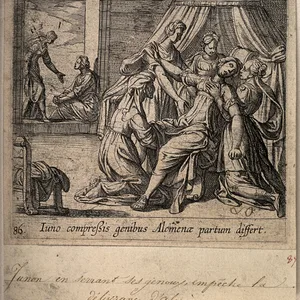
After the birth of Heracles and Iphicles — the twin boys fathered by Zeus and Amphitryon respectively — the jealous Hera sent two serpents into their cradle to kill the divine child. While little Iphicles screamed in terror, the infant Heracles strangled the snakes with his bare hands, revealing his heroic nature from the very first.
After the deaths of Amphitryon and later Heracles, Alcmena endured exile and persecution at the hands of Eurystheus, king of Mycenae, who feared the hero's descendants. According to several traditions, she died at Thebes at an advanced age. Some myths tell that Zeus granted her Elysium, the Elysian Fields reserved for virtuous souls, as a reward for her exemplary life.
A later myth recounts that at Alcmena's death, her sons wished to bury her, but Zeus had Hermes carry her away to the Isles of the Blessed, where she married Rhadamanthus, judge of the dead. This tradition highlights how Alcmena was seen not as a passive victim of the gods, but as a woman of exceptional moral worth.
Primary Sources
"Or like Alcmene, who gave birth to mighty Heracles after lying in the arms of the dark son of Cronos at seven-gated Thebes."
"Alcmene bore the bold son of Zeus, who was destined to accomplish labors beyond all human measure, and to cleanse the earth of monsters."
"Jupiter himself, to lie with Alcmene without her knowledge, took on the likeness of her husband Amphitryon. Thus, what virtue demands, even the gods must find a way around."
"Zeus, captivated by Alcmene's beauty and chastity, desired to be with her; but knowing she would never yield to force, he took on the appearance of Amphitryon and spent the night with her."
"Alcmene, daughter of Electryon and Lysidice, surpassed all the women of her time in stature and beauty; in wisdom and virtue, she was the equal of the immortals."
Key Places
The birthplace of Alcmene, daughter of Electryon, king of Mycenae. A powerful center of the Mycenaean world, Mycenae was associated with the great heroic families of Greek mythology.
The city where Alcmene and Amphitryon settled after Amphitryon's exile from Mycenae. It was at seven-gated Thebes that Heracles was born, son of Zeus and Alcmene.
A city linked to Amphitryon's family and to Alcmene's early life. Tiryns is also associated with Heracles, who fulfilled part of his legendary labors there under the orders of Eurystheus.
The home of the Olympian gods, including Zeus, who was captivated by Alcmene from his heavenly heights. Olympus represents the divine sphere that would upend the mortal life of the princess of Mycenae.
According to some traditions, Zeus had Alcmene carried after her death to the Isles of the Blessed, a mythical paradise reserved for virtuous souls, where she would wed Rhadamanthus, judge of the Underworld.
Typical Objects

Symbols of feminine virtue in ancient Greece, the distaff and spindle represent Alcmene's role as a faithful wife and mistress of the household. Spinning wool was considered the mark of an honorable woman.

Alcmene wore this veil at her wedding to Amphitryon, a symbol of her chastity and conjugal devotion. It was precisely this absolute fidelity that Zeus had to circumvent in order to approach her.

Used during domestic religious ceremonies, the phiale held wine or oil offered to the gods. Alcmene, a pious and virtuous woman, regularly performed these rituals to protect her home and family.

During the triple night prolonged by Zeus, oil lamps would have been the only source of light in the palace. This everyday object becomes, in the myth, a silent witness to the encounter between the mortal woman and the god.

It was in a cradle that the jealous Hera placed two serpents to kill the infant Heracles. That cradle thus became the hero's first battlefield and the first symbol of his divine strength.

Sacred to Aphrodite, goddess of love, myrtle symbolizes the beauty and grace that made Alcmene irresistible in Zeus's eyes. Brides were crowned with it during Greek wedding ceremonies.
School Curriculum
Vocabulary & Tags
Key Vocabulary
Daily Life
Morning
Alcmene rises at dawn and performs purification rites: ablutions with fresh water, prayers to the household guardian gods (the Greek Lares, or Hestia). She oversees the servants in preparing the morning meal and ensures the household runs in proper order.
Afternoon
The afternoon is devoted to wool work: spinning, weaving, and embroidery. Alcmene, as the wife of a king, oversees the gynaeceum (the women's quarters) and teaches the young servants the feminine arts prized in archaic Greek society.
Evening
At dusk, Alcmene presides over libations and offerings to the household gods. She dines with Amphitryon in the megaron (the great hall of the palace); the household gathers to hear a bard sing of heroes' exploits, before the lamps are put out.
Food
Clothing
Housing
Historical Timeline
Period Vocabulary
Visual Style
Style de la céramique grecque antique à figures rouges : Alcmène en peplos blanc, couronnée de myrte, dans un palais aux colonnes dorées baigné d'une lumière ambrée divine.
Sound Ambience
Une nuit grecque antique dans un palais mycénien : le chant des cigales, le crépitement des lampes à huile, la prière murmurée à la lueur du foyer sacré.
Liens externes & ressources
Références
Œuvres
Amphitryon — Plaute
Vers 200 av. J.-C.
Bouclier d'Héraclès — Hésiode
Vers 600 av. J.-C.
Amphitryon 38 — Jean Giraudoux
1929
Amphitryon — Molière
1668
Néméennes (Ode I) — Pindare
Vers 476 av. J.-C.
Bibliothèque mythologique — Apollodore
Ier-IIe siècle ap. J.-C.