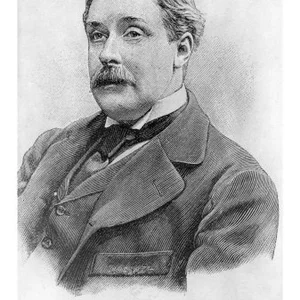

Alphonse Allais (1854-1905) was a French writer, journalist, and humorist, a major figure of absurd humor and *fumisme*. A regular at the “Le Chat Noir” cabaret, he is famous for his puns, his short tales, and his paradoxical aphorisms.
Alphonse Allais(1854 — 1905)
Alphonse Allais
France
6 min read
Frequently asked questions
Famous Quotes
« You have to take money where it is, that is to say, from the poor. True, they don't have much money, but there are a lot of poor people.»
« Logic leads to everything, provided you leave it behind.»
« Coffee is a drink that helps you sleep when you don't drink it.»
Key Facts
- Born in 1854 in Honfleur, the son of a pharmacist, he abandoned his pharmacy studies for the Parisian literary life.
- Became a figure of the “Le Chat Noir” cabaret and contributed to its magazine starting in the 1880s.
- Published *À se tordre* (“In Fits of Laughter,” 1891), a collection of humorous tales that established his reputation.
- A pioneer of conceptual and monochrome art with his absurd “paintings” (e.g. *Harvesting Tomatoes by the Shore of the Red Sea by Apoplectic Cardinals*, a red monochrome) presented around 1883-1897.
- Died in Paris in 1905.
Works & Achievements
Collection of short humorous tales that established his reputation as a master of absurd humor and the twist-ending story.
Collection of tales continuing his humorous and paradoxical vein.
Collection whose paradoxical title illustrates his taste for absurd logic.
Collection of humorous short stories marking his output from the Chat Noir period.
A series of captioned monochrome pictures, a pioneering work that foreshadowed abstract art through parody.
An entirely silent score, a conceptual gesture ahead of its time, justified by the idea that “great sorrows are mute.”
A comic novel, one of his longest works, later adapted for the theater and cinema.
Anecdotes
Alphonse Allais is regarded as a forerunner of abstract and monochrome art: in 1883, he exhibited an entirely black rectangle of paper titled “Nighttime Fight of Black Men in a Cellar,” followed by a white square (“First Communion of Anemic Young Girls in the Snow”) and a red rectangle. These humorous “monochromes” anticipated the pictorial experiments of the 20th century by several decades.
In 1897, Allais composed a “Funeral March for the Obsequies of a Great Deaf Man”: a musical score made up entirely of empty measures and silences. He justified this emptiness with the idea that “great sorrows are mute” — a gesture that would later be compared to the musical experiments of the 20th century.
The son of a pharmacist in Honfleur, Allais was meant to take over the family shop and studied pharmacy in Paris. He abandoned that profession for journalism and literature, but kept a lifelong taste for far-fetched experiments and inventions.
A regular at the “Le Chat Noir” cabaret in Montmartre, Allais was editor-in-chief of the magazine of the same name. It was in this world of *fumistes* — artists who cultivated hoaxes and the absurd — that he forged his style of paradoxical humor.
Allais is the inventor of a famous prank device, the holorhyme: two complete lines of verse that are pronounced identically but spelled differently, such as “Par les bois du djinn, où s'entasse de l'effroi, / Parle et bois du gin, ou cent tasses de lait froid.”
Primary Sources
Collection of short humorous tales published by Allais, showcasing his taste for the twist-ending story and everyday absurdity.
“You have to take money where it is, that is to say, from the poor. They don't have much money, it's true, but there are a great many of them who each have a little.”
Collection of monochrome pictures accompanied by humorous captions, including the black rectangle “Negroes fighting in a cellar at night.”
Collection of tales whose paradoxical title sums up the spirit of absurd logic so dear to the author.
Key Places
Port in Normandy where Alphonse Allais was born in 1854, in the family pharmacy.
Famous Parisian cabaret founded in 1881, the heart of the artistic bohemia where Allais became a figure of the *fumisme* movement.
Capital city where Allais pursued his career as a journalist and writer and where he died in 1905.
Parisian hilltop of artists and cabarets at the end of the 19th century, Allais's living environment.
Typical Objects

The writing tools of the journalist and author, with which Allais wrote his short tales and daily columns.

The satirical and literary weekly of the Montmartre cabaret, of which Allais was editor-in-chief and where he published many of his texts.

Rectangles of solid colour that Allais exhibited with absurd captions, a parody of painting and a forerunner of abstract art.

A tool used to grind substances when preparing remedies; a reminder of the pharmacy training Allais undertook before turning to literature.

The emblematic drink of the Parisian cafés and cabarets of the Belle Époque, consumed in the artistic circles that Allais frequented.

An elegant men's headpiece of the late 19th century, worn by men of letters and the regulars of Parisian cabarets.
School Curriculum
Vocabulary & Tags
Key Vocabulary
Daily Life
Morning
An inveterate night owl, Allais would get up late after his evenings at the cabaret. His mornings were often spent recovering and covering a few sheets of paper with ink, since he had to supply columns to the newspapers on a regular basis.
Afternoon
His afternoons were split between writing short tales and visiting Parisian editorial offices to hand in his texts. He also loved to stroll around Paris and spend time in cafés with his artist friends.
Evening
In the evening, he would head to the cabarets of Montmartre, especially Le Chat Noir, where poets, songwriters and pranksters gathered. There they improvised puns, hoaxes and readings in a cheerful, bohemian atmosphere.
Food
Like the regulars of Belle Époque cafés, Allais enjoyed bistro drinks, including absinthe, which was very fashionable at the time. Meals were readily taken at a restaurant or brasserie, depending on the whims of nightlife.
Clothing
He dressed as a late-nineteenth-century man of letters: a dark suit, a stiff-collared shirt, a tie or *lavallière*, and sometimes a top hat or bowler.
Housing
Allais lived in Paris, in the Montmartre neighbourhood and its surroundings, moving between apartments and hotels in keeping with a bohemian existence unconcerned with bourgeois comfort.
Historical Timeline
Period Vocabulary
Liens externes & ressources
Références
Œuvres
À se tordre — Histoires chatnoiresques
1891
Vive la vie !
1892
Deux et deux font cinq
1895
Le Parapluie de l'escouade
1893
Album primo-avrilesque
1897
Marche funèbre pour les obsèques d'un grand homme sourd
1897