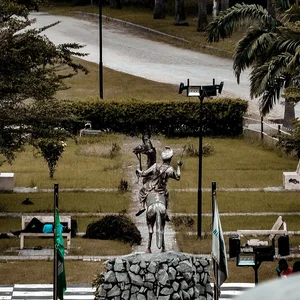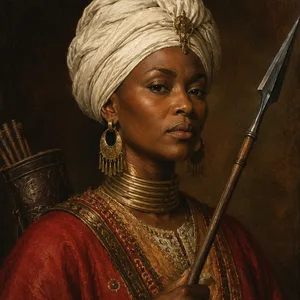

Warrior princess of the Hausa city-state of Zazzau (present-day Nigeria), she reigned around 1576–1610 and led numerous military campaigns that significantly expanded her kingdom's territory. The first woman to rule Zazzau, she has become a symbol of female power in West Africa.
Frequently asked questions
Key Facts
- Born around 1533 in Zazzau (present-day Zaria, Nigeria)
- Rose to power around 1576 after the death of her brother Karama
- Led military campaigns for nearly 34 years, extending Zazzau to the Atlantic coast according to some sources
- Said to have built fortifications (the “Amina walls”) around conquered cities
- Died around 1610, leaving behind a significantly enlarged kingdom
Works & Achievements
For over thirty years, Amina waged continuous military campaigns that subjugated Kano, Katsina, Nupe, and numerous neighboring territories. In doing so, she built the largest empire Zazzau had ever known, controlling the main trade routes between the Sahara and sub-Saharan Africa.
After each conquest, Amina ordered the construction of heavy earthen walls around the subjugated towns to fortify and control them. These defensive structures, visible in archaeological form across several states in northern Nigeria, represent the most tangible material legacy of her reign.
By securing the caravan routes and imposing tributes on conquered cities, Amina made Zazzau a major commercial power in the region. The introduction of kola nuts into trade and the opening of routes to the south brought lasting prosperity to her kingdom.
Amina reorganized and professionalized the Zazzau army, notably expanding its heavy cavalry equipped with chain mail. This reformed military force allowed her to conduct campaigns across hundreds of kilometers and to establish Zazzau's lasting hegemony.
Amina did not stop at conquest: she established permanent garrisons and founded or consolidated fortified settlements along her campaign routes. These strongholds ensured her authority was maintained across a considerable territory.
Anecdotes
Amina is said to have refused every suitor who came before her, choosing instead to devote her life to the art of war and the governance of her kingdom. According to Hausa oral tradition, her mother Bakwa Turunku gave her weapons in childhood, recognizing in her the temperament of a leader rather than a wife.
During each of her military campaigns, Amina is said to have taken a companion from among her soldiers or defeated chiefs, whom she would dismiss by morning — some versions of the oral tradition hold that he did not survive her. This legend, passed down by the griots of Zazzau, speaks both to her absolute authority and to a symbolic reversal of the roles between men and women.
Amina is credited with introducing the kola nut into the trade networks of the Hausa city-states. This fruit, valued for its stimulating properties and ceremonial significance, quickly became an essential commodity along the Sahelian trade routes, boosting the prosperity of Zazzau far beyond her military conquests alone.
After each victory, Amina ordered the construction of earthen walls around the conquered towns to secure their defenses. These fortifications, known ever since as 'Amina's walls' (Ganuwar Amina), are still visible as archaeological remains in several states of northern Nigeria, a lasting testament to her campaigns.
Although she was a princess of royal blood trained in governance by her mother, Amina chose to spend much of her youth in military camps, practicing horsemanship and the handling of arms. By the time she ascended the throne of Zazzau around 1576, she already commanded a battle-hardened army that answered to her with unconditional loyalty.
Primary Sources
In the time of sarki Ibrahim Maje, the woman Amina became ruler of Zazzau. She waged war for thirty-four years and brought Kano and Katsina under her authority. All the cities as far as the sea paid her tribute.
Among the rulers of Zazzau, there was a woman named Amina, who conquered many territories and whose renown spread throughout all the Hausa lands.
Amina, daughter of Nikatau, a woman as valiant as men. Amina who wore the war helmet, Amina whose horses tread distant lands.
The Hausa cities acknowledged the supremacy of Zazzau under the reign of Amina, who imposed tribute and opened the southern trade routes as far as the lands of the Niger.
Key Places
Capital of the Zazzau kingdom, Amina's birthplace and seat of her power. She reigned there from **1576** to **1610**, building or reinforcing the defensive walls that still bear her name.
A major neighboring Hausa city brought under Amina's authority during her conquests. The Kano Chronicle attests that she levied tribute on this powerful trading city, establishing Zazzau's supremacy over the region.
Another important Hausa city-state conquered by Amina, who imposed her authority and commercial demands upon it. Katsina was at the time a key hub along the trans-Saharan caravan routes.
Amina extended her campaigns southward into the lands of the Nupe people, opening trade routes toward the Gulf of Guinea and securing Zazzau's access to the resources of the south.
According to some Hausa oral traditions, the place where Amina died — most likely during a final military campaign around **1610**. The site remains difficult to pinpoint precisely, but it stands as a testament to the reach of her conquests.
Typical Objects

Amina wore metal chain mail armor during her campaigns, which was exceptional for a woman of that era. This protection, reserved for elite warriors, signified her status as commander-in-chief on the battlefield.

The metal or reinforced leather helmet was an integral part of Amina's equipment, mentioned in her *kirari* (praise songs). It symbolized her military authority and set her apart from every other woman at court.

Amina's campaigns relied on a powerful cavalry force, inherited from Hausa military traditions. Her personal horse was a symbol of royal prestige and warrior might in oral tradition accounts.

Amina is credited with introducing the kola nut as a trade commodity among the northern Hausa city-states. The fruit became a prestige item, offered during ceremonies and exchanged along Sahelian caravan routes.

The army of Zazzau used long spears and composite bows, the standard weapons of Hausa warriors in the 16th century. According to the oral tradition of Zazzau, Amina personally oversaw her troops' training with these weapons.

As sovereign (*sarauniya*), Amina held the symbols of power of the city of Zazzau, passed down from her mother **Bakwa Turunku**. These ceremonial objects legitimized her royal authority as much as her military victories.
School Curriculum
Vocabulary & Tags
Key Vocabulary
Tags
Daily Life
Morning
Amina began her days with troop inspection and horseback riding exercises, maintaining a personal discipline as rigorous as what she demanded of her soldiers. During campaigns, she held council with her commanders at dawn to plan the day's movements.
Afternoon
Her afternoons were devoted to administering the kingdom: audiences with tributaries and merchants, resolving disputes between subordinate chiefs, and overseeing fortification construction. In the field, she personally led her cavalry on reconnaissance missions or in combat.
Evening
In the evening, the court of Zazzau gathered around the sovereign for diplomatic affairs and ceremonies. Griots sang the praises (kirari) of Amina and her royal ancestors, orally transmitting the memory and legitimacy of the Zazzau lineage.
Food
Like the broader Hausa population of the region, Amina's diet consisted mainly of millet porridge (kunu), sorghum, legumes, and mutton or beef at important meals. The kola nut, which she helped introduce to the region, was consumed as a stimulant and offered during ceremonies.
Clothing
Outside of battle, Amina wore Hausa royal garments: long indigo-dyed cotton robes embroidered with characteristic geometric patterns, along with turbans or headdresses befitting royal status. On the battlefield, she donned her chainmail and war helmet — attire that made a powerful impression given how exceptional it was for a woman.
Housing
Amina resided in the royal palace of Zazzau (gidan sarki), a vast complex of mud-brick buildings in banco (sun-dried clay) organized around inner courtyards, following traditional Hausa architecture. On campaign, she stayed in a command tent surrounded by her personal guard, like any military leader of her rank.
Historical Timeline
Period Vocabulary
Liens externes & ressources
Références
Œuvres
Conquête et unification des cités haoussa du nord
1576-1610
Construction des murs d'Amina (Ganuwar Amina)
À partir de 1576
Développement du réseau commercial de Zazzau
1576-1610
Organisation militaire de l'armée de Zazzau
À partir de 1576
Fondation de villes fortifiées sur les territoires conquis
1580-1600