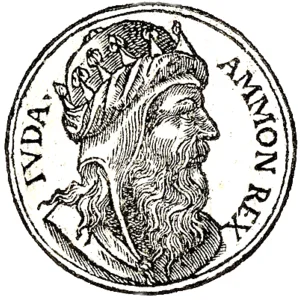

Amon was the fourteenth king of Judah, son of Manasseh, who reigned around 642–640 BC. Like his father, he practiced idol worship and abandoned the Yahwist faith. He was assassinated by his own servants after only two years of rule.
Frequently asked questions
Key Facts
- Reigned around 642–640 BC as king of Judah
- Son of Manasseh and father of Josiah
- Continued the idolatrous practices introduced by his father
- Assassinated by his servants after two years of reign (2 Kings 21:23)
- His son Josiah succeeded him and led a major religious reform
Works & Achievements
Amon's most theologically significant act was to perpetuate, without remorse, the foreign religious practices established by his father: the worship of Baal, Astarte, and the 'host of heaven.' This syncretic legacy became the ideological foil against which Josiah's future Yahwist reform would define itself.
Despite his brief two-year reign, Amon kept the Judean state functioning as a vassal of Ashurbanipal, ensuring the payment of tribute, the management of the provinces, and the continuity of the palace administration he had inherited from Manasseh.
Paradoxically, Amon's reign and his assassination brought Josiah to power — one of the greatest religious reformers in the history of Judah. In the biblical narrative, Amon represents the final moment of spiritual darkness before a radical Yahwist renaissance.
Anecdotes
Amon ascended to the throne at the age of twenty-two and reigned in Jerusalem for only two years. Unlike his father Manasseh, who — according to biblical texts — eventually repented and returned to the worship of Yahweh, Amon never underwent such a spiritual turnaround: he maintained the worship of idols until his death and offered sacrifices to the many gods of the region.
In 640 BCE, servants of the royal court hatched a conspiracy and assassinated King Amon in his own palace. But the 'people of the land' — a biblical expression likely referring to an elite class of landowners — rose up against the conspirators, put them to death, and placed Amon's son, the young Josiah, on the throne at only eight years old.
Amon was buried in the 'Garden of Uzza,' a private garden adjoining the royal palace in Jerusalem, where his father Manasseh had also been interred. This royal burial site, mentioned in the Books of Kings, has yet to be definitively identified by archaeologists.
The name 'Amon' carries a fascinating ambiguity: it echoes that of Amun-Ra, the great solar deity of Egyptian religion. In a context where Judah was subject to Assyrian influence while also maintaining ties with Egypt, this royal name could evoke connections to the foreign cults that the Yahwist prophets so strongly condemned.
According to biblical tradition, Amon multiplied the 'high places' — rural shrines dedicated to deities other than Yahweh — and offered worship to Baal and Astarte, Canaanite deities associated with fertility. His reign is presented as a providentially necessary relapse before the great religious reform carried out by his son Josiah.
Primary Sources
"Amon was twenty-two years old when he became king, and he reigned two years in Jerusalem. He did evil in the eyes of the LORD, as his father Manasseh had done. He followed completely the ways of his father, worshiping the idols his father had worshiped and bowing down to them."
"Amon was twenty-two years old when he became king, and he reigned two years in Jerusalem. He did evil in the eyes of the LORD, as his father Manasseh had done. Amon worshiped and offered sacrifices to all the idols Manasseh his father had made, and served them."
The annals mention the vassal kings of the Syro-Palestinian region who were compelled to supply tribute and military contingents to Assyria, illustrating the empire's domination over Judah in the 7th century BCE — the direct political context of Amon's reign.
"I will stretch out my hand against Judah and against all who live in Jerusalem. I will destroy every remnant of Baal worship in this place, the very names of the idolatrous priests [...] those who bow down on the rooftops to worship the starry host."
Key Places
The seat of royal power in Judah, the palace of Jerusalem was the place of Amon's reign and assassination. Archaeological excavations in the City of David have uncovered remains of administrative structures from this period of the 7th century BC.
The center of Yahwistic worship built by Solomon, the Temple is said to have housed altars dedicated to foreign deities under Manasseh and Amon. It would later be purified by Josiah during the great reform of 622 BC.
The burial place of Amon and his father Manasseh, this private garden adjoining the royal palace is mentioned in the Books of Kings and Chronicles. Its exact location remains unknown to modern archaeologists.
An ancient sanctuary of the Kingdom of Israel, Bethel was known for its syncretic religious practices following the fall of the Northern Kingdom. In biblical literature, it symbolizes the sin of idolatry perpetuated by kings such as Amon.
The capital of the Assyrian Empire under Ashurbanipal, Nineveh was the dominant power exerting pressure on Judah during Amon's reign. Assyrian vassalage partly explains the religious syncretism that was tolerated — and even encouraged — in tributary kingdoms.
Typical Objects

According to the Bible, Amon kept statuettes of foreign deities in his palace — Baal, Astarte, and the hosts of heaven. These syncretic cult objects, inherited from Manasseh, symbolized the abandonment of Yahwist faith that the prophets so strongly condemned.

The use of incense in Judah's rituals — whether Yahwist or idolatrous — is well attested archaeologically in the 7th century BCE. Amon is said to have "burned incense" before idols during syncretic ceremonies at the high places and in the royal palace.

The kings of Judah authenticated their decrees with engraved seals. Bullae dating to the 7th century BCE bearing Hebrew names have been found in Jerusalem, offering tangible evidence of the royal administration under Amon and his contemporaries.

Amon is said to have maintained altars dedicated to Baal and Astarte at the high places of Judah — rural ritual sites that rivaled the Temple in Jerusalem. Often built on elevated ground, these altars featured standing stones and sacred poles (asherah).

A symbol of military power and Assyrian influence, the war chariot was a royal attribute in 7th-century Judah. In biblical texts, its presence is linked to placing trust in foreign powers rather than in Yahweh.

The distinctive garment of the kings of Judah, shaped by the fashions of the Assyrian court. Purple — an extraordinarily precious royal color — and gold embroidery symbolized the royal dignity inherited through the Davidic line.
School Curriculum
Vocabulary & Tags
Key Vocabulary
Tags
Daily Life
Morning
Amon began his day with ritual ceremonies in the palace's sacred spaces, where officiating priests burned incense before idols inherited from Manasseh. Court dignitaries would then present themselves to pay homage to the king and receive their administrative instructions.
Afternoon
The afternoon was devoted to affairs of state: receiving Assyrian emissaries or tribal delegations, managing the tribute owed to Nineveh, and arbitrating disputes brought before the royal court. Royal scribes recorded decrees on clay tablets or scrolls.
Evening
In the evening, the king attended banquets with his officers and courtiers, entertained by musicians playing harp and flute. Ceremonies at the high places often took place at sunset, marking the liturgical rhythm of the court's syncretic cults.
Food
The royal table was plentiful: spelt and barley bread, roasted lamb and beef, legumes, figs, pomegranates and dried grapes, Judean wine and cold-pressed olive oil. Food offerings — flatbreads and wine libations — were placed before the divine statuettes kept in the palace.
Clothing
Amon wore a fine linen cloak dyed purple and embroidered with gold thread in the Assyrian court fashion, paired with an elaborate belt and leather sandals. A royal tiara or golden headband marked his dignity as a descendant of the line of David; his servants wore plain white linen tunics.
Housing
The royal palace in Jerusalem featured inner courtyards, audience halls with cedar columns from Lebanon, richly decorated private apartments, and a private garden known as the 'Garden of Uzza.' The walls were adorned with carved friezes, the floors laid with limestone slabs, and alabaster oil lamps lit the rooms at night.
Historical Timeline
Period Vocabulary
Visual Style
Style visuel proche-oriental du VIIe siècle av. J.-C. : esthétique assyrienne et levantine, tons ocre, lapis-lazuli et or, figures hiératiques en relief, atmosphère solennelle et syncrétiste, lumière ambrée des feux rituels.
Sound Ambience
Ambiance de Jérusalem au VIIe siècle av. J.-C. : chants liturgiques du Temple, percussions et fumées des rituels syncrétistes, vacarme des chars royaux et rumeurs des marchés de la Cité de David.
Liens externes & ressources
Références
Œuvres
Maintien et consolidation des cultes syncrétistes de Manassé
642-640 av. J.-C.
Administration du royaume de Juda sous tutelle assyrienne
642-640 av. J.-C.
Règne catalyseur de la réforme de Josias
640 av. J.-C.
Rechercher
See also
Related Characters
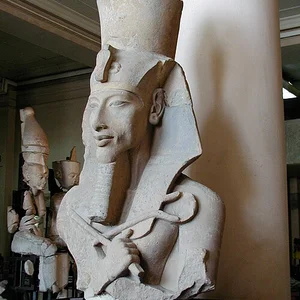
Akhenaten
1400 av. J.-C. — 1335 av. J.-C.
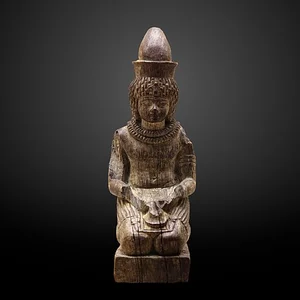
Amenhotep III
1399 av. J.-C. — 1350 av. J.-C.
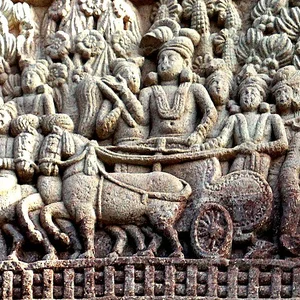
Ashoka
303 av. J.-C. — 231 av. J.-C.

Aten
Ay
1400 av. J.-C. — 1400 av. J.-C.
Bathsheba
1008 av. J.-C. — 936 av. J.-C.