
Anahita is a major goddess of ancient Iranian mythology, associated with fertilizing waters, fertility, and victory. Venerated throughout the Achaemenid Empire and beyond, she was integrated into Zoroastrianism as a yazata (benevolent celestial being).
Frequently asked questions
Key Facts
- Mentioned in the Avesta, the Zoroastrian sacred text, under the name Ardvi Sura Anahita
- Artaxerxes II (404–358 BCE) was the first Persian king to erect statues of her and promote her official cult
- Assimilated to Greco-Roman goddesses such as Aphrodite and Artemis during Hellenistic contacts
- Her cult spread from Persia to Armenia, Anatolia, and as far as the banks of the Indus
- She personifies the celestial cosmic river whose waters purify and fertilize the earth
Works & Achievements
A long hymn of more than one hundred and thirty stanzas devoted entirely to Anahita, constituting the most comprehensive source on her nature, her attributes, and the legendary heroes who invoked her. This sacred text establishes her central place in Iranian religion.
A royal commission to erect anthropomorphic statues of Anahita in all the major cities of the empire. The first systematic representation of an Iranian deity in human form, it revolutionized Achaemenid religious art.
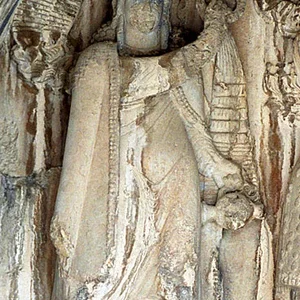
A large sacred complex dedicated to Anahita in the province of Kermanshah, parts of which are still visible today. This monument bears witness to the continuity of her cult from the Achaemenid Empire through the Parthian period.
The development of an autonomous Armenian cult around Anahit, who became the great protective goddess of the kingdom and of the Arsacid monarchy. Her influence lasted more than four centuries, leaving lasting traces in Armenian Christian culture.
The gradual assimilation of Anahita with the Greek goddesses Artemis (nature, hunting) and Aphrodite (love, fertility) in Hellenized regions. This syncretism facilitated the spread of her cult throughout the Mediterranean world during the Hellenistic period.
Anecdotes
The Achaemenid king Artaxerxes II (404–358 BC) was the first ruler to officially include Anahita in his royal inscriptions alongside Ahura Mazda and Mithra. He had statues erected in her image in the major cities of the empire, from Babylon to Sardis, marking a significant evolution of official Zoroastrianism toward a more openly polytheistic cult.
In the Avesta, the hymn dedicated to Anahita (Yasht 5, known as the Aban Yasht) describes her as a young woman of radiant beauty, dressed in a cloak of thirty female otter skins and wearing a golden crown adorned with a hundred stars and eight rays. This detailed description bears witness to the richness of ancient Iranian religious imagination.
The Greek geographer Strabo reports that in Zela, in Cappadocia (present-day Turkey), the sanctuary of Anahita was so powerful that its priests formed a true hereditary religious aristocracy. This fact reveals the extraordinary reach of her cult well beyond the borders of Iran.
In Armenia, Anahita underwent exceptional development: she became the principal national deity under the name Anahit. King Tiridates I called her the “mother of all wisdom and virtue, benefactress of the human race”; her great temple at Eriza (Erzincan) was considered the richest in the entire Armenian kingdom.
Anahita’s full name in the Avesta is Ardvi Sura Anahita, literally meaning “the moist, the mighty, the immaculate.” These three attributes summarize her nature: she is the great cosmic river that descends from the heavens to fertilize the earth, combining the raw force of waters with absolute purity.
Primary Sources
“I worship Ardvi Sura Anahita, the wide-expanding, the mighty, the immaculate, who favors herds, villages, and lands. She rides a chariot drawn by four white horses: the Wind, the Rain, the Clouds, and the Hail.”
“By the grace of Ahura Mazda, Anahita, and Mithra, I have built this palace. May Ahura Mazda, Anahita, and Mithra protect me from all evil and all enemies.”
“The Persians honor Anahita with solemn worship. At Zela, the temple is maintained by priests of high nobility, and the goddess is venerated with ancient rites handed down from father to son for generations.”
“Anahit is the glory of our nation and its life-giving benefactress, the mother of all wisdom and virtue. The kings of Armenia offered her the first fruits of their victories and dedicated to her the noblest of their war captives.”
“The waters of Ardvi Sura flow from Mount Hukairya to the sea of Vourukasha, purifying all the lands they cross, making women fertile and the herds of pious men abundant.”
Key Places
Cosmic mountain from which, according to the Avesta, the waters of Ardvi Sura Anahita spring forth. These divine waters descend from the celestial summit to spread across the entire earth, nourishing the seas and fertilizing the plains.
Ceremonial capital of the Achaemenid Empire where Artaxerxes II built a sanctuary dedicated to Anahita. Inscriptions discovered on site attest to her importance in Achaemenid royal religion.
City in central Turkey where a major sanctuary of Anahita, mentioned by Strabo, once stood. The temple was administered by a powerful hereditary priestly aristocracy and drew pilgrims from across Anatolia.
Site of the great temple of Anahit in Armenia, considered the richest and most glorious in the entire kingdom. It was destroyed during the Christianization of Armenia in the early 4th century.
Administrative capital of the Achaemenid Empire where inscriptions of Artaxerxes II explicitly mentioning Anahita were discovered. These texts constitute the earliest official attestations of her cult at the state level.
Site of a large sacred complex in Kermanshah province, attributed to Anahita by Sasanian sources. The remains still visible today bear witness to the enduring nature of her cult from the Achaemenid period through to the Parthian era.
Typical Objects

The Aban Yasht describes Anahita wearing a golden crown adorned with eight rays and a hundred stars. This celestial attribute symbolizes her sovereignty over the cosmic waters and her astral dimension.

A bundle of tamarisk or pomegranate twigs used in Zoroastrian rituals. Anahita is often depicted holding the *barsom*, a sign of her nature as a yazata and her role in purification ceremonies.

According to the Avesta, Anahita wears a cloak made from thirty otter skins — the otter being an animal associated with pure water. This precious garment symbolizes her power over the waters and the wealth that rivers bring to humanity.

A ritual cup of gold or silver used for offerings of *haoma* and pure water. Worshippers would pour libations before Anahita to seek her protection, the fertility of the land, and victory in battle.

The Aban Yasht describes Anahita riding a chariot drawn by four white horses personifying the Wind, the Rain, the Clouds, and the Hail. This cosmic chariot illustrates her absolute mastery over meteorological phenomena.

Despite her primary association with water and fertility, Anahita is also a goddess of military victory and may be depicted carrying a spear. She grants or withholds victory to the kings and heroes who invoke her before battle.

A fruit symbolizing fertility throughout the ancient Near East, associated with Anahita as an emblem of the abundance she bestows upon women, animals, and lands irrigated by her waters.
School Curriculum
Vocabulary & Tags
Key Vocabulary
Tags
Lieu
Daily Life
Morning
At sunrise, Anahita descends from Mount Hukairya on her chariot drawn by four white horses — Wind, Rain, Clouds, and Hail. She watches over the sacred springs and rivers as they begin their morning course, bringing life-giving dew to fields and meadows. In her sanctuaries, her priests light the first ritual fires and recite the hymns of the Aban Yasht to welcome her.
Afternoon
At the height of the day, Anahita receives the supplications of warriors and kings before their battles, granting or withholding victory according to their piety. She protects women in childbirth and promotes the fertility of herds. In her temples, the barsom are presented, the haoma prepared, and the faithful lay their offerings at the feet of her jewel-adorned statues.
Evening
At sunset, Anahita gathers the waters of the world and guides them to the sea Vourukasha. The priests complete their ritual recitations and symbolically extinguish the libation fires. In the deepening darkness, she watches over pregnant women and newborns, eternal protector of the cycles of life and renewal.
Food
As a goddess, Anahita is sustained by the offerings of mortals: libations of haoma (a sacred drink prepared from a divine plant), offerings of pure water drawn from consecrated springs, and hymns recited with devotion. Milk and the first fruits of the herds are dedicated to her to secure her favor over the fertility of humans and animals alike.
Clothing
The Avesta describes Anahita wearing a mantle made from thirty female otter skins gleaming like gold, and a golden belt cinched at her waist to display her divine beauty. Her golden crown is adorned with a hundred stars and eight rays. Her arms are decorated with bracelets, her wrists with precious gems, and she holds the sacred barsom in her hands.
Housing
Anahita dwells in the celestial waters atop Mount Hukairya, a mythical mountain a thousand men tall according to the Avesta, the meeting point between the heavens and the primordial great waters. On earth, her abodes are the stone-pillared temples consecrated by kings, where sacred flames burn without ceasing, tended by a devoted caste of priests.
Historical Timeline
Period Vocabulary
Liens externes & ressources
Références
Œuvres
Aban Yasht — Hymne aux Eaux (Avesta)
Ve–IVe siècle av. J.-C.
Programme iconographique d'Artaxerxès II
v. 400 av. J.-C.
Temple de Kangavar (actuel Iran)
IIIe–IIe siècle av. J.-C.
Culte national d'Anahit en Arménie
IIe siècle av. J.-C. — IVe siècle ap. J.-C.
Syncrétisme avec Artémis et Aphrodite
IVe–Ier siècle av. J.-C.