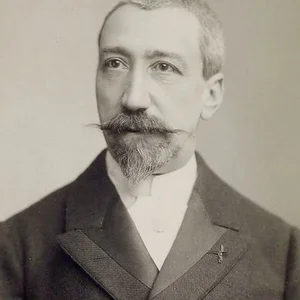

Born François-Anatole Thibault, Anatole France was a French writer, literary critic, and essayist, and a major figure of the Belle Époque. A committed Dreyfusard, he was awarded the Nobel Prize in Literature in 1921.
Anatole France(1844 — 1924)
Anatole France
France
8 min read
Frequently asked questions
Famous Quotes
« Chance is perhaps the pseudonym of God when He does not wish to sign.»
« Without the curiosity of the mind, what would we be? Very small things indeed.»
Key Facts
- 1844: born in Paris, son of a bookseller on the Quai Malaquais
- 1881: publication of 'The Crime of Sylvestre Bonnard', his first major success
- 1896: elected to the Académie française
- 1898: signs the Dreyfusard petition alongside Zola
- 1921: awarded the Nobel Prize in Literature
Works & Achievements
Anatole France's first major success, this novel features a lovable elderly bibliophile at odds with bureaucracy and bourgeois morality. It introduced readers to the tender, ironic, and erudite style that would become the author's trademark.
A philosophical and satirical novel set in the 18th century, it features the Abbé Coignard, a boisterous and skeptical character. Anatole France uses it to mock religious obscurantism and celebrate the free-thinking spirit of the Enlightenment.
A four-volume satirical series depicting provincial French society at the time of the Dreyfus Affair. Through M. Bergeret, a disillusioned professor, Anatole France delivers a biting critique of antisemitism and nationalism.
A short novel recounting the judicial ordeal of a modest street vendor unjustly convicted. Inspired by the Dreyfus Affair, this text powerfully denounces the arbitrariness of justice and the crushing of ordinary people.
An allegorical novel tracing the entire history of France through a civilization of penguins accidentally baptized. It contains Anatole France's most biting take on national history, politics, and religion.
Considered his masterpiece, this historical novel is set during the Reign of Terror (1793–1794) and follows a young painter radicalized by Jacobin ideology. Anatole France analyzes with striking insight the mechanisms of political fanaticism and ideological violence.
A whimsical and anticlerical novel featuring angels determined to overthrow God. Through this humorous tale, Anatole France develops a radical critique of religion and celebrates freedom of thought.
Anecdotes
Anatole France was born in 1844 in his father's bookshop, located on the quai Malaquais in Paris, overlooking the Seine and its famous bouquinistes. This childhood spent surrounded by old books and precious bindings definitively shaped his calling: he became one of the most erudite and ironic writers of his era, able to wield classical French with a disarming ease.
In January 1898, Anatole France was one of the first intellectuals to sign the petition supporting Émile Zola following the publication of “J'accuse…!” in L'Aurore. His commitment to the Dreyfusard cause earned him bitter enmities — some friends turned their backs on him and he was jeered in nationalist circles — but he held firm, convinced that truth and justice outweighed social convention.
For nearly two decades, Anatole France's intellectual and social life was organized by Léontine Lippmann, wife of the banker Arman de Caillavet. Her salon on the rue de Courcelles drew Proust, Jaurès, and the cream of literary Paris; people jokingly said that “Madame de Caillavet had manufactured Anatole France,” so thoroughly did she manage his schedule, proofread his manuscripts, and arrange ideal working conditions for him.
When he received the Nobel Prize in Literature in December 1921 and traveled to Stockholm, Anatole France was seventy-seven years old. In his acceptance speech, he reflected with melancholy on civilization in the aftermath of the Great War, surprising those who had expected a moment of triumph: the master ironist revealed himself to be profoundly shaken by the horrors of the conflict.
At his death in October 1924, hundreds of thousands of Parisians lined the route of the funeral procession and the government accorded him a state funeral. Yet a few days later, André Breton, Louis Aragon, Paul Éluard, and Philippe Soupault published a scathing pamphlet entitled “Un cadavre,” denouncing his academicism and his irony as self-satisfied: the Surrealists had no mercy for their elders.
Primary Sources
The law, in its majestic equality, forbids the rich as well as the poor to sleep under bridges, to beg in the streets, and to steal bread.
I am old; I have read much; I have seen a little; and I know that life is grave and sweet, and that one must not weigh it too heavily.
Historians relate events as they happened, that is to say, as they did not happen.
Those who make revolutions by halves have only dug themselves a grave.
The good critic is one who relates the adventures of his soul among masterpieces.
Key Places
It was in his father's bookshop on this quay running along the Seine that Anatole France was born and spent his childhood surrounded by books. This early immersion in the world of books and ideas permanently shaped his vocation as a scholarly writer.
Anatole France lived for many years in this Parisian villa, where he received the intellectual and political elite of the Belle Époque. His study there was filled to overflowing with bookshelves and antique objects.
Elected in 1896 beneath the Coupole, Anatole France took his seat there and delivered several celebrated speeches. The Académie represented for him the pinnacle of national literary recognition, even if he sometimes criticized its tendency toward academic stuffiness.
Léontine de Caillavet's salon was for two decades the nerve center of Anatole France's intellectual life, where he met Proust, Jaurès, and the leading figures of the Dreyfusard cause.
A property acquired in 1914 near Tours, this retreat became Anatole France's favorite residence in his final years. It was here that he died on October 12, 1924, surrounded by his books; the house is now a museum open to the public.
Typical Objects

Anatole France wrote with a quill in a fine, careful hand, crossing out and revising his manuscripts abundantly. This meticulous attention to style, inherited from the great classical writers, was for him a true intellectual discipline.

The son of a bookseller, he was surrounded from childhood by rare volumes and precious bindings. His personal library, which was considerable, reflected his passion for ancient, medieval, and classical scholarship.

This republican daily, in which Zola published his "J'accuse…!", was read every day by Anatole France during the Dreyfus Affair. The opinion press was at the heart of public debate in the Belle Époque.

Like any cultured gentleman of his era, Anatole France sported a bowler hat or top hat when going out, a symbol of the intellectual standing and social respectability of the Parisian literary world.

He recorded in notebooks his ironic reflections, his readings, and his observations on the society of his time — the raw material for his novels, chronicles, and satirical essays.

Elected to the Académie française in 1896, Anatole France sat among the "Forty Immortals" beneath the Dome of the Quai de Conti. This green armchair represented the supreme consecration of French literature.
School Curriculum
Vocabulary & Tags
Key Vocabulary
Daily Life
Morning
Anatole France rose late, around nine or ten in the morning, and devoted his mornings to writing in his study, surrounded by bookshelves. He wrote slowly, crossed out abundantly, and never sought to produce quickly, convinced that the classical style is forged through patience and revision.
Afternoon
His afternoons were often spent on visits, strolls through the Palais-Royal gardens, or meetings in Parisian literary salons. He relished long conversations on politics, history, and literature, where his subtle irony and encyclopedic learning shone to great effect.
Evening
Evenings were frequently spent at fashionable dinners or in the salon of Madame de Caillavet, surrounded by the intellectual and political elite of the *Belle Époque*. An avid reader, he devoted part of his nights to works of history, philosophy, or classical literature.
Food
Anatole France was renowned for his love of good food, a taste typical of bourgeois Parisian circles during the *Belle Époque*. He frequented fine restaurants and savored good wines, though his contemporaries never remarked on any excess.
Clothing
He dressed in the bourgeois fashion of his day: dark frock coat, waistcoat, and a bowler hat or top hat depending on the occasion. Once famous, he took care of his appearance without ostentation, with the quiet dignity of a man of letters who valued propriety over flair.
Housing
He lived for many years in comfortable Parisian apartments and villas, most notably the Villa Saïd in the **16th arrondissement**. His interiors were filled with bookshelves, antiques, and paintings, reflecting his pronounced taste for the arts and erudition.
Historical Timeline
Period Vocabulary
Liens externes & ressources
Références
Œuvres
Le Crime de Sylvestre Bonnard
1881
La Rôtisserie de la Reine Pédauque
1893
L'Histoire contemporaine (4 volumes)
1897–1901
L'Affaire Crainquebille
1901
L'Île des pingouins
1908
Les Dieux ont soif
1912
La Révolte des anges
1914