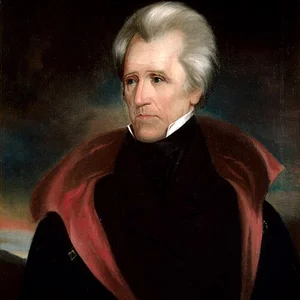

An American general and hero of the War of 1812, Andrew Jackson became the 7th President of the United States (1829–1837). A populist figure, he embodied Jacksonian democracy while also being a slaveholder and the architect of the policy to forcibly remove Native Americans from their lands.
Andrew Jackson(1767 — 1845)
Andrew Jackson
États-Unis
9 min read
Frequently asked questions
Famous Quotes
« One man with courage makes a majority.»
« The individual who refuses to defend his rights when called by his government deserves to be a slave.»
Key Facts
- 1767: Born in South Carolina to a family of Irish settlers
- 1815: Decisive victory at the Battle of New Orleans against the British
- 1829–1837: Presidency of the United States; founder of the Democratic Party
- 1830: Signed the Indian Removal Act, leading to the forced displacement of Native American peoples (Trail of Tears)
- 1845: Died in Nashville, Tennessee
Works & Achievements
A law signed by Jackson authorizing the federal government to negotiate treaties exchanging Native American lands east of the Mississippi for lands to the west. It led directly to the Trail of Tears and remains one of the most controversial acts in American history.
By vetoing the renewal of the central bank's charter, Jackson destroyed the financial institution he saw as a tool of the wealthy against the common people, permanently reshaping American monetary policy.
Faced with the secessionist threat from South Carolina, Jackson forcefully asserted the supremacy of federal law over state law, setting a crucial precedent for national unity that Lincoln would invoke thirty years later.
Jackson transformed his supporters into a structured political organization, giving birth to the modern Democratic Party. This institutional innovation introduced national conventions and mass politics to the United States.
Under his presidency, the United States paid off its entire national debt for the first and only time in its history, putting his ideals of government frugality into practice.
Through his military campaigns in Spanish territory, Jackson pressured Spain into ceding Florida to the United States via the Adams-Onís Treaty, significantly expanding the nation's territory.
Anecdotes
Andrew Jackson was the only U.S. president to have completely paid off the national debt, in January 1835. Convinced that banks and public debt corrupted democracy, he celebrated this achievement as the greatest victory of his presidency.
At the Battle of New Orleans in January 1815, Jackson commanded a motley army of regulars, militiamen, pirates, and free men of color against British troops. Despite being apparently outnumbered, he dealt the enemy a crushing defeat, making him the most celebrated national hero since Washington.
Jackson survived an assassination attempt in January 1835 — the first in American presidential history. When a man aimed two pistols at him, both weapons misfired. Jackson, furious, charged his attacker himself with his cane before being restrained by his guards.
Jackson carried a bullet lodged near his heart from a duel in 1806 against Charles Dickinson, who had publicly insulted him. He had allowed his opponent to fire first, absorbed the shot, then coolly killed him. He fought in several dozen duels over the course of his life.
A child of the frontier, Jackson was captured by the British at age 13 during the Revolutionary War. An officer ordered him to shine his boots; young Andrew refused. The officer slashed his face with a saber, leaving two scars he carried for the rest of his life — and a hatred of the British that never faded.
Primary Sources
The Federal Constitution must be obeyed, State rights preserved, our national debt must be paid, direct taxes and loans avoided, and the Federal Union preserved. These are the objects I have in view.
It is to be regretted that the rich and powerful too often bend the acts of government to their selfish purposes. [...] In the full enjoyment of the gifts of Heaven and the fruits of superior industry, economy, and virtue, every man is equally entitled to protection by law.
It will separate the Indians from immediate contact with settlements of whites; free them from the power of the States; enable them to pursue happiness in their own way and under their own rude institutions.
I consider, then, the power to annul a law of the United States, assumed by one State, incompatible with the existence of the Union, contradicted expressly by the letter of the Constitution.
You have no longer any cause to fear danger from abroad; your strength and power are well known throughout the civilized world. [...] But from within, combinations may arise to disturb our peace and throw our institutions into confusion.
Key Places
Jackson's plantation and primary residence from 1804. This estate of over 400 hectares, worked by enslaved people, is now a national museum that reflects the complexity of his character.
Site of Jackson's decisive victory over the British on January 8, 1815, which made him the most celebrated American hero since Washington. Now a national historical park.
Jackson lived here from 1829 to 1837, transforming the presidency into a popular institution open to ordinary citizens — his inaugural reception was open to all, resulting in a memorably chaotic gathering.
A poor, rural frontier region where Jackson was born in 1767, which deeply shaped his identity as a man of the people and his hostility toward the eastern seaboard elite.
Site of the massacre of American settlers by Creek warriors in 1813, which triggered the Creek War and allowed Jackson to establish himself as a military commander in the Southwest.
Liens externes & ressources
Références
Œuvres
Indian Removal Act
1830
Veto de la Banque nationale des États-Unis
1832
Proclamation sur la Nullification
1832
Fondation du Parti démocrate américain
1828
Remboursement de la dette nationale
1835
Annexion de facto de la Floride espagnole
1818-1821