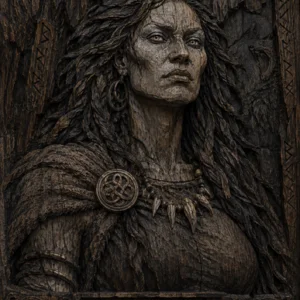

A giantess of Norse mythology, Angrboða is the consort of Loki and mother of three formidable beings: the wolf Fenrir, the serpent Jörmungandr, and the goddess Hel. She embodies the forces of chaos and the destruction to come at Ragnarök.
Angrboða
Angrboda
9 min read
Frequently asked questions
Key Facts
- Mother of Fenrir, the giant wolf destined to devour Odin at Ragnarök
- Mother of Jörmungandr, the Midgard Serpent that encircles the world
- Mother of Hel, the ruler of the realm of the dead (Niflheim)
- Her name roughly means "she who brings grief" in Old Norse
- Mentioned in the Prose Edda by Snorri Sturluson (c. 1220) and in the Poetic Edda
Works & Achievements
Angrboða's founding act in Norse mythology: giving birth to the three beings who seal the fate of the cosmos. Without her, the three main drivers of Ragnarök would not exist.
The first text to explicitly name Angrboða as the mother of the three cosmic monsters. Written in Old Norse Icelandic, this work has preserved Norse myths down to the present day.
A cosmogonic and eschatological poem from the Poetic Edda describing the Iron Wood and the wolves nursed by the giantess, foreshadowing Ragnarök. One of the most important sources for Norse mythology.
An Eddic poem in which Loki claims his union with Angrboða and their monstrous offspring during a divine feast, placing the giantess at the heart of Norse chaos genealogy.
A poem from the Poetic Edda in which Angrboða is named among the great mythological female figures endowed with prophetic powers, deepening her role as a seer and sorceress.
A precious Icelandic manuscript containing the poems of the Poetic Edda. Its written preservation allowed the Norse myths featuring Angrboða to be passed down to future generations.
Anecdotes
Angrboða, whose Old Norse name literally means "she who brings sorrow," dwelled deep within the dark forest of Járnviðr — the Iron Wood — east of Midgard. This terrifying place was home to giantesses and monstrous wolves. There she reigned like a queen of darkness, waiting for the hour of Ragnarök.
Through her union with the cunning god Loki, Angrboða gave birth to three beings destined to seal the fate of the world: the colossal wolf Fenrir, the great serpent Jörmungandr who encircles the seas, and Hel, goddess of the dead whose face is half living, half corpse. The gods of Asgard, terrified by these creatures, tore them from their mother and scattered them to the far corners of the cosmos.
In the Eddic poem Hyndluljóð, Angrboða is presented as a völva — a seeress capable of seeing past, present, and future. This prophetic dimension places her alongside the great female figures of Norse mythology, such as the Völva of the Völuspá, who foretells the end of the world to the powerless gods.
According to the Völuspá, in the forest of Járnviðr, an old giantess identified with Angrboða nurses the race of wolves and gives birth to Fenrir. This image of a mother feeding the destructive forces of Ragnarök makes her one of the most formidable figures in the Norse pantheon — both a loving mother and an embodiment of the chaos to come.
When the gods decided to bind Fenrir with the magical fetter Gleipnir, cast Jörmungandr into the depths of the ocean, and send Hel to rule the realm of the dead, they separated Angrboða from all of her children. This forced dispersal was not without consequence: the three children, confined to their respective domains, awaited Ragnarök to break free and join their mother in the final destruction.
Primary Sources
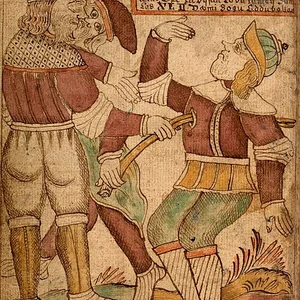
Loki also fathered children with the giantess Angrboða in Jötunheimr. There were three of them: the first was the wolf Fenrir, the second was the Midgard Serpent, and the third was Hel.
In the forest of Járnviðr sat the old woman, nursing the children of Fenrir; one of them, above all others, will be the thief of the Moon, gorged on the blood of dying men.
Loki proudly claims his unions with Angrboða and boasts of the monstrous offspring born from that relationship, whom the gods tried in vain to contain.
Angrboða is named among the great female figures of the primordial age, associated with giantesses gifted with the power of prophecy and seiðr, whose lineage weighs upon the fate of the gods.
Key Places
A mythical forest east of Midgard and the main dwelling of Angrboða. In this dreaded place, the giantess raises the cosmic wolves destined to devour the sun and moon at Ragnarök.
One of the Nine Worlds of Norse cosmology, Jötunheimr is the kingdom of the jötnar. It is here that Angrboða has her origins and where she conceives her fearsome offspring with Loki.
A cold, misty underworld ruled by Hel, the daughter of Angrboða. This place symbolizes the hold that Angrboða's bloodline has over death itself and over the souls of the departed.
The home of the Norse gods, from which the decisions to scatter Angrboða's children were made. Asgard represents order standing against the chaos embodied by the giantess of the Iron Wood.
It was in Iceland, in the 13th century, that Snorri Sturluson and Icelandic scholars committed the Norse myths to writing — myths in which Angrboða appears. Without Iceland, her figure might have vanished forever.
Typical Objects

A long ceremonial staff used by Norse prophetesses during seiðr rituals. Associated with powers of divination, Angrboða is often depicted carrying one, emphasizing her role as a seer of fates.

A ribbon forged by the dwarves to chain Fenrir, son of Angrboða. A symbol of the gods' attempt to contain the chaos born of her lineage, it represents one of Asgard's rare temporary victories against the forces of destruction.

An emblem of the Iron Wood over which Angrboða rules, the wolf skull symbolizes her role as mother of the great cosmic wolves, one of whom will devour the sun at Ragnarök.

Stones or staves inscribed with runes used to cast spells or read the future in Norse tradition. As a giantess who masters dark magic, Angrboða is associated with runes of doom and fatal prophecy.

A ritual vessel used during Norse mythological feasts. In Angrboða's hall, the drinking horn seals pacts between beings of darkness and symbolizes the acceptance of inexorable fate.

Giantesses in Norse mythology are often described as draped in veils of shadow or mist. Angrboða, queen of the Iron Wood, is associated with the darkness her offspring will spread across the world.
School Curriculum
Vocabulary & Tags
Key Vocabulary
Daily Life
Morning
At dawn in the Iron Wood, Angrboða rises in a heavy silence broken only by the cries of ravens and the distant growls of the wolves she rears. She consults runes carved into iron tree trunks to read the day's omens, her dark eyes scanning the morning mists that shroud her domain.
Afternoon
In the afternoon, Angrboða roams her forest, watching over her wolves and communing with the dark forces that surround her. She practices seiðr, weaving spells and prophecies about the fate of the cosmos. Giantesses and other creatures from Jötunheimr sometimes come to consult her as an oracle, seeking to learn their destiny.
Evening
At dusk, in her great hall of stone and twisted wood, Angrboða presides over dark feasts, drinking from an aurochs horn a mead brewed with bitter herbs. She sings ancient incantations whose vibrations make the iron trees tremble, meditating on the fate of her three children scattered to the far corners of the cosmos.
Food
Angrboða eats as all jötnar do in Norse mythology: meat roasted over great hearths, fish from icy rivers, berries and roots from the forest, and above all the mead shared during ceremonies. Her table reflects the wild, raw abundance of Jötunheimr — unrefined, but charged with a primal strength.
Clothing
She is dressed in heavy wolf and bear furs fastened with wrought-iron brooches. On her dark robe, patterns of serpents and wolves are embroidered or worked into the fabric. Around her neck she wears amulets of bone and runic stone, and her dark hair is braided with metal fragments and wolf fangs.
Housing
Angrboða dwells at the heart of Járnviðr in a great hall whose columns are twisted iron trees, their branches forming a natural vault through which a pale light filters. The walls are hung with animal hides and skulls, and runes carved into the metal at the entrances ward her space against intruders.
Historical Timeline
Period Vocabulary
Visual Style
Le style visuel d'Angrboða s'inspire des enluminures nordiques médiévales et de la sculpture viking, avec une palette sombre de gris-fer, bleu nuit et rouge sang soulignant sa majesté menaçante au cœur de la Forêt de Fer.
Sound Ambience
L'ambiance sonore d'Angrboða évoque la Forêt de Fer obscure et glaciale, peuplée de loups hurlants et traversée de vents porteurs de présages funestes. Les sons sont profonds et inquiétants, chargés d'une puissance ancestrale et d'un destin inéluctable.
Liens externes & ressources
Références
Œuvres
Maternité de Fenrir, Jörmungandr et Hel
Temps mythique
Edda en prose (Prose Edda) — Snorri Sturluson
vers 1220
Völuspá (La Prophétie de la Völva)
IXe-Xe siècle
Lokasenna (La Querelle de Loki)
IXe-Xe siècle
Hyndluljóð (Le Chant de Hyndla)
Xe-XIe siècle
Codex Regius
vers 1270