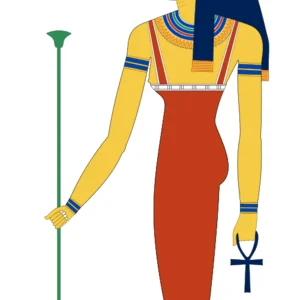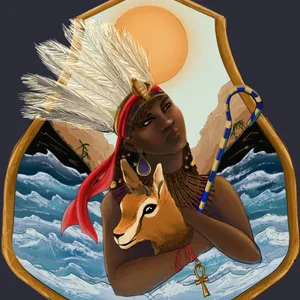

Anuket is an Egyptian goddess personifying the Nile and its annual floods, venerated at Elephantine and in Nubia. She is depicted wearing a crown of feathers and is associated with the fertility of lands irrigated by the river.
Anuket
Anuket
9 min read
Frequently asked questions
Key Facts
- Anuket is attested as early as the Middle Kingdom (c. 2000 BCE) in the region of Elephantine
- Together with Khnum and Satis, she forms the divine triad of Elephantine, at the first cataracts of the Nile
- Her name means "to embrace" or "to encircle
- referring to the arms of the river
- She was particularly honored during the festival of the Nile flood, the lifeblood of Egyptian agriculture
- Her cult extended into Nubia (Kush), reflecting the cultural exchanges between Egypt and sub-Saharan Africa
Works & Achievements
The principal sanctuary dedicated to Anuket, located on the island of Elephantine and built then expanded over several centuries. It hosted the annual rites linked to the flooding of the Nile and formed the heart of her official cult.
A chapel dedicated to Anuket on the island of Sehel, surrounded by rocks covered in pilgrims' inscriptions. This place of popular devotion reflects the importance of the goddess to travellers navigating the cataracts.
Hymns celebrated Anuket as "mistress of the cataracts" and "giver of life." These texts, carved on temple walls, describe her blessings upon the fertility of the land and the prosperity of the people.
Depictions of Anuket among the reliefs of the funerary temple of Pharaoh Hatshepsut, attesting to her integration into the royal pantheon and her protective role over Egyptian kingship.
A stele carved on a rock at Sehel invoking the triad of Elephantine, including Anuket, to bring an end to a famine. It illustrates the enduring nature of Anuket's cult as goddess of the inundation over more than two millennia.
Anuket appears in the decorations of the Nubian temples built by Ramesses II, bearing witness to her central role in the religion of the region and to the continuity of her veneration over more than a millennium.
Anecdotes
Anuket is one of the rare Egyptian deities whose name is directly linked to the Nile: in ancient Egyptian
Anuket" means "she who embraces" or "she who enfolds
referring to the river that surrounds and nourishes the cultivated lands. This etymology illustrates how vividly the Egyptians perceived the Nile as a living, benevolent entity.
The goddess was particularly venerated at Elephantine, an island in the Nile near Aswan, considered one of the mythical sources of the river. Each year, at the time of the flood, priests would cast offerings into the waters — jewels, gold coins, amulets — to thank Anuket for bringing the life-giving water that fertilized the fields.
Anuket was often depicted wearing a tall crown made of papyrus reeds or ostrich feathers, a symbol of the Nile's marshlands. This distinctive headdress set her apart from other goddesses and reminded worshippers of her nature as deeply tied to the wetlands and the verdant banks of the river.
In Nubia, Anuket formed part of a sacred triad with Khnum, the ram-headed god, and Satis, goddess of the floods. Together, they served as guardians of the Nile cataracts. This association reflects the Egyptian vision of the river as a divine gift shared among several heavenly powers.
Inscriptions found on the island of Sehel, near Aswan, show votive offerings addressed to Anuket by travelers and merchants crossing the Nile cataracts. These testimonies reveal that the goddess was invoked as a protector of perilous river journeys, in addition to her role in the fertility of the land.
Primary Sources
Anuket is mentioned among the protective deities of the deceased pharaoh, associated with the primordial waters and the life-giving floods of the Nile. She is invoked to purify and nourish the king in the afterlife.
The inscription names the gods of the Elephantine triad — Khnum, Satis, and Anuket — as masters of the sources of the Nile and responsible for the annual floods that ensure the fertility of Egypt.
Religious texts associate Anuket with the fertilizing waters of the Nile, describing her as the one who bestows life through the annual floods and nourishes all of Egypt with her gifts.
The temple's reliefs and texts describe Anuket as daughter of Ra and protector of the cataracts, celebrated during the great annual festivals tied to the Nile floods.
This Ptolemaic decree mentions the rites performed for the deities of the Nile, incorporating Anuket into the official religious calendar during celebrations linked to the floods and the prosperity of Egypt.
Key Places
Elephantine was the main cult center of Anuket in the Egyptian world. Her principal temple hosted the annual rites connected to the flooding of the Nile and stood as the heart of her official worship for more than two millennia.
This island at the cataracts was covered with rocks carved with votive inscriptions addressed in particular to Anuket. Travelers would leave their prayers there before facing the dangerous river rapids.
Nubia was the other major territory of Anuket's veneration. There, the goddess was regarded as a native power, and her cult was deeply rooted in local traditions long before its official adoption by the Egyptians.
The neighboring temple dedicated to Satis, Anuket's companion in the Elephantine triad, illustrates the collective dimension of the cult. Anuket was honored there alongside her divine companions during the great religious festivals.
Depictions of Anuket appear on the reliefs of Hatshepsut's funerary temple at Deir el-Bahari, attesting that her cult radiated far beyond Elephantine and reached the Egyptian royal court.
Typical Objects

Anuket is consistently depicted wearing a tall crown of ostrich feathers or reed stalks, a symbol of the marshes and lush banks of the Nile. This distinctive attribute evokes the life and fertility brought by the annual flood.

Like many of the great Egyptian deities, Anuket holds a was scepter shaped like a crook topped with a stylized animal head. This scepter is the emblem of divine power and dominion over the forces of nature.

Anuket frequently carries the ankh symbol, the hieroglyph representing eternal life, underscoring her role as a giver of life through the waters of the Nile that restore parched fields to green.

During major religious festivals, Anuket's statue was carried in procession aboard a sacred barque adorned with gold and flowers. This vessel symbolized the divine journey of the goddess along the river she personified.

Worshippers would throw necklaces, bracelets, and gold rings into the waters of the Nile to thank Anuket for sending the flood. These precious offerings bear witness to the gratitude of the Egyptians toward the goddess who guaranteed their survival.

The papyrus plant, which grew abundantly along the banks of the Nile, was sacred to Anuket and used to fashion her crown. It also decorated the columns of her temple, recalling the bond between the goddess and the river.

Anuket's sacred animal is the gazelle, whose grace and lightness evoke flowing water. In some depictions, the goddess is accompanied by this animal, and herds of gazelles were sometimes consecrated to her temple.
School Curriculum
Vocabulary & Tags
Key Vocabulary
Tags
Daily Life
Morning
At the break of day, the priests of Anuket at Elephantine performed the rites of the daily temple opening: they broke the seal of the naos, washed the divine statue, dressed it in white linen, and presented food offerings. These gestures signified that the goddess was present and active, ready to bestow her blessings upon the Nile and its banks.
Afternoon
During the hottest hours, the priests recited hymns and magical formulas meant to ensure the regularity of the Nile's floods. Pilgrims from across the region flocked to the temple to lay down their offerings — lotus flowers, figs, loaves of bread — and to implore the goddess's protection for their harvests and their crossing of the cataracts.
Evening
At sunset, a final ceremony closed the ritual day: the statue of Anuket was "put to bed" in her naos, and the temple doors were shut and sealed. The priests performed libations of Nile water, a symbol of the eternal bond between the goddess and her sacred river.
Food
The food offerings presented to Anuket reflected the bounty of the Nile: river fish, loaves of various shapes, dates, figs, pomegranates, and jars of beer made up the ritual meals. After being symbolically consumed by the goddess, these foods were redistributed to the priests and temple workers.
Clothing
Anuket is depicted wearing a long, form-fitting white linen dress, the noble fabric of ancient Egypt. Her distinctive crown of reeds or ostrich feathers — often very tall — adorned her head, while a wide gold and semi-precious stone pectoral collar decorated her neck and chest.
Housing
The temple of Anuket at Elephantine was her earthly dwelling: a stone structure oriented toward the Nile, comprising an entrance pylon, an open-air courtyard, a columned hall, and a naos housing the divine statue. The entire island of Elephantine was considered her sacred domain, where the cataracts of the Nile formed the boundary between the human world and her divine realm.
Historical Timeline
Period Vocabulary
Liens externes & ressources
Références
Œuvres
Temple d'Anuket à Éléphantine
Moyen Empire – époque ptolémaïque (vers 2000-30 av. J.-C.)
Chapelle votive de Séhel
Moyen Empire (vers 1900 av. J.-C.)
Hymnes liturgiques à Anuket
Nouvel Empire (vers 1550-1070 av. J.-C.)
Reliefs du temple d'Hatchepsout (Deir el-Bahari)
Vers 1480 av. J.-C.
Stèle de la Famine (Inscription de Séhel)
IIIe siècle av. J.-C. (ptolémaïque)
Représentations dans les temples nubiens de Ramsès II
Vers 1250 av. J.-C.