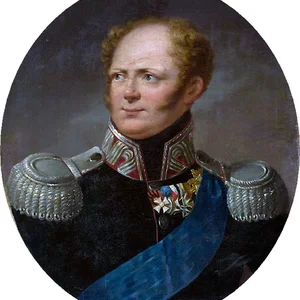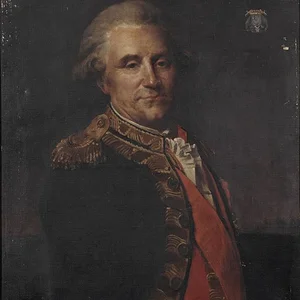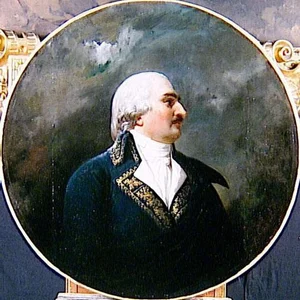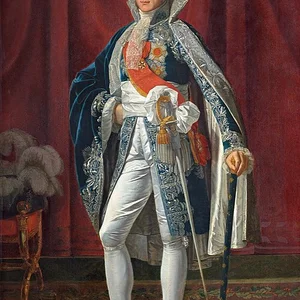

French general and diplomat, Duke of Vicenza, he served as Napoleon's ambassador to Russia (1807–1811) and was a privileged eyewitness to the Russian campaign of 1812. Minister of Foreign Affairs during the Hundred Days, he left behind essential Memoirs on the Napoleonic saga.
Armand de Caulaincourt(1773 — 1827)
Armand Augustin Louis de Caulaincourt
France
9 min read
Frequently asked questions
Famous Quotes
« War is the last argument of kings, but it should never be the first.»
Key Facts
- 1773: Born in Saint-Quentin into a noble military family
- 1807–1811: French Ambassador to Russia, architect of the Franco-Russian alliance of Tilsit
- 1812: Witness to the retreat from Russia, he accompanied Napoleon in his flight by sleigh
- 1813–1814: Negotiated in vain for peace on Napoleon's behalf at the congresses of Châtillon and Prague
- 1815: Minister of Foreign Affairs during the Hundred Days
Works & Achievements
An intimate and meticulous account of the Russian campaign and the final years of the Empire, including Caulaincourt's conversations with Napoleon during the sleigh journey back. Regarded as one of the most valuable primary sources on Napoleon, the work waited over a century before seeing publication.
For four years, Caulaincourt maintained the Treaty of Tilsit alliance between France and Russia, managing the tensions arising from the Continental Blockade. His skilled diplomacy delayed by several years the fateful conflict of 1812.
As Napoleon's plenipotentiary facing the representatives of the European coalition, Caulaincourt sought to secure an honorable peace in exchange for territorial concessions — demonstrating a keen diplomatic sense in a near-desperate situation.
Caulaincourt took part in the negotiations over Napoleon's abdication and the terms of his exile to the island of Elba, working until the very end to secure the best possible conditions for the fallen Emperor.
Anecdotes
In December 1812, as the Grande Armée was disintegrating in the Russian cold, Napoleon decided to rush back to Paris. He locked himself away for thirteen days in a sleigh with Caulaincourt, traveling from Smolensk to the capital, sharing his most intimate thoughts about the disaster of the campaign. Caulaincourt meticulously recorded these confidences, leaving us a unique account of the Emperor's state of mind after the greatest military catastrophe of his reign.
Before the Russian campaign, Caulaincourt had spent four years as ambassador in Saint Petersburg and knew the country better than anyone at the imperial court. He implored Napoleon to abandon the war, explaining that Russia would sooner burn its own cities than surrender. Napoleon, irritated, told him he had been “Russified” and ignored his warnings — warnings that proved cruelly accurate.
At the Battle of Borodino, on September 7, 1812, Armand's younger brother, General Auguste de Caulaincourt, led a heroic cavalry charge against the Great Redoubt. He captured the position but was killed in the assault. Armand learned of his brother's death during that same day of battle, turning what was for him a Pyrrhic victory into a personal bereavement.
In 1804, Napoleon sent Caulaincourt to arrest the Duke of Enghien, a prince of royal blood, on the neutral territory of Baden. Caulaincourt followed orders without knowing that the duke would be shot shortly afterward. This affair, widely seen as a political assassination, weighed on his conscience for the rest of his life, and he addressed it at length in his *Memoirs*, seeking to clear his name.
In 1814, Caulaincourt negotiated desperately at Châtillon to save Napoleon's throne, willing to cede territories in exchange for peace. But each time he was on the verge of a breakthrough, Napoleon would win a small victory and withdraw his concessions; when military fortunes reversed, it was too late to resume negotiations. Caulaincourt, powerless, watched the last chance of preventing the fall of the Empire slip away.
Primary Sources
Napoleon said to me: 'Russia is governed by chance and circumstances. Alexander is a good man, but weak; he lets himself be led by his advisers.' I noted that the Emperor seemed to want to convince himself that the campaign would be short.
I have the honour to report to Your Majesty that Emperor Alexander remains committed to the terms of the alliance of Tilsit, but that Russian public opinion is ill-disposed toward the Continental Blockade, whose effects on trade are disastrous.
I appointed you ambassador to Saint Petersburg because you enjoy the confidence of Emperor Alexander. Your mission is to maintain the alliance and to monitor the dispositions of the Russian court regarding the Continental Blockade.
The Duke of Vicenza, plenipotentiary of His Majesty the Emperor of the French, declared his readiness to accept the natural borders of France as a basis for negotiation, subject to the formal approval of his sovereign.
Caulaincourt, the Emperor would say, was a man of honour and talent, but he had become too Russian. He sincerely loved Alexander and could not bring himself to believe that the alliance would ever break apart.
Key Places
Village in Picardy where Armand de Caulaincourt was born in 1773. The family owned a seigneurial château there, which gave him his name and his noble title.
Capital of the Russian Empire where Caulaincourt served as France's ambassador from 1807 to 1811, forging close ties with Tsar Alexander I and gaining an intimate knowledge of Russia.
Caulaincourt served here as Minister of Foreign Affairs in 1814 and again during the Hundred Days. He died here in 1827 and spent his final years writing his *Mémoires*.
Site of the great battle of September 7, 1812, where Caulaincourt's brother Auguste was killed while heroically storming the Grand Russian Redoubt. That day was one of the bloodiest of all the Napoleonic Wars.
Town where the Allied coalition congress was held in early 1814. Caulaincourt negotiated there in vain to save the Napoleonic Empire, agreeing to territorial concessions that Napoleon never ratified in time.
Typical Objects

A closed carriage mounted on runners, heated and lined with furs, used for rapid travel on the snow-covered roads of Russia and Eastern Europe. It was in such a sleigh that Caulaincourt and Napoleon crossed Europe in December 1812, during the famous retreat from Russia.

A fur-lined coat essential for enduring Russian winters. During his four years in Saint Petersburg, Caulaincourt grew accustomed to this garment — one that the soldiers of the Grande Armée did not have in sufficient numbers in 1812.

A sealed and inviolable satchel containing official dispatches and correspondence between the ambassador and Paris. Caulaincourt used it daily to keep Napoleon informed of developments at the tsar's court.

An official document signed by the Emperor presenting Caulaincourt as France's representative to Alexander I. Its solemn delivery to the tsar marked the formal beginning of his diplomatic mission in Saint Petersburg.

Caulaincourt devoted his final years to writing his memoirs, carefully setting down his conversations with Napoleon and the events he had witnessed, in order to leave an accurate and faithful account for posterity.

The regulation sidearm of Empire cavalry generals, worn on all military and official occasions. Caulaincourt, from a military family and trained as a cavalry officer, carried one throughout campaigns and parades.

The maps available to the Grande Armée for the 1812 campaign were inaccurate and full of gaps, contributing to the logistical disasters that followed. Caulaincourt, drawing on his direct knowledge of the Russian terrain, was one of the few men capable of correcting these errors.
School Curriculum
Vocabulary & Tags
Key Vocabulary
Daily Life
Morning
Caulaincourt rose early, following the habit of military officers of the era. He would read and annotate the diplomatic dispatches that had arrived overnight, then prepare his reports for Napoleon or, during his ambassadorship in Saint Petersburg, organize the day's meetings with members of the Russian court.
Afternoon
His afternoons were occupied with diplomatic audiences, working sessions with his secretaries, and meetings with other ambassadors or generals. An accomplished horseman — an indispensable quality for the Emperor's Grand Equerry — he rode regularly, whether to inspect troops or to clear his mind.
Evening
Evenings at the imperial court, in Paris as in Saint Petersburg, were marked by long formal dinners, balls, and theatrical performances. Caulaincourt represented France with care on these occasions, but he also devoted part of his nights to writing his memoirs, determined to leave a faithful account for posterity.
Food
Like the high-ranking officers and diplomats of the time, Caulaincourt had access to an abundant table: roasted meats, game, fine pastries, and French wines. In Saint Petersburg, he adapted to Russian culinary traditions — thick soups, smoked fish, vodka — and organized banquets blending both cuisines to cultivate his relations with the Tsar's court.
Clothing
On military duty, Caulaincourt wore the gold-embroidered uniform of a divisional general, along with his decorations including the Légion d'honneur. In his role as the Emperor's Grand Equerry, he donned a sumptuous court dress of embroidered coat and silk breeches. In Russia, he adopted the fur-lined pelisse against the harshness of winter and wore his sword on all official occasions.
Housing
In Saint Petersburg, Caulaincourt resided in the French Embassy, a luxurious palace befitting the standing of the Napoleonic Empire. In Paris, he owned a private mansion in the aristocratic quarters, where he held a salon receiving diplomats, generals, and men of letters in keeping with the obligations of his position.
Historical Timeline
Period Vocabulary
Liens externes & ressources
Références
Œuvres
Mémoires du général de Caulaincourt, duc de Vicence
Rédigés vers 1822-1827, publiés en 1933
Mission diplomatique à Saint-Pétersbourg
1807-1811
Négociations du congrès de Châtillon
Février-mars 1814
Participation au traité de Fontainebleau
Avril 1814