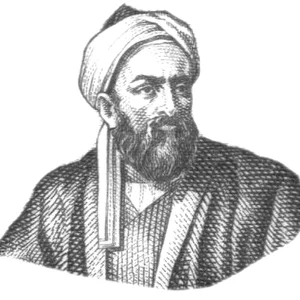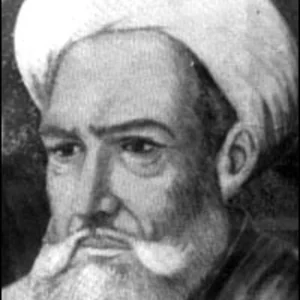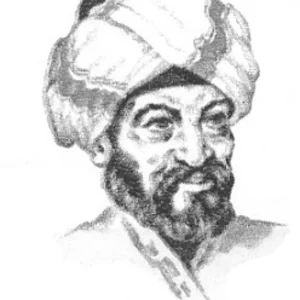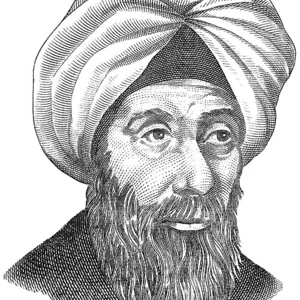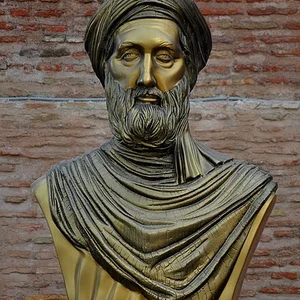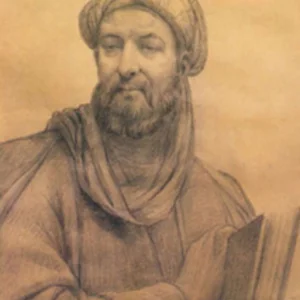

A Persian physician and philosopher of the 10th century, Avicenna authored the Canon of Medicine, a reference work used in Europe and the Islamic world for five centuries. He synthesized Aristotle's philosophy with Islamic thought and made decisive contributions to the medical sciences.
Avicenna(980 — 1037)
Avicenna
8 min read
Frequently asked questions
Famous Quotes
« Ignorance leads to fear, fear leads to hatred, and hatred leads to violence.»
« The body is the servant of the soul.»
Key Facts
- Born in 980 in Afshena (present-day Uzbekistan), died in 1037 in Hamadan (Iran)
- Wrote the Canon of Medicine (Al-Qanun fi al-Tibb) around 1025, translated into Latin in the 12th century
- Author of the Book of Healing (Kitab al-Shifa), a vast philosophical and scientific encyclopedia
- First to describe the contagious nature of diseases and advocate for quarantine
- His works were taught in European universities until the 17th century
Works & Achievements
A five-volume medical encyclopedia synthesizing the entirety of Greek and Islamic medical knowledge. Translated into Latin, it remained the standard textbook in European universities until the 17th century.
An 18-volume philosophical and scientific encyclopedia covering logic, natural sciences, mathematics, and metaphysics. It is the largest philosophical synthesis ever written by a single author.
A condensed summary of his philosophy, particularly his theory of the soul. It contains the Floating Man argument, a thought experiment that anticipates Descartes' cogito.
A late, synthetic philosophical work regarded as his intellectual testament. It develops his philosophical mysticism and his conception of the intellect.
A short philosophical treatise on the nature of love, conceived as a cosmic force uniting all beings. It reflects the literary and poetic dimension of Avicenna's thought.
A poem in Arabic describing the soul's descent into the body and its longing to return to its divine origin. One of the finest expressions of Neoplatonic philosophy in verse.
Anecdotes
Avicenna is said to have memorized the entire Quran before the age of ten. By sixteen, he was already treating patients and had earned such a reputation that the Samanid sultan Nuh ibn Mansur called upon him to cure an illness that other physicians had failed to treat. As a reward, Avicenna was granted access to the royal library, one of the finest of his era.
Avicenna wrote parts of his monumental work, the Canon of Medicine, on camelback, traveling between the courts of princes who competed for his services. He would dictate to his secretary while riding, so fertile was his mind and so prodigious his memory.
During his imprisonment at the castle of Fardajan, ordered by the emir Taj al-Mulk whom he had displeased, Avicenna never stopped writing. It was in prison that he composed several philosophical treatises, turning his captivity into a forced intellectual retreat.
Avicenna explored the nature of the soul through a thought experiment that has remained famous: he asked readers to imagine a man created in a void, with no sensory perception whatsoever. According to him, this 'floating man' would still be aware of his own existence, thereby proving that the soul is independent of the body. This reflection would directly influence Descartes six centuries later.
The Canon of Medicine was translated into Latin in the 12th century and became the standard textbook at European universities until the 17th century. In it, Avicenna precisely describes the transmission of disease through water and soil, anticipating germ theory by several centuries. Medical students in Paris and Montpellier were still studying it in the time of Molière.
Primary Sources
Medicine is the art of knowing the states of the human body with respect to health and the decline of health, in order to preserve the former and restore the latter.
The human soul is a spiritual substance whose existence does not depend on the body, although it acts through the body during earthly life.
She descended to you from the highest peaks, this dove veiled in mystery... She resists revealing herself, though she has come among us for but an evening's or a morning's stay.
I read Aristotle's Metaphysics, but could not understand it. Then I happened upon al-Farabi's commentary, and suddenly everything became clear to me.
Key Places
Avicenna's birthplace and cultural capital of the Samanid Empire, home to an exceptional royal library. It was here that he received his education and completed his first medical studies.
A major intellectual center where Avicenna rubbed shoulders with al-Biruni and other scholars at the Khwarazmian sultan's court. This period was decisive in the maturing of his philosophical thought.
The city where Avicenna served as vizier and physician to the emir Shams al-Dawla, and where he died in 1037. His mausoleum, rebuilt in the 20th century, has become a site of cultural pilgrimage.
Capital of the emir ʿAlāʾ al-Dawla, where Avicenna spent the most tranquil years of his later life. There he completed numerous treatises and enjoyed stable patronage.
A city of the Reconquista that became the leading translation center for rendering Islamic learning into Latin. It was here that the Canon of Medicine was translated in the 12th century, spreading Avicenna's knowledge throughout Europe.
Typical Objects

An astronomical measuring instrument used to determine the position of celestial bodies. Avicenna used it for his observations of the sky and incorporated it into his vision of an ordered cosmos governed by natural laws.

A trimmed reed used for writing on paper. Avicenna was never without his writing instruments, dictating or composing in all circumstances — even in prison or on horseback.

A distillation apparatus used in pharmacopoeia to extract the active compounds from medicinal plants. Avicenna refined distillation techniques and described rosewater in the Canon of Medicine.

A graduated glass vessel used to analyze a patient's urine, one of the fundamental diagnostic examinations described in the Canon of Medicine. Avicenna codified the colors and consistencies that could be used to diagnose diseases.

Paper, introduced into the Islamic world from China, enabled the widespread dissemination of knowledge. Avicenna produced a remarkable body of work estimated at 450 treatises, made possible by the availability of paper.

Glass or clay containers holding medicinal preparations. The Canon of Medicine catalogues over 800 drugs of plant, animal, and mineral origin used by Avicenna.
School Curriculum
Vocabulary & Tags
Key Vocabulary
Daily Life
Morning
Avicenna rose before dawn for the fajr prayer. He devoted the early morning hours to consulting patients who had sometimes been waiting since the previous day, examining their urine, pulse, and complexion. He would then dictate to his secretary the observations from the night and new sections of his treatises.
Afternoon
Afternoons were reserved for teaching: Avicenna received his disciples, who posed questions on Aristotle's philosophy or on difficult medical cases. He sometimes attended scholarly assemblies (majlis) held at the emir's court, debating theology, mathematics, or astronomy with other learned men.
Evening
Avicenna's evenings were renowned for their festive character: he enjoyed music, wine (which he drank despite Islamic precepts), and philosophical debates among friends. He would often continue writing his works late into the night by candlelight, sometimes fortifying himself with medicinal preparations of his own devising.
Food
Avicenna applied to himself the dietary principles of the Canon: light, balanced meals combining white meats, cooked vegetables, fresh fruit, and wheat bread. He advised eating according to the season and each person's temperament. Wine, consumed in moderation in his view, was regarded as a tonic in his medical system.
Clothing
Avicenna wore the dress of Persian scholars of his era: a long robe (qaftan) of silk or fine cotton, in blue or white, cinched with an embroidered belt. A white or blue turban marked his status as a learned man and respected figure. When traveling, he wore a sturdier woolen cloak.
Housing
Avicenna lodged at various times in princely palaces, caravanserais, and at least once in a fortress prison. His scholar's quarters were characterized by a sizeable personal library, a room set aside for medical consultations, and a garden or inner courtyard with a fountain — conducive to meditation and study.
Historical Timeline
Period Vocabulary
Visual Style
Enluminure persane médiévale aux pigments profonds : lapis-lazuli, or et ocre. Architecture en arabesques géométriques, savant entouré de manuscrits dans une bibliothèque à arcades.
Sound Ambience
Ambiance sonore d'une cité persane médiévale : appel à la prière, caravanes de la Route de la Soie, bibliothèques studieuses et hôpitaux animés du monde islamique à son apogée.
Liens externes & ressources
Références
Œuvres
Al-Qanun fi al-Tibb (Le Canon de la médecine)
vers 1025
Kitab al-Shifa (Le Livre de la guérison)
vers 1027
Kitab al-Najat (Le Livre du salut)
vers 1015
Kitab al-Isharat wa al-Tanbihat (Remarques et avertissements)
vers 1030
Risala fi al-Ishq (Traité de l'amour)
vers 1020
Al-Qasida al-'Ayniyya (Ode de l'âme)
vers 1020