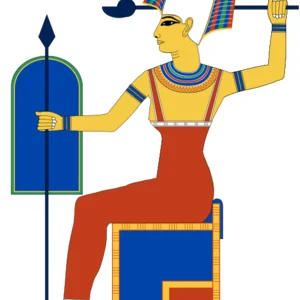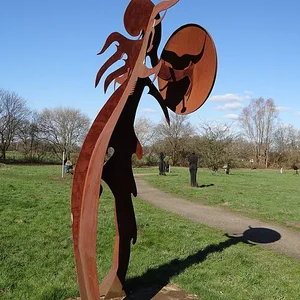

Baiame is the central creator deity of several Aboriginal peoples of southeastern Australia, notably the Kamilaroi and the Wiradjuri. Supreme being and sky father, he is considered the source of laws, initiation rites, and cosmic order.
Baiame
Baiame
10 min read
Frequently asked questions
Key Facts
- Baiame is venerated by the Kamilaroi, Wiradjuri, and Eora peoples of southeastern Australia
- He is associated with the 'Dreamtime' (Dreaming), the foundation of Aboriginal cosmology and law
- Rock art depictions of Baiame dating back several millennia have been found in New South Wales
- He is regarded as the creator of ceremonial laws and male initiation rites
- His cult is one of the clearest examples of monotheism — or a supreme figure — in the religions of Indigenous peoples
Works & Achievements
In the traditions of the Kamilaroi and Wiradjuri peoples, Baiame is the author of creation: he shaped the earth, plants, animals, and the first humans. This cosmogony does not belong to chronological time but to the Dreamtime, a foundational dimension that transcends ordinary time.
Baiame is the supreme lawgiver: he established the rules of marriage (the system of moieties and totemic sections), food taboos, and social obligations that organised the lives of the peoples of south-eastern Australia. These sacred laws (*lore*) are distinct from, yet complementary to, human-made laws.
Baiame is the origin of the *bora* male initiation rites, passed on through his son Daramulum. These ceremonies, which could last several weeks, transformed boys into men and initiated them into the sacred knowledge of the Dreaming.
According to oral traditions, Baiame taught humans the arts of hunting, fishing, and tool-making. He is thus both a cosmic creator and a cultural benefactor, passing on to humanity the knowledge needed to survive in the Australian country.
In certain accounts, the great rivers of south-eastern Australia (the Murray, Darling, and Murrumbidgee) were born from Baiame's movements across the primordial land. His footsteps and gestures are said to have carved out the valleys and riverbeds, binding the physical landscape to sacred memory.
A major artistic achievement of the peoples of south-eastern Australia, this large ochre painting depicting Baiame is the visual expression most directly associated with the deity and stands as a unique, irreplaceable testimony to this spiritual tradition.
Anecdotes
Baiame is depicted in the cave that bears his name, at Milbrodale (New South Wales), as an enormous rock art figure with outstretched arms adorned with emu feathers, estimated to be between 3,000 and 5,000 years old. This work, one of the largest rock paintings in eastern Australia, attests to the central role of Baiame in the cosmology of the southeastern peoples. It is still regarded as a sacred site by the descendants of the Wiradjuri and Kamilaroi.
According to the oral traditions of the Kamilaroi, Baiame once lived on Earth before ascending to the sky (Bullima). Before departing, he is said to have established the social laws and initiation rites known as bora, which he entrusted to his son Daramulum to pass on to men. These ceremonies included songs, dances, and the use of the bullroarer, a sacred instrument believed to reproduce the voice of Baiame, forbidden to women and the uninitiated.
The scar trees (dendroglyphs) surrounding the bora rings bore geometric patterns dedicated to Baiame. The ethnologist A.W. Howitt documented several examples in the 1880s, noting that initiates could not reveal their meaning to women and children on pain of severe sanctions pronounced in Baiame's name. Many of these trees were destroyed during colonization.
In the Dreaming story cycle, Baiame is said to have created the Murray-Darling river system by carving furrows into the earth during his primordial journeys. The rivers were thus seen as the traces of his founding actions — the landscape is a sacred text readable by the initiated, uniting real geography with mythological memory.
When the first Christian missionaries arrived in the 1820s–1840s, some noted striking resemblances between Baiame and the God of monotheistic religions: a single being, creator, lawgiver, and belief in an afterlife at Bullima. These parallels were sometimes exploited for missionary purposes, but later anthropologists emphasized the profound originality of Baiame, irreducible to Western theological categories.
Primary Sources
Baiame is regarded as the great supernatural being who, in the far past time, lived on the earth, and formed its inhabitants, and established their customs. He then went up to the sky, where he still remains.
Baiame made the laws of the borah, the great gathering of the tribes, when the young men are made into warriors. He sent Daramulum to teach the blacks the songs and dances of the borah.
Among the Kamilaroi, Baiame is the great spirit who dwells above the clouds. He is the maker of all things, the giver of life and the judge of the dead. His voice is heard in the bullroarer during the initiation rites.
The bora ground consists of two circles connected by a path. The larger circle is used for the preliminary ceremonies, and the smaller one for the more secret rites performed in the name of Baiame. The novices are warned that Baiame himself will punish any breach of the sacred laws.
Baiame, the All-Father of the Kamilaroi and Wiradjuri peoples, is conceived as an aged man of majestic appearance, seated in the sky with legs crossed beneath him, watching over the world he has created and the laws he has ordained.
Key Places
A sacred rock art site containing a representation of Baiame over 3 metres tall painted in red ochre, depicting the deity with outstretched arms adorned with feathers. It is one of the most significant Aboriginal art sites in eastern Australia, listed on the National Heritage register in 1984.
A sacred mountain considered by several traditions to be the place where Baiame stepped off to return to the sky after creating the world. Still revered as a place of pilgrimage and ceremony by the custodians of Dreaming traditions.
The traditional territory of the Kamilaroi (Gamilaraay), one of the peoples for whom Baiame is the supreme deity. The region, around Tamworth, Narrabri, and Walgett, is dotted with bora rings and Dreaming sacred sites documented as far back as the 19th century.
The largest linguistic territory in New South Wales, where Baiame is also the central creative figure. Bora ceremonies were held at numerous sites across the region, documented by ethnologists in the 19th century.
In the cosmology of the Kamilaroi and Wiradjuri, Bullima is the sky where Baiame has dwelt since leaving the Earth. Not a geographical location, it is also the paradise toward which the souls of the virtuous dead travel — the equivalent of a divine dwelling beyond the visible world.
A group of circular ceremonial grounds among the best-preserved associated with Baiame's initiation rites. Documented from the late 19th century by R.H. Mathews, they bear witness to the continuity and scale of ceremonial practices connected to this deity.
Typical Objects

An oblong piece of wood attached to a cord, spun to produce a deep, vibrating sound. This sacred object is said to be the voice of Baiame during bora initiation ceremonies; only initiated men were permitted to see and use it, under penalty of severe punishment.

Quartz crystals were associated with Baiame as symbols of his celestial power and primordial light. Shamans (clever men) used these stones during healing rituals, claiming to have received them directly from Baiame.

Trees whose bark was carved with geometric patterns and sacred symbols during bora ceremonies. These trees surrounded the ceremonial rings and served as markers of Baiame's sacred territory in the visible world.

Used to paint the bodies of initiates and decorate ritual objects during ceremonies dedicated to Baiame. Red ochre is associated with life and creative power; the rock paintings in Baiame's cave still bear traces of it today.

A ritual ornament depicted in the Baiame rock painting at Milbrodale, where the deity appears with protrusions resembling emu feathers on his arms. The emu is a totemic animal connected to creation myths in several south-eastern Australian traditions.

A ritual space consisting of two circles of packed earth connected by a path, dedicated to male initiation ceremonies in the name of Baiame. These spaces were carefully maintained and regarded as places of contact between the ordinary world and the Dreamtime.

A ceremonial and everyday garment of south-eastern Australian peoples, sometimes engraved with ritual motifs. According to some traditions, Baiame's laws governed the use of these cloaks, which varied according to the social status and degree of initiation of their wearer.
School Curriculum
Vocabulary & Tags
Key Vocabulary
Daily Life
Morning
At sunrise — perceived as Baiame's gaze resting upon the Earth — the Kamilaroi and Wiradjuri peoples began their day with ritual observances. Initiated men recited Dreaming songs (songlines) to maintain harmony between the visible world and the spirit world. Elders taught the young to read the signs of the land as messages from the Dreamtime.
Afternoon
Subsistence activities — hunting, fishing, and gathering — were carried out according to protocols codified by Baiame's laws. Each family group had its designated territories and resources, and the use of natural goods followed precise rules. During the preparatory periods leading up to bora ceremonies, adult men crafted ritual objects and prepared ceremonial sites.
Evening
In the evening, gathered around the fire, elders passed down Dreaming stories to younger generations. These narratives formed a living map of the land, social laws, and cosmology. Certain stories relating directly to Baiame were reserved for male initiates and could only be shared in the appropriate context.
Food
Food was organized according to Baiame's laws, which established dietary taboos based on clan totems. Kangaroos, emus, fish, reptiles, edible insects (witchetty grubs), seeds, and fruits were consumed according to the seasons. Certain animals were sacred to specific clans and could not be hunted or eaten by their members.
Clothing
In southeastern Australia, cloaks made of possum or kangaroo skin were worn during the cold seasons. During ceremonies dedicated to Baiame, the body was adorned with red and white ochre, emu feathers, and swan down glued to the skin with resin. These adornments temporarily transformed participants into Dreaming beings, inhabited by Baiame's power.
Housing
Dwellings varied with the seasons and the rhythms of nomadic movement: light shelters of branches, bark, and grasses that could be assembled quickly. During large ceremonial gatherings connected to Baiame, several clans came together at fixed sites. The bora rings themselves were regarded as Baiame's sacred dwelling places on Earth, and their upkeep was a collective responsibility.
Historical Timeline
Period Vocabulary
Liens externes & ressources
Références
Œuvres
La création du monde et des êtres vivants
Temps du Rêve (immémoriale)
Institution des lois sacrées et de l'ordre social (Lore)
Temps du Rêve (immémoriale)
Création des cérémonies bora et transmission aux hommes
Temps du Rêve (immémoriale)
Enseignement des techniques de subsistance
Temps du Rêve (immémoriale)
Création du système fluvial du Murray-Darling
Temps du Rêve (immémoriale)
Peinture rupestre de la grotte de Baiame (Milbrodale)
Estimée entre 3 000 et 5 000 ans avant notre ère