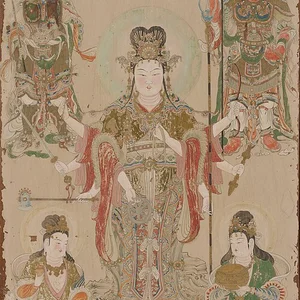

A Japanese goddess of Buddhist and Shinto tradition, Benzaiten is associated with music, the arts, wisdom, and water. Derived from the Hindu goddess Sarasvati, she was introduced to Japan through Buddhism around the 6th century. She is the only female figure among the Seven Gods of Fortune (Shichifukujin).
Benzaiten
Benzaiten
8 min read
Frequently asked questions
Key Facts
- Around the 6th century: introduction to Japan through Buddhist texts, notably the Golden Light Sutra (Suvarṇaprabhāsa)
- Derived from Sarasvati, the Hindu goddess of knowledge and the arts, transformed through Tantric Buddhism
- Depicted playing the biwa (Japanese lute), a symbol of her patronage of music
- Main shrines: Enoshima, Chikubushima, and Itsukushima — all three located on islands or near water
- Integrated into the Seven Gods of Fortune (Shichifukujin), a popular cult attested from the Muromachi period (14th–16th century)
Works & Achievements
The earliest pictorial representations of Benzaiten playing the biwa appear in illustrated scrolls and Buddhist paintings from the Heian period, establishing the iconographic conventions for the goddess that would endure for centuries.
A narrative text recounting the founding legend of the Enoshima shrine, which helped popularize the myth of Benzaiten and remains one of the most important texts in her devotional tradition.
Esoteric statues depicting Benzaiten with eight arms bearing various divine attributes. These works, preserved in temples such as the one at Enoshima, express the complexity and power of the goddess within the Japanese Tantric tradition.
Popular illustrated scrolls depicting the Shichifukujin, including Benzaiten, widely circulated during the Muromachi period. These works firmly embedded in Japanese popular culture the image of the goddess alongside the six other deities of good fortune.
A body of liturgies, songs, and ritual dances preserved at the Chikubushima shrine on Lake Biwa, representing the oldest musical tradition directly linked to the worship of Benzaiten and recognized as an intangible cultural heritage.
Anecdotes
According to a legend from Enoshima Temple, the thunder god Fujin was ravaging the region with a five-headed dragon. Benzaiten descended from the sky on a luminous cloud and managed to tame the dragon by offering it Buddhist teachings, thus transforming a destructive being into a guardian of the sacred site.
Benzaiten is the only woman among the Seven Gods of Fortune (Shichifukujin). This distinction is remarkable in a largely male pantheon: she represents beauty, music, and eloquence, a reminder that the arts and wisdom were considered precious gifts on a par with wealth or longevity.
The biwa, a four-stringed lute inherited from China, is Benzaiten's iconic attribute. Court musicians during the Heian period would offer prayers to her before their performances, convinced that her benevolence could help them achieve musical perfection. Some temples still preserve votive biwa offered by artists.
In medieval Japan, Benzaiten was also invoked to protect the country from natural disasters, particularly floods and earthquakes. Her connection to water — rivers, lakes, and seas — made her a protector of coastlines and ports, and many shrines were dedicated to her on islands or by the water's edge.
Primary Sources
A collection of Buddhist tales compiled by the monk Kyōkai, mentioning divine manifestations linked to syncretic deities introduced from the continent, including the earliest traces of the cult of Benzaiten in Japan.
The founding text of the Enoshima shrine, recounting the legend of Benzaiten's descent onto the island, her union with the dragon, and the establishment of her cult at this site. This text is preserved at the Iwaya shrine on Enoshima.
Texts from the Muromachi period describing the attributes, iconographic representations, and rituals associated with each of the Seven Gods of Fortune, including Benzaiten with her biwa and her eight arms in esoteric depictions.
Oral traditions and liturgical chants passed down at the Chikubushima shrine on Lake Biwa — one of the three great sites of Benzaiten worship in Japan — attesting to an unbroken ritual continuity since the Heian period.
Key Places
One of the three great shrines dedicated to Benzaiten in Japan, founded according to legend after she descended onto the island to tame a dragon. A major pilgrimage site since the medieval period.
A sacred site on an island in Japan's largest lake, whose very name (Biwa) evokes the goddess's instrument. A major center of devotion to Benzaiten since the Heian period, accessible only by boat.
Famous for its torii gate appearing to float on the sea, this shrine dedicated to female deities is associated with Benzaiten in the syncretic tradition. Its aquatic setting makes it a perfect symbol of the goddess's connection to water.
An important Buddhist temple from the Kamakura period housing representations of Benzaiten, bearing witness to the goddess's integration into popular devotion in medieval Japan.
The great shrine of the Kamakura shogunate capital, where the syncretic worship of the gods of good fortune — including Benzaiten — was woven into the religious practice of the medieval warrior elite.
Typical Objects
A four-stringed lute of Indian and Chinese origin, the biwa is Benzaiten's iconic attribute. She is almost always depicted playing it, symbolizing her mastery over the arts, music, and universal harmony.

A sacred animal associated with Benzaiten, often depicted coiled around her arm or as the guardian of her shrines. The white serpent symbolizes wisdom, transformation, and the protection of aquatic places.

A Shinto ritual gate erected at the entrance of shrines dedicated to Benzaiten, often built at the water's edge or on islands. It marks the passage between the mundane world and the sacred space of the goddess.

In her eight-armed representations, Benzaiten holds this Buddhist jewel symbolizing the fulfillment of desires and spiritual abundance. It serves as a reminder of her origins in the esoteric Buddhist tradition.

In the martial and protective iconography of the eight-armed Benzaiten, she is sometimes depicted holding a sword and bow, emphasizing her role as a protector against evil forces and disasters.

A symbolic flower of Buddhism, often present in depictions of Benzaiten. The lotus growing in water connects the goddess to her favored natural element while evoking spiritual purity.
School Curriculum
Vocabulary & Tags
Key Vocabulary
Tags
Daily Life
Morning
In the sanctuaries dedicated to her, the morning ritual begins before dawn with the purification (misogi) of priests in the cold water of the lake or sea. Offerings of rice, salt, and sake are placed before the goddess's statue at sunrise, accompanied by chanted prayers.
Afternoon
The afternoon is devoted to musical ceremonies in honor of Benzaiten — court musicians playing the biwa and other stringed instruments to attract her favor. Pilgrims who have traveled from afar cross the water by boat to reach the sacred island and present their wishes to her.
Evening
At dusk, priests light floating lanterns on the water as luminous offerings to the goddess. Accounts of her legends are passed down orally to the faithful, keeping alive the memory of her miraculous interventions and nurturing popular devotion across generations.
Food
Food offerings to Benzaiten include white rice, rice cakes (mochi), fish, and seafood in keeping with her aquatic domain. Shrines located on lakes or by the sea also receive offerings of fresh fish caught by local fishermen as thanks for her protection.
Clothing
Benzaiten is depicted in aristocratic Heian-style court dress: multi-layered silk kimono (jūnihitoe) in shades of white, red, and gold, with wide flowing sleeves. In her esoteric eight-armed representations, she wears Buddhist ornaments and a golden crown adorned with jewels.
Housing
Benzaiten's shrines are almost always built on islands, beside lakes, or by the sea, reflecting her fundamental connection to water. The architecture blends Shinto and Buddhist styles: red lacquer torii gates, a main hall of lacquered wood surrounded by pines and camellias, accessible by a wooden bridge or by boat.
Historical Timeline
Period Vocabulary
Visual Style
Style iconographique des rouleaux enluminés japonais (emaki) et de la sculpture bouddhiste des périodes Heian et Kamakura, avec laques de vermillon, or et ivoire.
Sound Ambience
Une atmosphère de sérénité sacrée mêlant les sons du biwa, des eaux japonaises et des rituels shintō-bouddhistes dans un cadre insulaire et naturel.