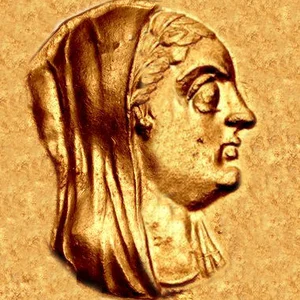

Macedonian queen who became the wife of Ptolemy I, founder of the Lagid dynasty in Egypt. Mother of Ptolemy II Philadelphus, she was deified after her death and played a foundational role in establishing the dynastic legitimacy of the Ptolemies.
Berenice I(339 av. J.-C. — ?)
Berenice I
royaume ptolémaïque
7 min read
Frequently asked questions
Key Facts
- Born around 340 BC in Macedonia, of noble origin
- Wife of Ptolemy I Soter, founder of the Lagid dynasty, around 317 BC
- Elevated to the rank of queen and co-ruler of Egypt
- Mother of Ptolemy II Philadelphus, who succeeded around 283 BC
- Deified after her death (around 279 BC); a city in Egypt bears her name
Works & Achievements
By supplanting Eurydice as Ptolemy I's favored wife and securing the designation of her son Ptolemy II as heir, Berenice ensured the continuity of a dynastic line that ruled Egypt for three centuries.
Her deification after death, associated with Aphrodite, laid the groundwork for the Lagid dynastic cult. This model was later systematized by Ptolemy II, who had his parents venerated as the kingdom's divine protectors.
As queen of Alexandria during the founding or expansion of the Library, Berenice contributed to the rise of the most important intellectual center of the ancient world, which attracted scholars, poets, and philosophers from across the globe.
Though composed after her death, this poetic tribute commissioned by Ptolemy II celebrates Berenice as a near-divine figure. It reflects the importance of her image in Lagid royal propaganda.
Anecdotes
Bérénice was originally a lady-in-waiting to Eurydice, the legitimate wife of Ptolemy I. Her beauty and intelligence so captivated the king that she became his favorite, and then his new wife. This unexpected rise would go on to change the course of the Egyptian dynasty.
Ptolemy I loved Bérénice so deeply that he decided to entrust the throne to their son Ptolemy II, rather than to Eurydice's elder sons. This choice sparked intense rivalries at the court of Alexandria, with several of Ptolemy II's half-brothers ending up exiled or eliminated.
After her death, Bérénice was deified and associated with the goddess Aphrodite, receiving an official cult throughout the kingdom. This deification was not purely religious: it bolstered the prestige and divine legitimacy of the entire Lagid dynasty, presenting the Ptolemies as descendants of the gods.
The poet Theocritus composed celebrated verses in her honor in his Idyll XVII, describing her as a woman of incomparable virtue and beauty. This kind of poetic commission illustrates how the court of Alexandria used the arts to glorify the royal family.
Bérénice held the title of basilissa — queen — at the very moment Ptolemy took the title of basileus — king — in 305 BC. This founding couple embodied the transition from a mere satrapy of Alexander's empire to an independent kingdom projecting its influence across the eastern Mediterranean.
Primary Sources
Berenice, most illustrious of women, gentle to her parents, whose heart full of tenderness was devoted to her husband. No woman ever loved her husband more.
Ptolemy, son of Lagos, seized Egypt. He took as his second wife Berenice, daughter of Magas, and from her was born Ptolemy surnamed Philadelphus.
To Queen Berenice, beneficent goddess, wife of Ptolemy the Savior king, the city pays homage and dedicates this sanctuary to her.
The glory of Berenice, mother of the benevolent king, shall shine among the stars like the very light of Aphrodite herself.
Key Places
Capital of the Ptolemaic kingdom, founded by Alexander in 331 BC. Berenice lived there as queen and died there; it was in Alexandria that her divine cult was established within the royal palace.
Capital of the kingdom of Macedonia and likely birthplace of Berenice. It was in this Macedonian aristocratic milieu that she grew up before joining the Ptolemaic court.
Ancient religious capital of pharaonic Egypt, where the Ptolemies maintained strong ties with Egyptian priests. Berenice was likely honored there as part of the dynastic cult.
Island off the coast of Alexandria where the famous lighthouse was built, one of the Seven Wonders of the Ancient World. This monumental construction project began during the reign of Ptolemy I and Berenice, symbolizing the new dynasty's ambition to shine across the Mediterranean.
Typical Objects

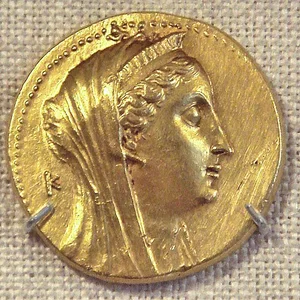
A gold headband worn by Hellenistic queens as a symbol of power. Berenice was among the first Ptolemaic queens to be depicted with this symbol, visible on coins struck in her likeness.

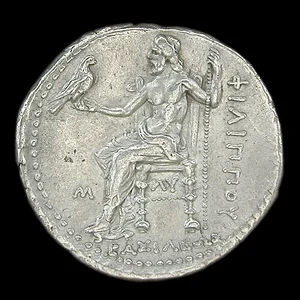
Gold and silver coins depicting Berenice were minted after her death and deification. These coins circulated throughout the kingdom and helped spread her divine image.

The court of Alexandria was the intellectual center of the Hellenistic world. Berenice moved through a palace where poets, philosophers, and scholars exchanged texts, forming one of the greatest centers of knowledge in the ancient world.

A ritual container used during religious ceremonies to pour liquid offerings to the gods. As a deified queen, Berenice herself was honored with this type of offering in sanctuaries.

A hybrid sculpture combining the body of an Egyptian sphinx with Greek facial features, symbolizing the cultural syncretism of the Ptolemaic court. These statues adorned the palaces and temples of Alexandria where Berenice lived.

Aristocratic grooming objects, often richly decorated, found in the tombs of upper-class Macedonian and Hellenistic women. They reflect the importance placed on personal appearance in the royal courts of that era.
School Curriculum
Vocabulary & Tags
Key Vocabulary
Tags
Daily Life
Morning
Berenice rose at sunrise in the royal apartments of the palace of Alexandria. Her day began with ritual ablutions attended by her handmaidens, followed by offerings to the gods — both Greek (Aphrodite, Zeus) and Egyptian (Isis, Hathor) in keeping with Ptolemaic syncretism. She then received reports from the palace steward and planned the day's audiences.
Afternoon
The afternoon was devoted to court affairs: receiving ambassadors, supporting the poets and scholars of the royal circle, and overseeing the education of her children. Berenice took part in political discussions with Ptolemy I, playing an active role in dynastic decisions — particularly those concerning the succession.
Evening
Evenings were spent at banquets (symposia) attended by philosophers, poets, and generals. Verses were recited, philosophical debates were held, and affairs of the kingdom were discussed. After nightfall, musicians played the kithara and aulos, blending Macedonian traditions with the refined tastes of the East.
Food
The Ptolemaic court enjoyed an abundant and varied table: fine wheat bread, fish from the Nile and the Mediterranean, roasted meats (lamb, poultry), vegetables, and fruits (figs, pomegranates, grapes). Greek wine mixed with water and olive oil were standard fare, along with spices imported from the East. Royal banquets featured exotic delicacies brought by merchants through the port of Alexandria.
Clothing
Berenice wore the Greek chiton in fine linen or silk, draped in the Macedonian fashion and adorned with purple embroidery reserved for the royal family. She wore a gold diadem, the emblem of Hellenistic royalty, along with jewelry combining Greek goldsmithing with Egyptian-inspired pectorals. Her ceremonial garments incorporated lotus and papyrus motifs — Egyptian symbols of power.
Housing
She resided in the great Royal Palace of Alexandria, a vast architectural complex on the tip of Cape Lochias, overlooking the Mediterranean. The palace blended Greek architecture (Doric and Ionic columns, peristyle gardens) with Egyptian décor (obelisks, sphinxes, hieroglyph-painted frescoes). The royal apartments were adorned with mosaics, embroidered linen hangings, and fine wooden furniture inlaid with ivory.
Historical Timeline
Period Vocabulary
Visual Style
Style helléno-égyptien de la cour ptolémaïque naissante : portraits naturalistes d'inspiration grecque, riches matières luxueuses (or, lin, lapis-lazuli) et architecture mariant colonnade grecque et hiéroglyphes égyptiens.
Sound Ambience
Ambiance sonore du palais royal d'Alexandrie au tournant du IIIe siècle av. J.-C. : le brouhaha cosmopolite du port, les chants religieux mêlant traditions grecques et égyptiennes, et la vie culturelle intense d'une cour qui se voulait le centre du monde.
Liens externes & ressources
Références
Œuvres
Fondation de la lignée lagide
Vers 317-283 av. J.-C.
Institution du culte dynastique ptolémaïque
Vers 279 av. J.-C.
Patronage de la Bibliothèque d'Alexandrie
Vers 295 av. J.-C.
Éloge poétique de Théocrite (Idylle XVII)
Vers 270 av. J.-C.