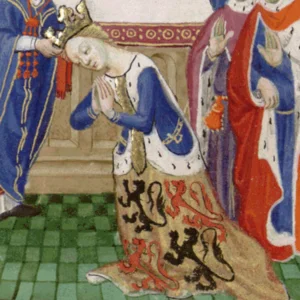

Daughter of Duke Conrad of Burgundy, Berthe was first Countess of Blois through her marriage to Odo I. After becoming a widow, she married King Robert II the Pious around 997, but this union, deemed incestuous by the Church due to their close kinship, was condemned by the pope and annulled around 1001.
Frequently asked questions
Key Facts
- Born around 964, daughter of Conrad of Burgundy and Mathilde of France
- First marriage around 985 to Odo I of Blois, through whom she became Countess of Blois and Chartres
- After the death of Odo I (996), she married King Robert II the Pious, her fourth-degree cousin
- Pope Gregory V excommunicated Robert II in 998 over this consanguineous marriage and ordered its dissolution
- The marriage was annulled around 1001 under papal pressure; Robert II subsequently married Constance of Arles
Works & Achievements
Her marriage to Odo I of Blois sealed an alliance between two of the most powerful forces in northern France. This union temporarily helped balance power between the County of Blois and the fledgling Capetian monarchy by consolidating peace among rival lords.
Her marriage to Robert II symbolically reinforced the ties between Burgundy and the French crown. This dynastic alliance aimed to consolidate Capetian authority over the kingdom's great lords, even though it was cut short by papal condemnation.
Like every great noblewoman of her era, Berthe contributed to religious foundations and pious donations across the royal domains and her former County of Blois — a common practice for securing the salvation of one's soul and asserting one's rank.
Anecdotes
Berthe de Bourgogne was the daughter of Conrad I of Burgundy, one of the most powerful kingdoms in Europe at the time. This rank made her a highly sought-after match, which explains her first marriage to Odo I, Count of Blois, one of the most powerful and turbulent vassals of the young Capetian kingdom. By marrying this great lord, Berthe embodied the fragile alliance between two rival powers in northern France.
When she married King Robert II the Pious around 996–997, just a few months after the death of Odo I, the Catholic Church triggered an unprecedented crisis: the two spouses were fourth-degree cousins, which was forbidden under the canon law of the time. Pope Gregory V convened a synod at Pavia in 997 and threatened Robert II with excommunication if he refused to repudiate Berthe.
Despite his reputation as a deeply pious king — Robert II attended services several times a day and sang the psalms himself — he refused for several years to comply with the papal injunction. His attachment to Berthe earned him excommunication, a terrifying sanction for a Christian ruler: it deprived him of the sacraments and could release his subjects from their oath of loyalty, threatening the very order of the kingdom.
The condemnation of this marriage illustrates the ongoing power struggle between the papacy and Christian kings at the turn of the millennium. The Church sought to control noble unions in order to prevent the concentration of land and power, while rulers used marriage as a diplomatic tool. The case of Berthe and Robert II became a powerful symbol of the nascent Gregorian Reform that would go on to reshape medieval Europe.
After the annulment of the marriage around 1001, Berthe almost entirely disappears from medieval chronicles. She died around 1010, never having recovered a rank equivalent to that of Queen of France. Her trajectory — from Countess of Blois to Queen of France to repudiated wife — illustrates how completely the fate of noblewomen depended on political alliances and Church decisions, with their own wishes never once consulted.
Primary Sources
Pope Gregory V and the bishops assembled at Pavia condemn the union of Robert, king of the Franks, with Bertha, on the grounds of a kinship prohibited by canon law, and order the separation of the spouses under pain of excommunication.
Robert, the most Christian king, was bound to Bertha by ties of blood according to canonical computation, and the Church demanded that he separate from her, which he did reluctantly after many years of resistance to papal injunctions.
King Robert took as his wife Bertha, widow of Count Odo of Blois, but the bishops and the pope ordered him to repudiate her on grounds of consanguinity, and he was ultimately compelled to obey.
We enjoin Robert, king of the Franks, to comply with the decrees of our predecessors concerning his unlawful union, so as not to draw upon his kingdom and his person the divine wrath and the sanctions of the Church.
Key Places
The region from which Berthe came, as daughter of Conrad I of Burgundy. It was within this context of high Burgundian nobility that she received the education of a princess destined for great dynastic alliances.
Capital of the County of Blois, where Berthe resided as countess alongside Odo I. This powerful county, which vied with the Capetians for regional dominance, was the first major political stage of her life.
The main residence of the Capetian kings, where Berthe lived as queen of France. It was here that tensions played out between the royal court and the papal legates who came to demand the separation of the spouses.
The Italian city where Pope Gregory V convened the Synod of 997, which officially condemned the marriage of Berthe and Robert II. This conciliar decision definitively sealed Berthe's fate.
An important Capetian royal city and episcopal seat, and a regular residence of Robert II and Berthe. It was here that tensions with the bishops of the kingdom manifested themselves most concretely.
Typical Objects

Great noblewomen used a personal seal to authenticate their charters and donations. As Countess of Blois and later Queen of France, Berthe had a seal bearing her likeness to officially validate her documents and decisions.

A book of psalms richly decorated with miniatures and gilded ornaments, the psalter was the devotional object par excellence of the Capetian monarchs. Robert II the Pious was renowned for his intense piety, and Berthe almost certainly shared this daily religious practice in the royal chapel.

As Queen of France, Berthe wore a crown at official ceremonies, a symbol of her royal legitimacy. A veil covered her hair during religious services, marking both her secular rank and her Christian devotion.

Great noblewomen frequently gave lands or revenues to monasteries for the salvation of their souls and those of their deceased loved ones. As countess and later queen, Berthe would have validated such acts of charity toward abbeys in Blois or Touraine.

A long, fitted garment, the *bliaut* was the fashionable aristocratic dress of the era, made from silk imported from Byzantium for important occasions. As Queen of France, Berthe would certainly have worn versions embroidered with gold thread and gemstones at court celebrations.

The Capetian monarchs carefully collected the relics of saints as pledges of divine protection. In the circle of the deeply devout Robert II the Pious, Berthe would have had access to precious reliquaries — sacred objects as much as symbols of royal prestige.
School Curriculum
Vocabulary & Tags
Key Vocabulary
Daily Life
Morning
Berthe rose at dawn to attend matins, the morning religious service, alongside Robert II the Pious, renowned for his extreme devotion that led him to pray for several hours each day. She joined in the prayers in the royal chapel before receiving her ladies-in-waiting for her toilette and dressing, a solemn ritual that could last an hour and required the assistance of several handmaidens.
Afternoon
Afternoons were devoted to audiences, receiving vassals and emissaries, or overseeing the embroidery workshops that operated within the palace precincts. Berthe also managed the day-to-day affairs of her lands in coordination with her stewards — particularly the revenues she had inherited from her widowhood in the County of Blois, and the donations to the monasteries under her protection.
Evening
In the evening, after vespers and compline, the court gathered for the main meal, served with great ceremony and accompanied by music or tales from jongleurs. As queen, Berthe co-presided alongside Robert II at these dinners where political alliances were forged and the affairs of the kingdom discussed beneath tapestried walls, by the light of torches and candles.
Food
The Capetian royal table offered venison, freshwater fish, roasted poultry, and white wheaten bread — luxury goods reserved for the nobility. On fast days — numerous in the household of the deeply pious Robert II — meat was replaced by fish and vegetables, in keeping with the strict monastic rules the king imposed on himself and those around him.
Clothing
As Queen of France, Berthe wore long tunics of silk imported from Byzantium or the East, covered for official ceremonies by a fine wool cloak trimmed with precious fur. Her hair was concealed beneath a veil or a richly embroidered headband of gold thread and colored silks, a visible mark of her royal rank and Christian respectability.
Housing
Berthe lived in the Capetian royal palaces, the chief of which occupied the Île de la Cité in Paris, with its towers, great halls, and chapel. These stone residences, still barely distinguishable from the great aristocratic houses of the day, lacked effective heating: warmth came from the central fireplaces in the great halls, and one slept in beds heaped with thick furs, surrounded by draperies to keep out the cold.
Historical Timeline
Period Vocabulary
Liens externes & ressources
Références
Œuvres
Alliance politique Blois-Capétiens (premier mariage)
vers 985
Union royale franco-bourguignonne (mariage avec Robert II)
996-997
Actes de donation pieuse en Touraine et Blésois
vers 996-1001