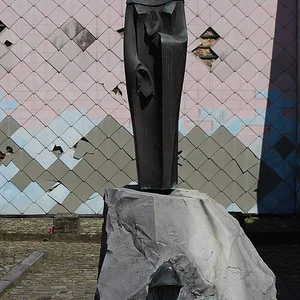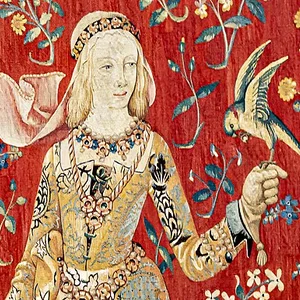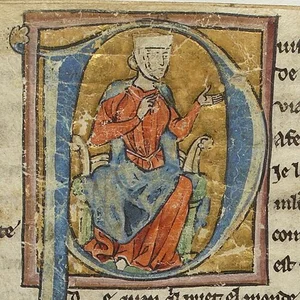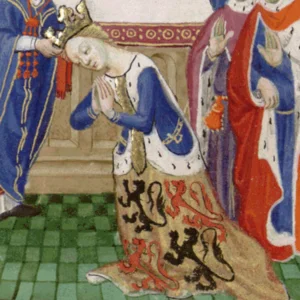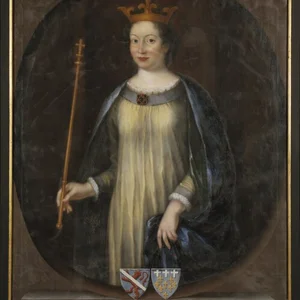

Princess of Namur (c. 1320–1363), she married Magnus IV of Sweden in 1335 and became Queen of Sweden and Norway. Mother of Eric XII of Sweden and Haakon VI of Norway, she played a role of dynastic representation in medieval Northern Europe.
Blanche de Namur(1320 — 1363)
Blanche de Namur
Norvège, Suède
8 min read
Frequently asked questions
Key Facts
- Born c. 1320, daughter of John I, Count of Namur
- Married Magnus IV of Sweden in 1335, becoming Queen of Sweden and Norway
- Mother of Eric XII of Sweden and Haakon VI of Norway (future husband of Margaret I of Denmark)
- Her marriage illustrates the network of alliances between the nobility of the Low Countries and the Scandinavian crowns
- Died c. 1363
Works & Achievements
Blanche's marriage to Magnus IV was in itself a major political act, uniting the County of Namur with the crowns of Sweden and Norway and drawing Scandinavia into the diplomatic networks of Franco-Flemish Europe. This alliance made a lasting contribution to the cultural opening of the Nordic courts toward the West.
Blanche secured dynastic continuity by giving birth to Eric (the future Eric XII of Sweden, around 1336) and Haakon (the future Haakon VI of Norway, around 1340). Through her sons, she became the direct ancestor of the royal line that would govern Scandinavia for several generations and pave the way for the Kalmar Union.
Like all medieval queens, Blanche played a patronage role toward ecclesiastical institutions, granting donations to monasteries and churches across Sweden and Norway. These acts of piety, recorded in diplomatic archives, reinforced the crown's spiritual legitimacy in the eyes of the clergy and the people.
During the revolt of her son Eric XII against his father Magnus IV, Blanche found herself at the heart of a painful family and political crisis. Her role as mediator between the two factions illustrates the function traditionally assigned to medieval queens: arbitrating conflicts within the royal household in order to preserve the unity of the kingdom.
Anecdotes
At around 15, Blanche de Namur left her native Belgium to marry Magnus IV of Sweden in 1335, becoming queen of two Scandinavian kingdoms. This journey from the Flemish plains to the fjords of the North perfectly illustrates how, in the Middle Ages, matrimonial alliances were the primary diplomatic tool of ruling families.
Blanche brought with her the refined culture of the Franco-Flemish courts to the Swedish royal court, helping to introduce Western European fashions, culinary habits, and literary practices into a Nordic environment. The knights and ladies-in-waiting who accompanied her formed a lasting cultural bridge between Namur and Stockholm.
Blanche was mother to two kings: Eric XII, who became king of Sweden in 1356, and Haakon VI, who reigned over Norway. Tragically, she witnessed her two sons turn against each other in a wrenching dynastic conflict — Eric XII rebelled against his own father Magnus IV to seize the Swedish throne.
The Black Death (1349–1350) devastated Scandinavia with particular brutality, killing up to a third of the population. Blanche, like most rulers of the time, had to confront an unprecedented health crisis that struck nobles and peasants alike, undermining the social order and the stability of kingdoms.
In 1360, Danish king Valdemar IV reconquered Scania, a province Magnus IV had bought back from Denmark thirty years earlier, inflicting a major humiliation on the crown. Blanche thus witnessed the gradual decline of her husband's power, surrounded by increasingly hostile Swedish lords, until her death in 1363.
Primary Sources
Royal charters mentioning Queen Blanche among the witnesses or beneficiaries of religious donations and confirmations of privileges, attesting to her active presence at the court of Magnus IV.
The fourteenth-century Swedish chronicles record the marriage of Magnus IV to Blanche of Namur and the birth of princes Eric and Haakon, underlining the importance of this dynastic alliance for the consolidation of Scandinavian royal power.
Official acts mentioning Blanche as Queen of Norway and mother of the future Haakon VI, in the context of donations to ecclesiastical institutions and the management of the kingdom's day-to-day affairs.
Diplomatic correspondence exchanged between the Swedish crown and European powers, in which Blanche is mentioned in her capacity as queen consort during negotiations concerning the kingdom's dynastic and commercial alliances.
Key Places
Blanche's birthplace and capital of the County of Namur, situated at the confluence of the Meuse and Sambre rivers. It was here that she was born around 1320 and received the education of a Franco-Flemish princess before leaving her homeland to join Scandinavia.
Capital of the Kingdom of Sweden, where Blanche settled after her marriage in 1335. Stockholm's royal castle was the primary residence of the royal couple and the administrative centre of Scandinavian power.
The leading port and royal city of Norway in the Middle Ages, Bergen was one of the court's residences when Blanche and Magnus IV were exercising their duties as Norwegian sovereigns. The city was also a major hub of Baltic Hanseatic trade.
A strategically fortified town in southern Sweden, Kalmar was one of the important stopping points of the Swedish royal court. Its imposing medieval castle served as a royal residence and a control point for trade on the Baltic Sea.
A royal fortress built in 1308 at the mouth of the Göta River, Bohus Castle was one of the Crown's principal strongholds on the border between Sweden and Norway. Blanche likely stayed there during the royal court's travels.
Typical Objects

As queen, Blanche had her own wax seal, engraved with her personal coat of arms, which she affixed to official documents to authenticate them. This seal embodied her legal and dynastic authority, distinct from that of her husband the king.

An illuminated manuscript containing the liturgical prayers of the day, the book of hours was the most prized devotional object a medieval queen could own. Raised in the Franco-Flemish tradition, Blanche likely possessed such a work, richly illustrated by Flemish illuminators.

The insignia of power worn during official ceremonies and coronations, the crown symbolized Blanche's dynastic legitimacy as queen of Sweden and Norway. Its form and ornamentation reflected the goldsmithing standards of medieval Northern Europe.

Blanche brought with her from Namur a taste for Flemish cloth, renowned throughout medieval Europe for its exceptional quality. These precious fabrics, worn by the queen and her ladies-in-waiting, helped spread Franco-Flemish fashion at the Swedish court.

Objects of daily devotion worn by medieval queens, these items attest to the central place of Catholic faith in Blanche's life. Religion structured her days between the canonical hours, daily masses, and support for ecclesiastical institutions.

Official sealed documents through which medieval sovereigns forged alliances and recognized their representatives, these letters were the primary instrument of diplomacy of the era. Blanche's own marriage was preceded and formalized by exactly such exchanges between Namur and Stockholm.
School Curriculum
Vocabulary & Tags
Key Vocabulary
Daily Life
Morning
Blanche began her day with the liturgical prayers of Matins and Lauds, in keeping with the rules of the Catholic Church. Attended by her ladies-in-waiting, she dressed in her private castle apartments before joining the royal chapel for daily Mass — the central moment of spiritual and social life at the Scandinavian court.
Afternoon
The afternoon was devoted to audiences, to receiving nobles, ambassadors, and ecclesiastical dignitaries, and to overseeing the affairs of the royal household. Blanche accepted petitions and requests, took part in councils when the kingdom's business required it, and occupied herself with embroidery, reading illuminated manuscripts, or chamber music.
Evening
Evenings gathered the court around elaborate banquets, punctuated by readings aloud, music, and sometimes performances by jugglers or minstrels. As queen, Blanche presided over these gatherings alongside Magnus IV, embodying the magnificence and prestige of the Scandinavian crown before the assembled lords and ambassadors.
Food
The Swedish royal table combined Nordic traditions — dried or smoked fish, game, rye bread, ale, and mead — with the culinary refinements that Blanche may have brought from Namur. Imported spices (cinnamon, ginger, pepper, saffron) were especially prized by the aristocracy, while the many fast days prescribed by the Church reduced the menu to preparations based on fish and legumes.
Clothing
Blanche wore long gowns with fitted sleeves, made from rich wool or silk cloth depending on the importance of the occasion. Her headdress, in keeping with Franco-Flemish fashion, covered the hair entirely. Precious furs (ermine, vair) trimmed her ceremonial mantles and signalled her royal rank, while her jewellery — brooches, an ornate belt, a signet ring — completed an ensemble designed to assert the majesty of the crown.
Housing
Blanche resided chiefly in the Swedish and Norwegian royal castles, including Stockholm and Kalmar — medieval fortresses combining military defence with courtly residence. Her apartments comprised a private bedchamber, a reception room, and an adjoining chapel. The rooms were hung with tapestries to keep out the Nordic cold and heated by large fireplaces, creating a space considerably more comfortable than ordinary dwellings.
Historical Timeline
Period Vocabulary
Liens externes & ressources
Références
Œuvres
Alliance dynastique Namur-Scandinavie
1335
Transmission dynastique : naissance des héritiers royaux
1336-1340
Mécénat religieux et donations aux monastères
1335-1363
Rôle de médiatrice lors de la crise dynastique (1356-1359)
1356-1359