
Brahmā is the creator god in Hinduism, forming with Vishnu and Shiva the Trimūrti, the divine trinity of Hinduism. He is the master of the Vedas and cosmic knowledge, responsible for the creation of the universe and all living beings.
Brahma
Brahmā
8 min read
Frequently asked questions
Key Facts
- Brahmā is one of the oldest deities in the Vedic tradition, mentioned in Sanskrit texts dating back to around 1500 BCE.
- Together with Vishnu (the preserver) and Shiva (the destroyer), he forms the Trimūrti, the fundamental trinity of Hinduism.
- According to Hindu mythology, Brahmā creates the universe from a lotus flower that rises from Vishnu's navel.
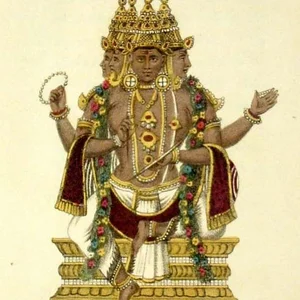
- He is depicted with four heads symbolizing the four Vedas (Rigveda, Sāmaveda, Yajurveda, Atharvaveda).
- Although the supreme creator god, Brahmā is paradoxically almost unworshipped today: virtually no temples dedicated to him remain in India.
Works & Achievements
The founding act by which Brahmā shaped the universe out of primordial chaos. He created gods, humans, demons, animals, celestial bodies, time, and the cosmic laws (dharma) that govern all existence.
Brahmā is the source and guardian of the four Vedas, the eternal cosmic knowledge he transmitted to the seven great sages (saptarishi) at the beginning of each world age. Each of his four mouths recites one of the Vedas.
Brahmā created Manu Svayambhuva, the first human being and mythic lawgiver, from his own self. Manu is the ancestor of all humanity and received from Brahmā the laws of dharma recorded in the Manusmriti.
The first of the eighteen great Purānas, this text sets out the cosmology and cosmogony associated with Brahmā. It is the principal narrative source on his acts of creation and his place in the Hindu pantheon.
To populate the three worlds, Brahmā created the ten Prajāpatis — including Marīchi, Atri, Daksha, and Kashyapa — who became the fathers of all living beings: gods, humans, demons, and animals.
Anecdotes
Brahmā originally had five heads, which allowed him to see in all directions and recite the four Vedas simultaneously. According to the Shiva Purāna, he lost his fifth head when he spoke arrogant words before Shiva, who severed it with a single gesture. This is why Brahmā is now depicted with only four faces, one for each cardinal direction.
Despite his role as creator of the universe, Brahmā is the least venerated god of the Trimūrti: there are barely two major temples dedicated to him in India, including the famous Pushkar temple in Rajasthan. According to a Purānic legend, the goddess Sarasvatī cursed him because he committed a ritual error during a sacrifice, condemning him to be almost no longer worshipped by mortals.
According to Purānic texts, Brahmā was born from a golden lotus that emerged from the navel of Vishnu, reclining on the primordial cosmic ocean. Opening his eyes for the first time in the darkness of non-being, he first created the waters, deposited a cosmic seed in them from which the golden egg (Hiranyagarbha) was born, and from this egg the entire universe burst forth.
In the Mahābhārata, Brahmā plays the role of supreme arbiter summoned by the gods during cosmic crises. He intervenes notably at the birth of Skanda, the god of war, to restore order after the chaos caused by the birth of Shiva's son.
Brahmā's vehicle (vāhana) is the hamsa, a sacred swan or goose, symbol of spiritual discernment. According to Hindu tradition, the hamsa can separate milk from water when mixed, just as the sage discerns the ātman (the immortal soul) from the illusory world — a symbol of the knowledge of which Brahmā is the guardian.
Primary Sources
"Who was the primordial germ that the waters bore, in whom all the gods were gathered? He rose upon the waters, bearing life within himself. To him alone, Prajāpati, we offer our homage."
"In the beginning, Prajāpati was alone. He desired: 'May I multiply, may I propagate myself.' He practiced austerity, and from his austerity the waters were born."
"This world was darkness, imperceptible, without distinguishing mark… Then the Lord himself (Svayambhū) appeared, dispelling the darkness. He created the waters and deposited his seed within them, which became an egg brilliant as the sun."
"Brahmā, the grandfather of all beings, seated upon his lotus, gazed upon the primordial darkness and uttered the Vedas, which illuminated the three worlds."
"Brahmā first created water, then deposited his seed within it. From that golden egg Brahmā himself was born — the Ātmabhū, the Self-Born — who divided the egg into sky and earth, and between the two placed space."
Key Places
The supreme celestial realm and abode of Brahmā at the apex of the cosmic universe according to the Purānas. It is the highest of the fourteen planes of existence, beyond which lies only the absolute and unconditioned Brahman.
Founded according to legend on the spot where Brahmā dropped a lotus flower while searching for a place of sacrifice, this temple is the most famous dedicated to the creator god. The city of Pushkar is a major pilgrimage site of Hinduism.
A mythical cosmic mountain regarded as the axis of the world in Hindu and Buddhist cosmology. According to some traditions, Brahmā resides at its summit, surrounded by the celestial cities of the gods.
A holy city on the banks of the Ganges, regarded as the navel of the world in the Hindu tradition. Associated with the original act of creation, it is the place where all the gods are present and where Brahmā is said to have laid the first cornerstone of cosmic order.
Typical Objects

A wooden or clay vessel containing the sacred waters of creation. Brahmā holds it in one of his hands as a symbol of the source of life and his mastery over the primordial waters of creation.

The four revealed texts (Rigveda, Yajurveda, Sāmaveda, Atharvaveda) are carried by Brahmā in his four hands or depicted beside him. He is their guardian, their source, and their first reciter.

A rosary of Rudrāksha seeds or crystal beads, held by Brahmā to symbolize cyclical time and the perpetual repetition of the cosmic cycles of creation, preservation, and dissolution.

Brahmā was born from a lotus that emerged from Vishnu's navel and always sits upon a lotus-flower throne. The flower represents pure creation rising from the waters of primordial chaos without being tainted by them.

Brahmā's vāhana (celestial vehicle), the hamsa embodies spiritual discernment and wisdom. It carries the god across the three worlds and symbolizes the ability to separate the essential from the illusory.

A ritual implement used in Vedic sacrifices (yajnas), held by Brahmā as master of the cosmic sacrifice. The yajna is the founding act through which the order of the universe is maintained.
School Curriculum
Vocabulary & Tags
Key Vocabulary
Daily Life
Morning
Brahmā awakens at the beginning of each *kalpa* (a cosmic cycle lasting 4.32 billion Earth years) by meditating on the absolute Brahman, seated on his golden lotus above the primordial waters. At the dawn of each divine day, he recites the Vedas, whose sonic vibration sustains the order of the universe.
Afternoon
Brahmā's celestial afternoon is devoted to overseeing creation: he delegates to the Prajāpatis the populating of the three worlds, arbitrates conflicts between gods and demons, and grants boons to deserving ascetics who have performed severe austerities (*tapas*) to earn his favor.
Evening
In the evening, Brahmā withdraws to Brahmaloka in the company of Sarasvatī, his divine consort embodying wisdom, music, and the arts. He immerses himself in contemplation of the primordial sound *AUM*, the founding vibration that resonates as the foundation of the entire cosmos.
Food
Brahmā consumes neither flesh nor mortal drink: he subsists on the pure essence of the Vedic sacrifice (*havis*), the ritual offerings of ghee (clarified butter) and grains that humans consecrate to him during *yajnas*. The sacred water held in his *kamandalu* is sufficient to sustain his divine life.
Clothing
Brahmā is depicted dressed in immaculate white, the color of absolute purity and unsullied knowledge. He wears celestial gold ornaments, a four-sided crown, and the sacred thread (*yajnopavita*) of the Brahmins, symbolizing his status as supreme master of ritual and Vedic knowledge.
Housing
Brahmā's abode is Brahmaloka (also called Satyaloka, the realm of absolute truth), the highest sphere in Hindu cosmology. It is described in the Purāṇas as a city of pure light, inaccessible to unliberated beings, where eternity and perfect knowledge reign.
Historical Timeline
Period Vocabulary
Liens externes & ressources
Références
Œuvres
Création de l'univers (Srishti)
Temps mythique
Les quatre Védas
Temps mythique
Création de Manu, premier ancêtre de l'humanité
Temps mythique
Brahma Purāna
IVe–Xe siècle apr. J.-C.
Création des Prajāpatis
Temps mythique