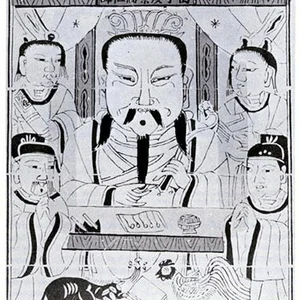

An official at the imperial court during the Han dynasty, Cai Lun is credited with inventing paper in 105 AD. He refined a process using plant fibers, bark, and rags to produce a lightweight and inexpensive writing material.
Frequently asked questions
Key Facts
- 105 AD: official presentation of paper to Emperor He of Han
- Use of recycled materials (rags, fishing nets, bark) to make paper
- The process spread across Central Asia and then into Europe via the Silk Road
- Deified after his death in certain Chinese artisan traditions
Works & Achievements
Cai Lun refined a process for making paper from plant fibers, mulberry bark, hemp, and rags, and officially presented it to the Emperor. This standardization of paper would permanently transform written communication throughout the world.
As director of the imperial workshops (Shang Fang), Cai Lun oversaw improvements to forging techniques and the manufacture of court objects. Han texts credit him with raising the quality of imperial craft production.
An official document presented to Emperor He describing the materials, process, and advantages of the new medium. This report, mentioned in the *Hou Han Shu*, is the founding act of the invention's official recognition.
With imperial backing, Cai Lun organized the dissemination of the process across the empire's provinces. This sweeping administrative adoption made paper the dominant medium, gradually replacing bamboo and silk.
Anecdotes
Cai Lun was a court eunuch who climbed the ranks of the Eastern Han imperial hierarchy to become director of the imperial workshops. This position gave him access to the artisans and materials needed to conduct his experiments on new writing surfaces, at a time when bamboo and silk still dominated.
In 105 CE, Cai Lun officially presented his paper to Emperor He of the Han dynasty. He had experimented with a mixture of mulberry bark, hemp, old rags, and worn fishing nets, soaked in water and then dried on frames. The emperor was so impressed that he ordered the technique to be disseminated throughout the empire.
In tribute to its inventor, the new paper was quickly nicknamed 'Cai Hou Zhi' (蔡侯纸), meaning 'paper of Marquis Cai.' Cai Lun had indeed been granted the title of Marquis of Longting in recognition of his services at court. This name remained in use for centuries in Chinese texts to denote high-quality paper.
Cai Lun's final years were tragic. Caught up in court intrigues during the reign of Emperor An of Han, he was accused of having once taken part in a plot against the imperial family. Rather than face a humiliating trial, he drank poison after dressing himself in his ceremonial robes. This episode illustrates the precariousness of power at the Han court.
For a long time, archaeologists debated whether Cai Lun had truly invented paper or merely improved upon an existing technique. Excavations carried out in China during the 20th century uncovered paper fragments predating Cai Lun, dating to the 2nd century BCE. His true contribution therefore appears to have been industrializing and standardizing the manufacturing process, turning paper into an accessible and reliable writing surface.
Primary Sources
Cai Lun, whose courtesy name was Jingzhong, was a native of Guiyang. [...] He submitted to the Emperor a report on the manufacture of paper from tree bark, hemp, old rags, and fishing nets. The Emperor acknowledged his merits, and from that time on everyone used this paper, which became known throughout the world as 'the paper of Marquis Cai'.
In the fourteenth year of the Yuanxing era (105 AD), Cai Lun presented to the throne paper made from mulberry bark, hemp, rags, and fishing nets. The Emperor approved it and ordered its dissemination.
The imperial workshops supplied the court with writing materials, notably bamboo tablets and silk scrolls. The cost of silk made administrative correspondence extremely expensive for the state.
Paper has its origins in bamboo bark, hemp, rice straw, and reeds. The craftsman soaks the fibers, beats them, spreads them on a frame, and leaves them to dry. It was Cai Lun who first brought these techniques together and refined them.
Key Places
Presumed birthplace of Cai Lun. This region of southern China was rich in bamboo and hemp, raw materials that played a role in his experiments with plant fibers.
The imperial capital where Cai Lun spent most of his career at court. It was in the imperial workshops of Luoyang that he conducted his research and presented his invention to Emperor He in 105 AD.
A palatial institution in Luoyang that Cai Lun came to direct. These workshops produced weapons, tools, and prestige objects for the court; it was here that Cai Lun was free to experiment with new materials.
The site of the traditional tomb attributed to Cai Lun, venerated as a memorial by papermakers. Ceremonies in his honor were still held there during the medieval period.
The trade network that enabled the gradual spread of Han paper westward into Central Asia, Sasanian Iran, and the Arab world. The Battle of Talas (751) accelerated this transmission toward the West.
Typical Objects

A large wooden or stone container in which plant fibers (bark, hemp, rags) were soaked and macerated in water. This is the fundamental step of the process developed by Cai Lun to obtain a homogeneous pulp.

A bamboo frame strung with fine threads onto which diluted paper pulp was poured and spread. Once the water had drained and the sheet dried in the sun, a sheet of paper was obtained. This tool remained unchanged for centuries.

Before paper, the Han administration used thin bamboo slats bound together with cords to record laws, accounts, and correspondence. Their weight and bulk made archives difficult to manage, which motivated the search for a lighter writing medium.

A luxury writing medium used by the Han court and scholars before paper became widespread. Silk was precious and costly, which confined writing to the elite and the central administration.

Tools used to pound and reduce raw materials (mulberry bark, old rags, worn fishing nets) into pulp. The pounding produced fibers fine enough to make smooth and durable paper.

The traditional Chinese writing instrument, made of animal hairs bound to a bamboo handle. With the spread of paper, the brush became the tool of choice for Han scholars and officials when drafting official documents and correspondence.

A bronze or jade stamp used by imperial officials to authenticate documents and edicts. As a high-ranking official, Cai Lun possessed one that gave legal force to his reports and petitions addressed to the Emperor.
School Curriculum
Vocabulary & Tags
Key Vocabulary
Daily Life
Morning
Cai Lun rose before dawn to attend the audiences and rituals of the imperial court. As a high-ranking eunuch official, he was required to be present at the morning ceremonies of the Luoyang palace and receive instructions from the Emperor or regents before heading to the workshops.
Afternoon
The afternoon was dedicated to overseeing the imperial workshops (Shang Fang): he inspected the craftsmen, supervised the quality of production, and conducted his own experiments with plant fibers. Tests involving soaking, grinding, and drying raw materials took place in the workshop courtyards.
Evening
In the evening, Cai Lun wrote administrative reports by the light of oil lamps, on bamboo tablets or, after his invention, on his own paper. He could also attend court banquets or study classical texts, a pursuit highly valued among Han scholars and officials.
Food
His diet reflected his elevated rank: cooked rice and millet, vegetables (radishes, cabbage), pork or fish depending on the season, fermented soybean soup, all accompanied by rice wine. High-ranking eunuchs received food rations provided by the imperial court.
Clothing
Cai Lun wore the official silk robes of his rank, in the colors and with the embroidery prescribed by the Han hierarchy. The color, cut, and ornaments of his clothing signaled his position as a marquis and high-ranking court official.
Housing
He lived in the quarters reserved for eunuch officials within the enclosure of the imperial palace of Luoyang. These lodgings, though modest compared to the noble apartments, were comfortable and included a study where he kept documents, tools, and paper samples.
Historical Timeline
Period Vocabulary
Liens externes & ressources
Références
Œuvres
Invention et standardisation du papier (蔡侯紙)
105 apr. J.-C.
Amélioration des armes et ustensiles impériaux
88-105 apr. J.-C.
Rapport technique sur la fabrication du papier soumis à l'Empereur
105 apr. J.-C.
Diffusion du papier dans l'administration Han
105-121 apr. J.-C.