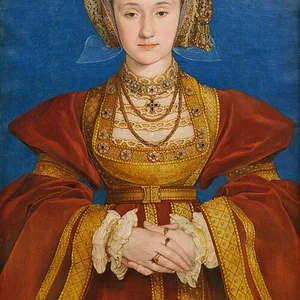

A Spanish Infanta who became Queen of England, Catherine of Aragon was the first wife of Henry VIII. Her refusal to have their marriage annulled triggered the Anglican schism and England's break with Rome.
Catherine of Aragon(1485 — 1536)
Catherine of Aragon
Espagne
9 min read
Frequently asked questions
Famous Quotes
« I am your rightful queen, and if you drive me from that rank, I shall die believing myself to be so.»
Key Facts
- 1485: born in Alcalá de Henares, daughter of the Catholic Monarchs Ferdinand and Isabella
- 1501: marriage to Arthur, Prince of Wales, who dies a few months later
- 1509: marriage to Henry VIII of England
- 1516: birth of the future Queen Mary I, the couple's only surviving child
- 1533: Henry VIII has the marriage annulled by Archbishop Cranmer, triggering the break with Rome
Works & Achievements
Appointed regent by Henry VIII during his military expedition to France, Catherine oversaw the kingdom's defence and the decisive victory at Flodden Field against the Scottish army. This act of governance demonstrates her genuine political competence and her ability to lead a state in wartime.
A speech delivered in English before Henry VIII and the ecclesiastical judges, in which Catherine refused the court's jurisdiction and asserted her rightful status as Queen of England. It is considered one of the most remarkable acts of female resistance of the sixteenth century.
Catherine championed Renaissance humanists at the English court, extended her protection to Thomas More, and invited the renowned humanist Luis Vives to London to develop ideas on women's education, turning the English court into a centre of Latin learning.
Catherine conducted an intensive diplomatic correspondence with her nephew, Emperor Charles V, to secure Rome's support against the annulment proceedings. These letters had a direct influence on the papal policy of Clement VII.
Inspired by the Spanish humanist Luis Vives, whom she had invited to London, Catherine funded and encouraged the education of her daughter Mary and her ladies-in-waiting, helping to introduce humanist ideas about female learning into England.
Anecdotes
In 1513, while Henry VIII was campaigning in France, Catherine of Aragon served as regent of England. She oversaw the decisive victory of the English army over the Scots at the Battle of Flodden, where James IV of Scotland was killed. She sent Henry a letter announcing the victory, accompanied, it is said, by the bloodstained coat of the Scottish king.
Catherine was one of the most educated women of her time. Raised by her mother Isabella of Castile — herself remarkably learned — she was fluent in Latin, French, and Greek in addition to her native Spanish. The humanist Erasmus of Rotterdam admired her scholarship and maintained an intellectual correspondence with her.
When Henry VIII sought an annulment of their marriage, Catherine categorically refused to relinquish her title of queen. Despite the pressure, the forced separations from her daughter Mary, and increasingly difficult living conditions, she never signed any document acknowledging the legitimacy of the divorce.
The pomegranate was Catherine's personal emblem, a reference to Granada, the kingdom her parents had conquered the year of her birth (1492). This motif appears on her coat of arms, her embroideries, and her tapestries. She was herself a highly skilled needlewoman and created liturgical ornaments that she donated to churches.
In her very last letter to Henry VIII, written shortly before her death in January 1536, Catherine still addressed him as “my most dear lord and husband” and forgave him. She ended the letter writing that her “eyes desire you above all things.” Henry, to whom the letter was delivered, is said to have wept upon reading it, even though he had refused to see her for years.
Primary Sources
My lord and beloved husband, the hour of my death now approaches, and the tenderness of my love for you compels me to speak to you of the state of my soul. I forgive you with all my heart for all the wrongs you have done me, and I pray God to forgive you also. I die, my eyes desiring you.
I beseech Your Majesty to consider that this concerns not only my cause but that of the universal Church, and that if the Pope yields to the pressure of the King of England, he will open the way to the ruin of Christendom.
I beseech you, for all the love that has been between us, and for the love of God, to render me justice. I came into this country as a stranger, with no one to whom I could turn. I call upon the God of Truth as my witness that I am your true and lawful wife.
We declare that the marriage between Henry, King of England, and Catherine, Queen of England, is valid and lawful, and that all proceedings to the contrary are null and void.
Key Places
Catherine's birthplace, on 16 December 1485, in the archiepiscopal palace. A university and intellectual city in Castile, home to one of the first great universities of the Spanish Renaissance, founded by Cardinal Cisneros.
Henry VIII and Catherine's favourite royal residence during their happy years together. It was here that their daughter Mary was born in 1516, and where many pivotal scenes of their shared life unfolded.
The site of the annulment trial in June 1529. It was here that Catherine delivered her remarkable plea before Henry VIII and the papal legates, rejecting the tribunal's jurisdiction and publicly asserting her rightful title as queen.
The place of Catherine's confinement and death. Placed under house arrest after the forced divorce, she lived there in increasingly wretched conditions, unable to see her daughter Mary again. She died there on 7 January 1536.
Catherine of Aragon's burial place since 1536. Her tomb lies in the north nave; every year, flowers are laid on her stone slab in tribute to the queen, keeping her memory alive five centuries after her death.
Typical Objects

Catherine was a deeply devout woman who prayed several times a day. Her book of hours, richly illustrated in the Hispano-Flemish style, accompanied her in her daily devotions and was one of her most treasured possessions.

A symbol of both her unwavering Catholic piety and her Spanish heritage, Catherine carried a rosary of deep red semi-precious stones — the colour associated with the pomegranate, emblem of her maternal family.

Catherine was renowned for her exceptional skill at needlework. She personally crafted liturgical vestments (chasubles, altar cloths) and taught the art to her ladies-in-waiting, introducing Hispano-Flemish embroidery techniques to the English court.

The pomegranate was Catherine's personal badge, evoking her parents' conquest of Granada in 1492. The motif appeared embroidered on her garments, her tapestries, and her chamber hangings, constantly affirming her Spanish royal identity.

As regent of England in 1513, Catherine signed official decrees and sealed military and diplomatic letters. These documents bear witness to her real exercise of political power — far beyond the purely ceremonial role so often attributed to queens.

The central symbol of her dignity, the crown represented everything Catherine fought for. Until her death she refused to renounce her title of Queen of England or to be addressed by any other name, even under threat.
School Curriculum
Vocabulary & Tags
Key Vocabulary
Daily Life
Morning
Catherine rose at dawn and attended daily Mass, accompanied by her Spanish and English ladies-in-waiting. She recited her morning prayers in Latin from her illuminated Book of Hours, a practice she maintained until her final days, even during her captivity at Kimbolton.
Afternoon
Afternoons were divided between representational duties — receiving ambassadors, audiences, court ceremonies — and private activities. Catherine devoted a large part of her time to embroidery and to reading the Church Fathers, humanist works, and books of piety.
Evening
Evenings at court were enlivened by banquets, concerts of lute and flute, theatrical performances, and sometimes dancing. Catherine appreciated music and was herself a musician. During the dark years of the divorce proceedings, her evenings dwindled to pious readings and the writing of letters to her daughter Mary, whom she was forbidden to see.
Food
As Queen of England, Catherine shared the royal table, which was rich in roasted meats (beef, venison, poultry), fish, and spiced pastries. She scrupulously observed the fast days and Lenten period required by the Catholic Church, a practice she maintained even after the Anglican schism. She introduced certain Spanish dietary customs to court.
Clothing
Catherine wore wide-sleeved gowns in the Hispano-Flemish and English styles, crafted from velvet, silk, and gold-embroidered brocade. Her outfits frequently featured the pomegranate embroidered in precious threads, an affirmation of her Spanish identity. After her fall from favour, the riches of her wardrobe were progressively taken from her.
Housing
During her years as queen, Catherine resided in the great royal palaces: Greenwich, Hampton Court, Richmond, and Westminster. After the annulment proceedings began, she was progressively distanced from court and placed under house arrest in increasingly remote castles, the last being Kimbolton — damp and cold — where she died in 1536.
Historical Timeline
Period Vocabulary
Liens externes & ressources
Références
Œuvres
Exercice de la régence d'Angleterre
1513
Plaidoyer devant le tribunal de Blackfriars
1529
Mécénat humaniste : protection de Thomas More et invitation d'Érasme
1509–1533
Correspondance diplomatique avec Charles Quint pour défendre l'autorité pontificale
1527–1535
Promotion de l'éducation des femmes
1509–1533