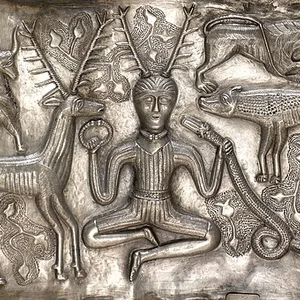

Cernunnos is a horned Gaulish deity, god of wild animals and nature. His name is attested only once, on the Pillar of the Boatmen discovered in Paris. He is depicted seated cross-legged, wearing antlers, surrounded by deer and serpents.
Cernunnos
Cernunnos
10 min read
Frequently asked questions
Key Facts
- His name is attested only once, on the Pillar of the Boatmen (Paris, 1st century CE)
- Depicted on the Gundestrup Cauldron (2nd–1st century BCE), seated cross-legged with antlers
- Associated with wild animals, abundance, and the passage between worlds (the living and the dead)
- A deity with no preserved narrative myth, known solely through archaeology and iconography
- A possible symbolic ancestor of the horned Devil in medieval Christian imagery
Works & Achievements
A masterpiece of Celtic silversmithing in repoussé silver (69 cm in diameter), this cauldron discovered in Denmark bears on one of its inner plates the most complete depiction of Cernunnos: seated cross-legged, surrounded by animals, holding a torque and a serpent. It is housed in the National Museum of Denmark in Copenhagen.
A votive monument erected by Gaulish river merchants in Lutetia, this pillar is the only source bearing the name Cernunnos in carved inscription. Combining Gaulish and Roman deities, it is an irreplaceable witness to Gallo-Roman religion; its stone blocks are preserved at the Musée de Cluny in Paris.
This limestone stele depicts Cernunnos dispensing abundance — grain or coins — to a stag and a bull at his feet. It illustrates the nurturing and benevolent dimension of the god, and his role in the fertility of the land and the prosperity of Gaulish communities.
This Gallo-Roman plaque depicts Cernunnos seated and wearing two torques hung from his stag antlers. It illustrates the persistence of the cult of Cernunnos under Roman rule and the adaptation of Celtic iconographic traditions to Roman artistic techniques.
These rock carvings from the Camonica Valley are among the oldest known representations of a horned Celtic figure. They attest to the great antiquity of beliefs associated with the horned god, predating the classical Gaulish period by centuries.
Anecdotes
The name Cernunnos is attested only once in all of Antiquity, carved on the Pillar of the Boatmen, discovered in 1710 beneath the choir of Notre-Dame Cathedral in Paris. This monument, erected by the river merchants of Lutetia during the reign of Emperor Tiberius, is the only direct epigraphic evidence of this Gaulish god's existence — without it, we would not even know his name.
On the Gundestrup Cauldron, discovered in 1891 in a Danish bog, Cernunnos is depicted seated cross-legged, holding a torque in his right hand and a ram-headed serpent in his left, surrounded by wild animals. This meditative posture, halfway between man and beast, attests to his role as master of animals and mediator between the wild world and the world of men.
Cernunnos always bears antlers on his head, sometimes adorned with torques hung upon them. In Gaulish society, the stag was the royal animal of the forest: its antlers fall and regrow each year, making Cernunnos the embodiment of the great natural cycles — death, rebirth, and the eternal return of life.
In certain Gallo-Roman depictions, such as the Reims stele, Cernunnos is seated between a stag and a bull, with coins or grain spilling from a bag. This often-forgotten facet of the horned god reveals that he was also a deity of abundance and prosperity, protector of harvests as well as herds.
Unlike the Greek or Roman gods, Cernunnos left behind no written myths passed down directly: the Gauls did not record their sacred texts, and the druids transmitted everything orally. Everything we know about this god rests solely on sculpted or engraved images, which means his interpretation remains largely debated among archaeologists and historians of religion.
Primary Sources
On a limestone block discovered beneath Notre-Dame de Paris, the inscription CERNUNNOS appears above a depiction of the horned god. It is the only known occurrence of his name carved in stone, providing direct epigraphic evidence of his cult in Lutetia.
This repoussé silver cauldron features on one of its inner plates a cross-legged figure wearing antlers, holding a torc and surrounded by animals. This plate is universally identified as depicting Cernunnos and represents the richest iconographic source on this deity.
A limestone stele discovered in Reims depicts a figure wearing antlers, seated cross-legged, with a torc around his neck. At his feet, two animals feed from a bag from which grains or coins spill, illustrating the deity's nurturing aspect.
In the Camonica Valley, a human figure wearing antlers is carved into the rock. Although the name Cernunnos does not appear there, this depiction is considered one of the oldest known images of a horned Celtic deity.
This Gallo-Roman plaque depicts Cernunnos seated cross-legged with two torcs hanging from his antlers. The combination of Gaulish elements (posture, antlers) and Roman sculptural techniques illustrates the persistence of Cernunnos's cult under Roman rule.
Key Places
At the site of the present Notre-Dame Cathedral in Paris, the Gallic boatmen erected a votive pillar in the 1st century AD bearing the only attested inscription of the name Cernunnos. It is the most geographically certain anchor point of this deity's cult.
This Alpine valley contains thousands of petroglyphs dating from the Neolithic to the Middle Ages. A seated horned figure from the 4th century BC is considered one of the oldest known representations of a Celtic antlered deity.
It was in a peat bog in this region that the silver cauldron bearing the most famous representation of Cernunnos was discovered in 1891. Its presence in Scandinavia testifies to the wide spread of Celtic ritual objects across Europe.
Several representations of Cernunnos have been discovered in this former Gallo-Roman capital of the Remi. The Reims stele, depicting the god dispensing abundance, is one of the most important testimonies of his cult in Roman Gaul.
The nemeton were open-air ritual spaces, often forest clearings at the heart of Celtic Gaul. Cernunnos, deity of the wild, was very probably honored there, even though no nemeton dedicated solely to him has been confirmed with certainty.
Typical Objects

A rigid necklace of precious metal, symbol of power and divine status in Gaulish society. Cernunnos wears one around his neck and often holds one in his hand, sometimes hung from his own antlers, signifying that he distributes wealth and power to mortals.

The defining attribute of Cernunnos, the stag antlers growing from his human head make him a hybrid deity straddling the boundary between the human world and the animal world. Shed and regrown each year, they symbolize the natural cycles of death and rebirth.

A recurring mythological creature in the iconography of Cernunnos, this hybrid serpent symbolizes chthonic forces, earthly fertility, and the passage to the underworld. Held in the god's hand, it embodies his mastery over the powers of the earth and the dead.

In certain Gallo-Roman depictions, Cernunnos holds or carries a sack from which grains or coins spill out, casting him as a deity of agricultural abundance and commercial prosperity — a reflection of the economy of Celtic Gaul.

The sacred animal ever-present at Cernunnos's side, the stag is the royal beast of the Gaulish forest. An embodiment of majesty and natural strength, it forms the living bond between the god and the wild world of which he is the guardian.

A foundational object of Celtic religion, the cauldron symbolizes abundance, rebirth, and the passage to the Otherworld. The Gundestrup Cauldron, which bears the most celebrated depiction of Cernunnos, was most likely used during major communal ceremonies.
School Curriculum
Vocabulary & Tags
Key Vocabulary
Daily Life
Morning
In Gaulish beliefs, Cernunnos was associated with forest edges and dawns, the moment when the forest awakens. At sunrise, he was conceived as roaming the deep forests of Gaul, watching over wild animals as they resumed their lives. Druids believed the first light of morning belonged to him, and some morning offerings were likely intended for him at forest sanctuaries.
Afternoon
At the height of day, Cernunnos reigned over the nemeton, the sacred clearing at the heart of the forest. Invariably depicted seated cross-legged — a posture that embodied his rootedness between sky and earth — he mediated between the world of humans and that of wild animals. It was in these ritual spaces that the Gauls came to deposit offerings (torques, animals, grain) to secure his goodwill over hunts and harvests.
Evening
At dusk, Cernunnos was associated with the passage between the world of the living and the Otherworld (the sid of the Celts), a mysterious beyond located underground or on distant islands. His ram-headed serpents slid between tree roots to reach this underground world, where Cernunnos also held power over the dead and wandering souls.
Food
Offerings consecrated to Cernunnos included parts of game (deer, boar), grain symbolizing the earth's abundance, and libations of fermented drinks such as grain beer or mead. These offerings were deposited in forest sanctuaries or cast into sacred waters (springs, rivers), the privileged points of contact with the divine world in Celtic religion.
Clothing
In all his known depictions, Cernunnos wears a short tunic or simple garment, in keeping with the dress of ordinary Gauls rather than warriors. His divine attributes — the antlers, torques, the horned serpent — form his true symbolic insignia. Sometimes depicted bare-chested, his human body contrasts with his head crowned by animal antlers, a mark of his hybrid nature on the frontier between two worlds.
Housing
Cernunnos had no fixed columned temple like the Roman gods: his dwelling was the entire Gaulish forest, and in particular the nemeton, sacred clearings bounded by wooden palisades or simply by remarkable trees. The oak, the Celts' sacred tree par excellence, was likely his emblematic tree, the living heart of his open-air sanctuaries.
Historical Timeline
Period Vocabulary
Liens externes & ressources
Références
Œuvres
Chaudron de Gundestrup
Ier siècle av. J.-C.
Pilier des Nautes (Lutèce)
14–37 apr. J.-C.
Stèle de Reims (Durocortorum)
Ier–IIe siècle apr. J.-C.
Plaque de bronze d'Étang-sur-Arroux (Bourgogne)
Ier–IIe siècle apr. J.-C.
Pétroglyphes corniformes du Val Camonica
IVe siècle av. J.-C.