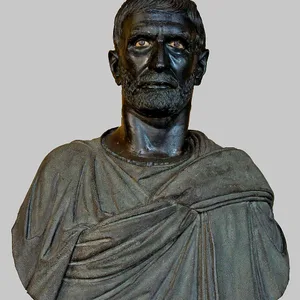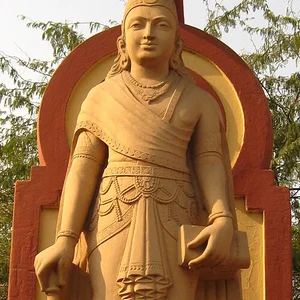

Founder of the Maurya Empire in the 4th century BCE, Chandragupta unified the Indian subcontinent after overthrowing the Nanda dynasty. He established the first great centralized empire in Indian history.
Chandragupta Maurya(339 av. J.-C. — 296 av. J.-C.)
Chandragupta Maurya
Empire Maurya
9 min read
Frequently asked questions
Key Facts
- Around 321 BCE: overthrow of the Nanda dynasty and founding of the Maurya Empire
- Around 305 BCE: victory against Seleucus I Nicator, Alexander's successor in Asia
- Advised by Kautilya (Chanakya), author of the Arthashastra, a treatise on statecraft
- The Maurya Empire extended across nearly the entire Indian subcontinent
- Around 298 BCE: abdication in favor of his son Bindusara; he retired to a life of Jainism
Works & Achievements
The first unified empire in Indian history, covering nearly the entire subcontinent. This unprecedented political achievement laid the foundations of a civilization that would influence Asia for centuries.
Chandragupta organized the empire into provinces (janapadas) governed by royal administrators, supported by a network of spies and officials described in the Arthashastra. This bureaucratic system was the most sophisticated of its era.
Construction of a major royal road linking Pataliputra to Taxila (the future Grand Trunk Road), facilitating trade, military movement, and administrative communication. Megasthenes describes regular rest stations and milestones along the route.
The first diplomatic treaty between the Indian and Greek worlds. Chandragupta obtained the territories of Bactria and Arachosia (present-day Afghanistan and Pakistan) from Seleucus in exchange for 500 war elephants, establishing India's western borders for generations to come.
Megasthenes describes a colossal palace whose gilded columns and gardens rivaled the royal residences of Persia and Macedonia. Archaeological excavations have uncovered polished sandstone columns characteristic of Mauryan art.
The Arthashastra credits the Mauryan administration with standardizing units of measurement, currency, and taxation across the empire, thereby facilitating interregional trade throughout the subcontinent.
Anecdotes
According to tradition, the young Chandragupta is said to have met Alexander the Great during his passage through India around 326 BCE. Impressed by the Macedonian conqueror but also aware of his limits in the face of Indian resistance, Chandragupta reportedly grasped that the unification of India was within reach. The Roman historian Justin records that he even dared to reproach Alexander for not pressing his conquest as far as the Ganges, claiming that the local populations were ready to rise up against the Nanda dynasty.
Chandragupta owed his rise to power largely to his mentor Chanakya, a brilliant and ruthless Brahmin. Legend has it that Chanakya, humiliated by the Nanda king, vowed to bring down that dynasty and began searching for a worthy candidate. He spotted the young Chandragupta playing war games with other children, commanding them with natural authority, and decided to have him educated at Taxila to forge him into a king. This alliance between the strategist and the warrior would go on to change the destiny of India.
In 305 BCE, Chandragupta faced the Macedonian general Seleucus I Nicator, Alexander's successor, who was attempting to reclaim the Indian territories. After several battles, a remarkable treaty was signed: Seleucus ceded vast territories (present-day Afghanistan and Pakistan) in exchange for 500 war elephants. Chandragupta also sent his ambassador to the Seleucid court, and Seleucus gave him his daughter in marriage, sealing the first diplomatic alliance between India and the Greek world.
Toward the end of his life, Chandragupta converted to Jainism, the religion of non-violence founded by Mahavira. According to Jain tradition, he abdicated in favor of his son Bindusara, renounced his throne and his wealth, and walked on foot to Shravanabelagola in present-day Karnataka. There, in keeping with the Jain ascetic practice known as sallekhana, he voluntarily fasted until death around 296 BCE. This act of total renunciation of power remains one of the most striking gestures of ancient India.
The Arthashastra of Chanakya, Chandragupta's chief advisor, describes a royal security protocol of remarkable paranoia: the king was never to eat without food tasters having tested his meals, was not to sleep two consecutive nights in the same bed, and was to change his quarters regularly to foil conspiracies. Secret agents were embedded throughout every layer of society, including royal families and temples. This obsession with security reflected the brutal nature of Indian political life at the time.
Primary Sources
The king must be active and vigilant in the governance of his kingdom. He must rise early, inspect his armies, meet with his ministers, and administer justice. The prosperity of the people is the prosperity of the king.
The city of Palibothra [Pataliputra] is the greatest in all of India. It is surrounded by a moat six hundred feet wide and a wooden palisade pierced by sixty-four gates and five hundred and seventy towers.
Sandracottus [Chandragupta], with an army of six hundred thousand men, brought all of India under his dominion. He then invaded Macedonia with that same army and defeated Seleucus, who ceded him a portion of his empire.
Through Chanakya's cunning and Chandragupta's valor, the mighty and proud Nanda dynasty was overthrown, and the throne of Magadha was seized as easily as picking up a fruit fallen to the ground.
Under the reign of Chandragupta Maurya, the empire stretched from the Himalayas to the southern seas, from the lands of the Yavanas [Greeks] to the eastern frontiers. The king upheld the dharma and protected his subjects as a father protects his children.
Key Places
Capital of the Maurya Empire, founded on the Ganges. Megasthenes described it as an enormous city 15 km long, surrounded by moats, and considered one of the greatest cities of the ancient world.
A renowned intellectual center of the ancient Indian world, where Chandragupta is said to have been educated by Chanakya. A crossroads between the Greek, Persian, and Indian worlds, this city was the greatest center of learning in South Asia.
A sacred Jain site where Chandragupta is said to have spent his final years as an ascetic, dying by voluntary fasting. It is home to the famous colossal statue of Gommateshvara, a symbol of the Jain tradition he embraced.
The central kingdom of the Indian subcontinent, which Chandragupta seized by overthrowing the Nanda dynasty around 322 BCE. This fertile Gangetic territory formed the core of his empire.
The border river that Chandragupta crossed to push back the Macedonians and reclaim Alexander's satrapies. Control of this river was essential for dominating the trade routes between India and the western world.
Typical Objects

The war elephant was the decisive weapon of the Mauryan armies. Chandragupta owned thousands of them, deploying them to break enemy lines, and gifted 500 to Seleucus as part of the peace treaty of 303 BCE.

Stamped seals were used to authenticate royal orders and administrative documents throughout the empire. The term mudra gave its name to the play Mudrarakshasa, which dramatizes Chandragupta's rise to power.

These small silver or copper coins, stamped with geometric and animal symbols, served as the official currency of the Maurya Empire. They are evidence of a thriving commercial economy under Chandragupta's reign.

The two-wheeled horse-drawn chariot was a symbol of military and royal power. It led Mauryan military processions and was described in detail in Chanakya's Arthashastra.

The lion throne of Pataliputra symbolized universal sovereignty (chakravartin). Chandragupta wrested it from the Nanda dynasty and made it the symbolic heart of his unified empire.

This treatise on statecraft, written by Chanakya, laid out all the techniques of administration, espionage, and diplomacy that Chandragupta put into practice. It served as the governing manual of the Mauryan Empire.

The composite bow made of bamboo or horn, taller than a man, was the weapon of choice for the Mauryan infantry. Megasthenes noted with astonishment that Indian soldiers drew their bows from the ground, bracing them with one foot.
School Curriculum
Vocabulary & Tags
Key Vocabulary
Tags
Daily Life
Morning
The king rises before dawn, as prescribed by the Arthashastra. He first receives reports from his disguised spies, who brief him on the events of the night. After ritual ablutions and prayers, he meets with his ministers (amatyas) to review urgent affairs of the empire: border disputes, tax collection, and army provisioning.
Afternoon
The afternoon is devoted to public audiences, where Chandragupta receives petitioners and foreign ambassadors — including Greek envoys from the Seleucid court. He then inspects the training of his armies, particularly the cavalry and the mahouts with their elephants, before holding a war council or trade strategy meeting with his generals and merchants.
Evening
In the evening, surrounded by armed female bodyguards described by Megasthenes, Chandragupta dines only after a meticulous inspection by his royal food tasters. He listens to poets and musicians, receives reports from provincial governors, and consults Chanakya on major political decisions. Security is paramount: he never sleeps in the same chamber two nights in a row.
Food
The Mauryan royal diet included rice, lentils (dal), vegetables such as gourd and chickpeas, ghee (clarified butter), milk, and tropical fruits like mangoes and figs. Meat — kid goat, game, and fish from the Ganges — featured at royal banquets, though Chandragupta gradually adopted vegetarianism as he grew closer to Jainism.
Clothing
Chandragupta wore a dhoti of fine white or saffron-dyed muslin, draped according to the customs of the Magadha court. During ceremonies, he wore gold and gemstone adornments, including pearl necklaces and gold bracelets. On military campaigns, he donned leather armor reinforced with metal, as described in texts of the period.
Housing
The royal palace at Pataliputra, described by Megasthenes, was a structure of teak wood and polished stone whose magnificence rivaled the Achaemenid residences of Persia. It featured ornamental gardens with peacocks and fountains, colonnaded audience halls, fortified private apartments, and a permanent military enclosure. Modern excavations at Kumhrar (Patna) have uncovered remains of this architecture.
Historical Timeline
Period Vocabulary
Visual Style
Direction artistique inspirée de l'art maurya primitif — colonnes en grès poli, motifs de lotus et de paon, palette ocre et or, mêlant influences indiennes et touches hellénistiques.
Sound Ambience
Ambiance sonore de la cour impériale de Pataliputra, mêlant rituels védiques, effervescence du marché multilingue et bruits militaires d'un empire en construction.
Liens externes & ressources
Références
Œuvres
Fondation de l'Empire Maurya
321 av. J.-C.
Mise en place du système administratif centralisé
vers 320 av. J.-C.
Réseau routier de l'Empire Maurya
vers 315 av. J.-C.
Traité indo-séleucide
303 av. J.-C.
Palais royal de Pataliputra
vers 310 av. J.-C.
Politique d'unification des poids et mesures
vers 315 av. J.-C.