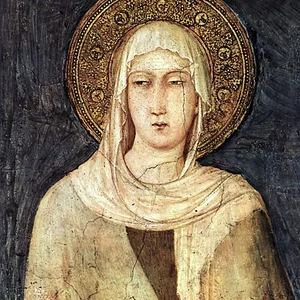

Clare of Assisi (1194–1253) was an Italian Catholic saint and founder of the Order of Poor Ladies, known as the Poor Clares. Inspired by Francis of Assisi, she chose monastic life and absolute poverty. She was the first woman to write a religious rule approved by the papacy.
Frequently asked questions
Famous Quotes
« Our form of life is to observe the holy Gospel of our Lord Jesus Christ.»
« Among all the gifts and graces we have received from our generous Benefactor, the Father of mercies, and for which we owe him boundless thanksgiving, the gift of our vocation is one of the greatest.»
Key Facts
- 1194: born in Assisi into a noble family
- 1212: fled her family home to join Francis of Assisi at the Portiuncula
- 1215: settled at San Damiano, the nucleus of the future Order of Poor Clares
- 1253: her written rule approved by Pope Innocent IV, two days before her death
- 1255: canonized by Pope Alexander IV
Works & Achievements
The first monastic rule written by a woman and approved by a pope. It codifies the life of the Poor Clares around absolute poverty, communal life, and prayer.
Written shortly before her death, this spiritual text retraces her journey and urges her sisters to remain faithful to the ideal of evangelical poverty championed by Francis of Assisi.
Four letters addressed to Princess Agnes of Bohemia, who had renounced the throne to found a Poor Clares monastery in Prague. They offer a precious insight into Clare's spirituality.
A brief letter of encouragement addressed to a Flemish nun, reflecting Clare's international influence and her spiritual guidance beyond the borders of Italy.
By settling at San Damiano with her first companions, Clare founded what would become the Order of Poor Ladies, renamed the Order of Saint Clare after her death, and still active today.
Anecdotes
At the age of 18, Clare secretly fled her family home on the night of March 18–19, 1212, to join Francis of Assisi at the Portiuncula. Her brothers tried to drag her back by force, but she clung to the church altar and refused to leave — showing remarkable determination for a young woman of her social standing.
Pope Gregory IX himself tried to persuade her to renounce her vow of absolute poverty, considering the rule too harsh for women. Clare stood firm, replying that she needed to be absolved of her sins, not of her poverty. It is one of the rare instances in the Middle Ages where a woman openly defied the highest authority of the Church.
In 1240, Saracen mercenary soldiers in the service of Emperor Frederick II attacked Assisi and scaled the walls of the convent of San Damiano. According to tradition, Clare, gravely ill, had herself carried to the walls holding a monstrance to face the attackers. The soldiers fled in terror. This episode is why she is traditionally depicted holding a monstrance in religious art.
Though bedridden by illness for the last twenty-eight years of her life, Clare never stopped working: she embroidered corporals (altar cloths) which she sent to poor churches throughout the Assisi region. Her spiritual and artisanal productivity, despite her physical suffering, earned the deep admiration of her contemporaries.
Clare was canonized in 1255, just two years after her death, by Pope Alexander IV — an extraordinarily short interval for the time. At her canonization, it was recalled that she had obtained the bull Privilegium Paupertatis (1228), a unique document guaranteeing her sisters the right to own no property whatsoever, even collectively.
Primary Sources
I, Sister Clare, servant of the poor ladies of the monastery of San Damiano of Assisi... promise obedience and reverence to the lord Pope Innocent and to his canonically elected successors, and to the Roman Church.
The Son of God made himself our way, and our blessed father Francis showed us this way by his word and by his example.
To the illustrious virgin Agnes, daughter of the most excellent and illustrious king of Bohemia... Clare, the most humble servant of Christ.
As you have renounced the desires of the world, we confirm by our apostolic authority your resolve of the highest poverty.
She despised the world when it was in bloom; she fled riches when they smiled upon her; she trampled pleasures when they offered her their charms.
Key Places
Clare's hometown and the birthplace of the Franciscan movement. It was in Assisi that she grew up in a noble family before leaving everything behind to embrace monastic life.
A former oratory restored by Francis of Assisi, it became the home of the community of Poor Ladies founded by Clare in 1212. She lived and died there in 1253.
Built after her canonization (1257–1265), it houses the relics of Clare as well as the San Damiano crucifix which, according to tradition, spoke to Francis of Assisi.
A small chapel where Francis of Assisi received Clare on the night of March 18–19, 1212, and cut her hair — a symbolic act marking her entry into religious life.
Clare's first place of refuge after fleeing her family, before her permanent settlement at San Damiano. Her sisters Agnes and Beatrix later joined her there.
Typical Objects

A liturgical vessel used to display the consecrated host. Clare is depicted holding a monstrance in reference to the episode in which she is said to have driven away Saracen mercenaries by presenting them with the Blessed Sacrament.

A rough tunic of gray or brown wool, belted with a rope, and a black veil. Clare established this as the garment of her community as a sign of radical poverty and humility.

A parchment containing the rule written by Clare — a remarkable document, as it is the first rule of religious life written by a woman and officially approved by the papacy.

A belt worn by Franciscans and Poor Clares, with three knots symbolizing the vows of poverty, chastity, and obedience. Clare wore it at all times.

Embroidery tools that Clare used even during her long years of illness to make corporals — altar cloths sent to poor churches in the surrounding region.

A prayer book containing the Psalms, central to the Liturgy of the Hours that Clare and her sisters recited seven times a day according to the Benedictine rule.
School Curriculum
Vocabulary & Tags
Key Vocabulary
Daily Life
Morning
Clare and her sisters rose before dawn to chant Matins and Lauds in the freezing chapel of San Damiano. The day began in silence and prayer, with no heat or comfort, on mats or bare wooden planks.
Afternoon
The afternoon was devoted to manual work — embroidery, making liturgical linens — and to spiritual reading of the Scriptures. Clare personally cared for the sick sisters, washing their feet and cleaning their pallets.
Evening
After Compline, the final evening prayer, complete silence fell over the convent. Clare would often keep watch through the night in personal prayer and practiced severe mortification through strict fasting, sometimes to the point of alarming her sisters.
Food
The diet was one of the strictest poverty: barley or bran bread, boiled vegetables, water or occasionally heavily watered wine. Clare fasted completely three days a week, and Francis of Assisi had to order her to eat a minimum amount to preserve her health.
Clothing
The habit consisted of a coarse gray or brown woolen tunic, a cord with three knots as a belt, a black veil, and rough leather sandals. In winter, no additional clothing was provided for in the original rule, which caused serious health problems.
Housing
The sisters lived at San Damiano in tiny, bare cells, with no personal possessions of any kind. The convent, a former small church restored by Francis of Assisi, was dilapidated and damp — a deliberate material poverty embraced as union with the stripped Christ.
Historical Timeline
Period Vocabulary
Visual Style
Style pictural italo-byzantin et proto-gothique inspiré de Cimabue et du jeune Giotto — fond d'or, visages d'une spiritualité intense, palette de gris franciscains, ocres ombriens et rehauts dorés.
Sound Ambience
Ambiance sonore d'un couvent médiéval en Ombrie : chant grégorien des heures canoniales, silence contemplatif entrecoupé de la cloche appelant à la prière, bruits feutrés de la vie monastique en pierre.
Liens externes & ressources
Références
Œuvres
Règle de sainte Claire (Regula Bullata)
1253
Testament de sainte Claire
1253
Lettres à Agnès de Bohême
1234–1253
Lettre à Ermentrude de Bruges
vers 1250
Fondation de l'Ordre des Clarisses
1212