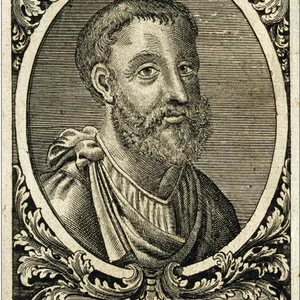

A Greek physician of the 2nd century AD, Galen served as doctor to the Roman emperors and became the greatest medical theorist of antiquity. His work in anatomy and physiology, based on the dissection of animals, dominated Western medicine for over a thousand years.
Galen(129 — 300)
Claudius Galenus
Rome antique
8 min read
Frequently asked questions
Famous Quotes
« The best physician is also a philosopher.»
« Anatomy is the foundation of medicine.»
Key Facts
- Born around 129 AD in Pergamon (present-day Turkey), died around 216 AD
- Personal physician to Emperor Marcus Aurelius in Rome
- Author of approximately 300 medical treatises, about a hundred of which have survived
- Developed and systematized the theory of the four humors inherited from Hippocrates
- His writings remained the medical authority in Europe and the Arab world until the 16th century
Works & Achievements
A treatise in 17 books describing the teleological anatomy of the human body — that is, each organ justified by its function. A foundational work that dominated medical thought for over a thousand years.
A practical dissection manual in 15 books, precisely describing techniques and anatomical observations drawn from the dissection of monkeys and other animals. A major surgical reference of Antiquity.
A treatise in 14 books setting out a rational and systematic method for diagnosing and treating diseases. A standard reference for medieval European and Arabic physicians.
A founding treatise of Galenic physiology, expounding the theory of the faculties governing digestion, nutrition, and growth. In it, Galen brilliantly defends teleological thinking against the atomists.
A treatise developing and systematizing the four-humour theory inherited from Hippocrates (blood, phlegm, yellow bile, black bile), which became the foundation of medieval medicine and the psychology of temperaments.
A short introductory treatise on Galenic medicine and one of the most widely read and commented medical texts of the Middle Ages. It synthesizes the fundamental principles of diagnosis and therapeutics.
Anecdotes
Galen began his career treating the gladiators of Pergamon. This position allowed him to observe numerous serious wounds and deepen his anatomical knowledge. It is said that he reduced gladiator mortality so effectively that the high priest who had hired him renewed his appointment four years in a row.
To demonstrate his theories on the nervous system, Galen performed a spectacular public demonstration: by severing the recurrent laryngeal nerves of a pig before an assembly of philosophers and physicians, he proved that the brain — not the heart — controlled the voice. The pig, which had been squealing until that moment, fell instantly silent, confounding his opponents.
Galen was summoned to Rome to treat Marcus Aurelius, who suffered from a chronic ailment. He diagnosed not a fever, but indigestion, and prescribed a simple diet. The emperor, relieved, called him 'the first among physicians and the only philosopher.' Galen went on to become the personal physician of several Roman emperors.
Galen was known for his combative nature and verbal jousting with rival physicians. He had no hesitation in performing public dissections to humiliate his detractors by proving them wrong through direct observation. He fiercely denounced those he called 'charlatans' and 'ignoramuses' who harmed their patients.
Galen narrowly escaped the fire that destroyed the Temple of Peace in Rome in 192 AD, which consumed a large portion of his library and medical preparations stored in nearby warehouses. He devoted much of his later years to reconstructing and rewriting the works he had lost in the blaze.
Primary Sources
Nature does nothing in vain, nothing superfluous, nothing lacking in what is necessary. Every part of the body was created for a specific function, and that function is perfectly fulfilled.
The physician must first understand the nature of the healthy body, then that of the diseased body, in order to restore the latter to its natural state through appropriate remedies.
Every part of the body possesses its own faculty: a faculty of attraction for what is beneficial to it, a faculty of retention, a faculty of alteration, and a faculty of expulsion for what is harmful.
If you wish to know the bones, do not be content with reading books — examine them with your own eyes, either by dissecting yourself or by carefully observing those who dissect.
Health is the condition in which we neither suffer nor are hindered in our activities. Disease is the opposite condition, in which we suffer and are prevented from performing our natural functions.
Key Places
Galen's birthplace and a major intellectual and medical hub of the Roman world, home to its Asclepion (a temple-sanatorium dedicated to Asclepius) and a renowned library. It was here that he received his first medical training.
Galen studied here for several years, making use of the largest library in the ancient world and the medical schools that carried on the Hippocratic and anatomical traditions. This period was decisive in shaping his education.
Capital of the Empire where Galen spent most of his adult career, becoming imperial physician and achieving international renown. It was here that he conducted his public dissections and wrote the bulk of his works.
A great healing sanctuary dedicated to Asclepius, the god of medicine, where the sick and pilgrims came seeking cures through dreams, baths, and prescribed diets. Galen began his medical career here and was profoundly influenced by its practices.
Typical Objects

The primary surgical instrument of ancient physicians, which Galen used during his dissections and operations. In his treatises, he describes in precise detail the shape and use of the various types of scalpels.

The writing medium on which Galen composed the bulk of his vast body of work. He maintained a considerable personal library and bitterly lamented the loss of many scrolls in the fire of 192 AD.

An essential tool for preparing compound medicines (theriac, poultices, purgatives). Galen was one of the great theorists of ancient pharmacology, systematically cataloguing the properties of plants and mineral remedies.

Galen primarily used monkeys for his dissections, since the dissection of human corpses was forbidden in Rome. It was through dissecting these animals that he built his anatomical theories — theories that were sometimes mistaken on points specific to human anatomy.

An instrument Galen used to measure the pulse rate of his patients, a diagnostic technique he theorized extensively. He claimed to be able to detect many diseases — and even emotional states — through pulse reading alone.

A red-hot iron instrument used to burn wounds and stop bleeding, widely employed in the treatment of gladiators. Galen recommended its judicious use in several of his surgical treatises.
School Curriculum
Vocabulary & Tags
Key Vocabulary
Daily Life
Morning
Galen rose early and devoted the first hours of the day to writing his treatises or reviewing his dissection notes. He would then receive his first patients in his consulting room, conducting a careful examination of the pulse, skin, and urine before making any diagnosis.
Afternoon
Afternoons were often spent on house calls to wealthy Roman patients or at the imperial court. Galen also visited his dissection room, where he worked with assistants and students, narrating his anatomical observations aloud as he dissected monkeys or pigs.
Evening
In the evenings, Galen sometimes attended philosophical banquets where medical and natural questions were debated, though he often preferred to withdraw and read or dictate his writings to his secretaries. He would compile his clinical observations from the day to incorporate them into the treatises he was working on.
Food
As a physician mindful of his own humoral balance, Galen followed a strict and reasoned diet. He ate mainly cooked vegetables, grains, olive oil, and wine diluted with water, avoiding rich or spiced foods that he considered harmful to health. He advised his patients to follow a balanced diet suited to their individual temperament.
Clothing
As a renowned physician and imperial doctor, Galen wore a white toga (toga virilis) on official occasions and at court consultations. In his consulting room or laboratory, he wore a simple white linen tunic — easy to wash and practical for medical care and dissections.
Housing
In Rome, Galen lived in a comfortable urban house (domus) on a hillside, featuring an atrium, a triclinium for receiving guests, and several rooms dedicated to his medical practice: a consultation room, a space for preparing remedies, and a study crowded with papyrus scrolls. He also had access to storage facilities near the Temple of Peace, where he kept his preparations and his library.
Historical Timeline
Period Vocabulary
Visual Style
Style gréco-romain classique avec une lumière méditerranéenne dorée, mêlant la rigueur scientifique des illustrations anatomiques et le cadre luxueux d'un médecin impérial entouré de rouleaux de papyrus.
Sound Ambience
Ambiance sonore d'un cabinet médical romain du IIe siècle, mêlant les bruits de la ville antique, la préparation de remèdes et le travail anatomique dans un contexte d'enseignement.
Liens externes & ressources
Références
Œuvres
De usu partium corporis humani (De l'utilité des parties du corps humain)
vers 170 apr. J.-C.
De anatomicis administrationibus (Sur les procédures anatomiques)
vers 177 apr. J.-C.
De methodo medendi (De la méthode thérapeutique)
vers 178 apr. J.-C.
De naturalibus facultatibus (Des facultés naturelles)
vers 170 apr. J.-C.
De temperamentis (Des tempéraments)
vers 170 apr. J.-C.
Ars medica / Microtechne (L'Art médical)
vers 160 apr. J.-C.