
Mother goddess of Aztec mythology, Coatlicue is the mother of the sun god Huitzilopochtli. Venerated by the Mexica people (Aztecs), she embodies life, death, and regeneration all at once. Her depiction — wearing a necklace of skulls and a skirt of serpents — symbolizes the perpetual cycle of creation and destruction.
Coatlicue
Coatlicue
9 min read
Frequently asked questions
Key Facts
- Coatlicue means "She of the Serpent Skirt" in Nahuatl, the language of the Aztecs
- According to oral tradition and the Mexica codices (compiled around the 16th century), she is the mother of the sun god Huitzilopochtli, whom she conceived miraculously
- She is depicted wearing a necklace of severed hands and human hearts, a double serpent head, and a skirt of intertwined snakes
- Her colossal statue, discovered in 1790 in Mexico City, is housed in the National Museum of Anthropology in Mexico City
- She embodies the fundamental dualism of Aztec cosmology: creator and destroyer, nurturer and devourer
Works & Achievements
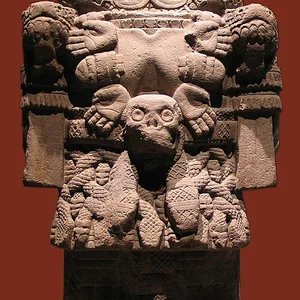
A masterpiece of Mexica sculpture in gray andesite, standing 2.5 meters tall, depicting the goddess in all her symbolic complexity: a skirt of serpents, a necklace of skulls, and two serpent heads facing each other. It is housed in the National Museum of Anthropology in Mexico City.
A monumental stone disk depicting the dismemberment of Coatlicue's daughter, discovered at the base of the Templo Mayor in 1978. It directly illustrates the myth of Huitzilopochtli's birth and stands as one of the most important works of Aztec art.
Ceremonial songs in Nahuatl recited during religious festivals dedicated to the goddess, preserved in the Manuscript of the Cantares Mexicanos. They represent a unique record of Mexica ritual poetry.
Numerous miniature representations of Coatlicue found in domestic and funerary archaeological contexts, attesting to the spread of her cult beyond the major ceremonial centers.
A major agricultural and ritual festival of the Mexica calendar (eighth month) during which earth goddesses including Coatlicue were honored through dances, offerings, and sacrifices to ensure the fertility of the fields.
Anecdotes
Coatlicue was conceived as the ultimate cosmic mother in Mexica mythology: she was said to have given birth to the stars, the moon, and finally the solar deity Huitzilopochtli. According to the myth, Huitzilopochtli was born fully armed from her womb to immediately battle his celestial siblings, symbolizing the sun's daily victory over darkness.
Her name literally means "She Who Wears a Skirt of Serpents" in Nahuatl. Her famous colossal statue, discovered in 1790 beneath the main plaza of Mexico City, stands over 2.5 meters tall and depicts with striking detail her skirt of intertwined serpents, her clawed feet, and her necklace of human hearts and skulls.
According to a founding myth, Coatlicue was beheaded by her daughter the moon, Coyolxauhqui, and her sons the Centzonhuitznahua, who considered her dishonored for having become mysteriously pregnant. At that very moment, Huitzilopochtli burst from her womb and slaughtered his siblings, tearing off their heads. This story explained to the Aztecs the cycle of the sun driving away the moon each morning.
The great statue of Coatlicue housed at the National Museum of Anthropology in Mexico City was considered so terrifying upon its rediscovery during the colonial era that Spanish authorities had it reburied several times, fearing it might reawaken ancient beliefs among the indigenous population. It was not until the 19th century that it was permanently unearthed and put on display.
Coatlicue was associated with the nurturing earth but also with death: warriors who fell in battle were believed to join her underworld realm. She was thus venerated simultaneously as a source of life and a guardian of the dead — a fundamental duality in Mexica cosmology, where life and death were seen as inseparable.
Primary Sources
A cosmogonic account in Nahuatl recorded around 1558, describing the birth of Huitzilopochtli from Coatlicue's womb and the dismemberment of Coyolxauhqui following the celestial battle.
"Coatlicue, our mother, whose skirt is made of serpents... she is the goddess of the earth, mother of all gods." Detailed description of the rites, attributes, and sacred hymns dedicated to Coatlicue, gathered from the Mexica elders.
A ceremonial chant in Nahuatl invoking Coatlicue as goddess of earth and war: "O our mother, you are adorned with eagle feathers; in your hands you hold the shield and the obsidian knife."
A pre-Columbian pictographic manuscript depicting Coatlicue in several ritual and calendrical sequences, showing her associations with agricultural cycles, fertility, and sacrifice.
An account of the Ochpaniztli festival during which the Mexica honored Coatlicue and Toci, goddesses of the earth, through purification rites and sacrifices intended to ensure the fertility of the fields.
Key Places
The great double temple of the Mexica capital, dedicated to Huitzilopochtli and Tlaloc — the former being a son of Coatlicue. This was the site of major sacrificial ceremonies and festivals honoring the deities, including Coatlicue.
Home to the famous colossal statue of Coatlicue discovered in 1790, considered one of the most important sculptures in pre-Columbian art. It stands 2.5 meters tall and weighs approximately 12 tons.
The mythical mountain where, according to legend, Huitzilopochtli was born from the womb of Coatlicue after her daughter Coyolxauhqui decapitated her. The Templo Mayor of Tenochtitlán was considered a symbolic replica of Coatepec.
An ancient sacred city whose religious traditions deeply influenced Mexica cosmology and the worship of earthly deities such as Coatlicue. The Pyramid of the Moon and the Pyramid of the Sun are associated with the cosmic forces she embodies.
The lake at the heart of which Tenochtitlán was founded on artificial islands called chinampas. The watery, marshy landscape reflected the chthonic nature of Coatlicue, goddess of the damp and fertile earth.
Liens externes & ressources
Références
Œuvres
Statue colossale de Coatlicue
vers 1500
Relief de Coyolxauhqui (Templo Mayor)
vers 1469-1481
Hymnes sacrés (Teocuicatl) en l'honneur de Coatlicue
avant 1521, transcrits vers 1560-1580
Figurines votives en céramique et en pierre
XIVe–XVIe siècle
Fête Ochpaniztli (calendrier cérémoniel mexica)
annuel, XIVe–XVIe siècle