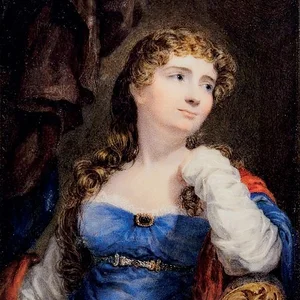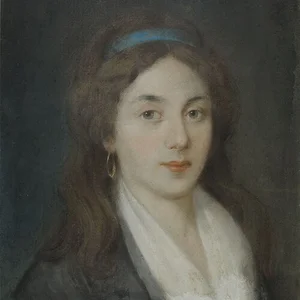

Daughter of Scipio Africanus and wife of Tiberius Sempronius Gracchus, Cornelia (c. 190–100 BC) is the model of the virtuous Roman matron. She raised her twelve children alone after being widowed, refusing a royal remarriage. She is famous for pointing to her sons Tiberius and Gaius as "her most precious jewels."
Cornelia(190 av. J.-C. — 100 av. J.-C.)
Éléonore Duplay
France
7 min read
Frequently asked questions
Famous Quotes
« "These are my jewels," she said, pointing to her sons Tiberius and Gaius when a woman showed her her ornaments (reported by Valerius Maximus, IV, 4)»
Key Facts
- Around 190 BC: born, daughter of Scipio Africanus, conqueror of Hannibal
- Around 172 BC: married Tiberius Sempronius Gracchus, consul and censor
- 163 BC: widowed, she declines the hand of King Ptolemy VIII of Egypt
- 133 and 121 BC: assassinations of her sons, the tribunes Tiberius and then Gaius Gracchus
- Around 100 BC: died at Misenum; she received public honors and a statue was erected in her name
Works & Achievements
Preserved fragments of Cornelia's correspondence with her son Gaius, in which she urges him to temper his political ambitions for the sake of the Republic. These letters are among the rarest surviving examples of a female voice in Latin literature.
Cornelia personally organized and oversaw her sons' education, bringing in the finest Greek rhetoricians. This pedagogical achievement was universally recognized as the source of the Gracchi's eloquence and cultural refinement.
Cornelia is said to have written memoirs about her sons' lives and her own recollections, cited by ancient authors. These texts are now lost, but their very existence speaks to her literary engagement.
Anecdotes
One day, a Roman matron was showing off her precious jewels to Cornelia and asked her to display her own in return. Cornelia waited for her sons Tiberius and Gaius to come home from school, then gestured toward them: "These are my jewels." This remark, recorded by Valerius Maximus, became one of the most celebrated sayings of Antiquity.
After the death of her husband Tiberius Sempronius Gracchus, King Ptolemy VIII of Egypt sent word asking for her hand in marriage. Cornelia refused, preferring to remain a widow so she could devote herself to raising her children. This rejection of a royal crown was universally praised by the Romans as an act of moral greatness.
Cornelia personally oversaw her sons' education by bringing the finest Greek rhetoricians to Rome. She spoke to them in both Greek and Latin with equal fluency, and her letters reveal a literary and philosophical culture that was exceptional for a woman of her time.
After the tragic deaths of both her sons — Tiberius assassinated in 133 BC, Gaius forced to suicide in 121 BC — Cornelia retired to her villa at Misenum. There she received scholars and philosophers, and spoke of her sons without tears, as though recounting the story of men from a heroic age, according to Plutarch.
Cornelia was the first Roman woman to have a statue erected in her honor during her own lifetime. The inscription read simply: "Cornelia, mother of the Gracchi." This statue, placed in a public space, was a remarkable mark of recognition for a Roman citizen.
Primary Sources
You will tell me that it is a fine thing to take revenge on one's enemies. This seems great and noble to me, provided it can be done without putting the Republic at risk. But if that is not possible, let our enemies live long and continue doing what they do, rather than see the Republic ruined and destroyed.
It is said that Cornelia bore the death of her sons with nobility and greatness of soul, and that, speaking of the sacred places where they had been slain, she said they had received tombs worthy of their virtues.
A wealthy woman who had been boasting of her jewels in front of Cornelia wished to see hers. Cornelia delayed the conversation until her sons returned from school, then said: 'These are my jewels.'
We have read the letters of Cornelia, mother of the Gracchi: it is clear that her sons were raised not so much in their mother's lap as in her language.
Key Places
The Palatine was Rome's aristocratic district, home to its most prominent families. Cornelia lived there surrounded by Greek tutors she had personally chosen to educate her sons.
After the death of her sons, Cornelia retired to her villa at Misenum, on the Bay of Naples. She continued to receive philosophers and scholars there until her death, around 100 BC.
It was in the Forum that a public statue of Cornelia was erected, bearing the inscription "Cornelia, Mother of the Gracchi." This site symbolized Rome's exceptional recognition of her legacy.
Carthage was finally destroyed in 146 BC by Scipio Aemilianus, Cornelia's cousin. Her father Scipio Africanus had already written the family into Roman history with his defeat of Hannibal in 202 BC.
Liens externes & ressources
Références
Œuvres
Lettres à Caius Gracchus
vers 124 av. J.-C.
Éducation de Tiberius et Caius Gracchus
vers 160-140 av. J.-C.
Mémoires (perdus)
après 121 av. J.-C.