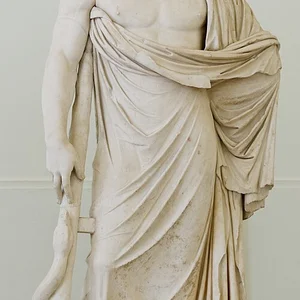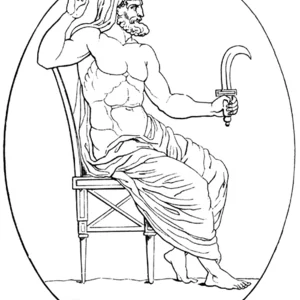

Cronos is the youngest of the Titans, son of Uranus and Gaia. He overthrew his father, ruled over the Golden Age, then devoured his own children for fear of being dethroned. Zeus, saved by his mother Rhea, eventually defeated him.
Cronos
Cronos
8 min read
Frequently asked questions
Key Facts
- Son of Uranus (the Sky) and Gaia (the Earth), youngest-born of the Titans
- Castrated his father Uranus with a flint sickle on Gaia's orders
- Married his sister Rhea and ruled over the gods during the Golden Age
- Swallowed five of his children (Hestia, Demeter, Hera, Hades, Poseidon) to ward off the prophecy of his downfall
- Was overthrown by his son Zeus during the Titanomachy and banished to Tartarus (or the Isles of the Blessed, depending on the source)
Works & Achievements
The founding act by which Cronus ended the tyranny of Ouranos and freed the Titans from their oppression. This feat inaugurated a new cosmic era: the reign of the Titans.
Under Cronus's rule, the first generation of humanity lived in absolute bliss, free from toil and suffering. Hesiod presents this age as the model of lost innocence and happiness.
Cronus led the Titans in a ten-year war against the Olympians. Though ultimately defeated, this resistance lies at the heart of the cosmic order as described by Hesiod in the Theogony.
According to some mythographers, Cronus — pardoned by Zeus — reigns over the paradise of virtuous heroes, rehabilitated as the benevolent guardian of an ideal world at the edges of the universe.
Anecdotes
Cronus was persuaded by his mother Gaia to overthrow his father Uranus, who had imprisoned his brothers — the Cyclopes and the Hecatoncheires — in the depths of Tartarus. Armed with an adamantine sickle forged by Gaia, he castrated Uranus and seized power over the cosmos, ushering in the reign of the Titans over the world.
Despite his triumph over his father, Cronus fell prey to a prophecy: an oracle foretold that one of his own children would dethrone him, just as he had overthrown Uranus. Fearing this fate, he swallowed each of his children at birth — Hestia, Demeter, Hera, Hades, and Poseidon all vanished into his belly.
His wife Rhea, desperate at the birth of Zeus, devised a trick to save the newborn: she wrapped a stone in swaddling clothes and presented it to Cronus, who swallowed it without suspicion. Zeus was then secretly raised in Crete, in a cave on Mount Ida, nursed by the divine goat Amalthea.
According to Hesiod, the reign of Cronus corresponded to the Golden Age of humanity: people lived like gods, free from pain and old age, in abundance and peace. This sense of longing is one of the earliest literary expressions of the lost paradise myth in Western culture.
After his defeat in the Titanomachy, Cronus was bound and cast into Tartarus. Some later versions of the myth, particularly in Pindar, grant him a kinder fate: Zeus is said to have pardoned him, and Cronus now rules over the Isles of the Blessed, a paradise for heroes who died virtuously.
Primary Sources
And great Cronos the wily answered her at once: 'Mother, I will undertake to do this deed, for I care nothing for our father of evil name.' So he spoke, and the great Gaia rejoiced greatly in her heart.
First of all, the deathless gods who dwell on Olympus made a golden race of mortal men. They lived like gods, their hearts free from sorrow, untouched by pain and misery; nor did wretched old age come upon them.
Cronos rules over the Isle of the Blessed, where the ocean breezes blow forever, and golden flowers blaze — some on land from gleaming trees, others fed by the sea.
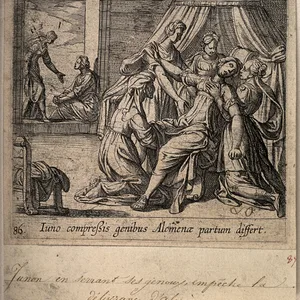
Cronos married Rhea; and since both Gaia and Ouranos had foretold that he would be overthrown by his own son, he swallowed his children as they were born. He swallowed Hestia first, then Demeter and Hera, then Hades and Poseidon.
Key Places
Fortress of the Titans and residence of Cronus during the Titanomachy. From this summit, Cronus and his allies led their resistance against Zeus and the Olympians for ten years.
A primordial abyss located beneath the Underworld, as far below the Earth as the sky is above it. Cronus was imprisoned there after his defeat, guarded eternally by the Hecatoncheires according to Hesiod.
The place where Zeus was hidden and secretly raised, sheltered from Cronus. The Curetes clashed their shields together to drown out the cries of the divine infant and outwit the watchful Titan.
The omphalos of Delphi — the stone that Cronus had swallowed in place of Zeus — was later enshrined at this sacred site and displayed as the symbolic navel of the Greek world.
According to Pindar, after his reconciliation with Zeus, Cronus would rule over this mythical paradise located beyond the Ocean, where the souls of heroes and the righteous find their rest.
Typical Objects

Emblematic weapon forged by Gaia and entrusted to Cronus to castrate Uranus. It symbolizes the breaking of the ancient cosmic order and the transfer of power between divine generations.

The stone Rhea substituted for Zeus to deceive Cronus. After being regurgitated, it was consecrated at Delphi as the navel of the world, at the heart of Apollo's sanctuary.

After his defeat during the Titanomachy, Cronus was chained in the depths of Tartarus. These bonds symbolize the subjugation of the primordial powers to the victorious Olympian gods.

Associated with the Golden Age, the golden cup evokes the abundance and bliss of Cronus's reign — a mythical era when wine, honey, and grain flowed freely for humankind.

In later iconography, Cronus was conflated with Chronos, the personified god of Time, and often depicted holding an hourglass, enriching his symbolism as the force of time that devours all things.

Seat of Titanic power from which Cronus ruled the cosmos during the Golden Age. Mount Othrys, the Titans' stronghold in Thessaly, stands in symbolic opposition to the Olympian gods' Mount Olympus.
School Curriculum
Vocabulary & Tags
Key Vocabulary
Daily Life
Morning
Cronus sits enthroned atop Mount Othrys at the dawn of the world, surveying the expanse of his reign from his titanic dwelling. The Titans, his brothers and sisters, gather in council to govern the natural forces of the cosmos — the seasons, the harvests, the rivers and the winds.
Afternoon
During the Golden Age, Cronus ensures that abundance reigns on earth: fields are carpeted with wheat without need for plowing, and streams run with honey. He receives the homage of the first generation of men, who live under his protection in absolute peace, untouched by death and hardship.
Evening
In the evening, Cronus feasts with the Titans around tables laden with ambrosia and nectar. Yet beneath this apparent calm, the anxiety of prophecy smolders: each night he watches over his children, dreading that one of them will fulfill the fate destined to overthrow him. This obsessive fear drives him to devour his own sons and daughters.
Food
As a Titan god, Cronus feeds on ambrosia and drinks nectar, the divine sustenance that grants immortality. Myth depicts him swallowing his own children — an act that goes beyond nourishment to symbolize the devouring nature of time and the terror of inexorable fate.
Clothing
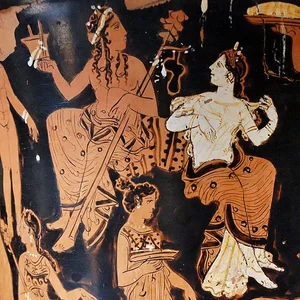
Cronus is depicted on archaic Greek vases wearing a long, heavy chiton, often in dark or golden-bronze hues, clasped at the shoulder. He wears a draped cloak befitting his nature as a primordial deity, and carries the adamantine sickle as the emblem of his titanic power.
Housing
His home is Mount Othrys in Thessaly, the natural fortress of the Titans. Before his fall, he rules from a cosmic palace of stone and gold, open to sky and earth alike. After the Titanomachy, his dwelling becomes Tartarus — an abyss of eternal darkness located at the deepest bounds of the universe.
Historical Timeline
Period Vocabulary
Visual Style
Un Titan colossal à l'aspect archaïque et sévère, mêlant l'austérité de la céramique grecque ancienne aux ors déclinants d'un cosmos primordial basculant dans l'ombre.
Sound Ambience
Une atmosphère primordiale et sombre : grondements telluriques profonds, résonances métalliques de la faucille d'adamant, et silence pesant des abîmes traversé par des éclairs lointains de la foudre de Zeus.
Liens externes & ressources
Références
Œuvres
Renversement d'Ouranos
Temps mythiques primordiaux
Règne de l'Âge d'Or
Temps mythiques primordiaux
Conduite de la Titanomachie
Temps mythiques — avant l'Olympe
Gouvernance des Îles des Bienheureux
Tradition tardive (Pindare, Ve s. av. J.-C.)