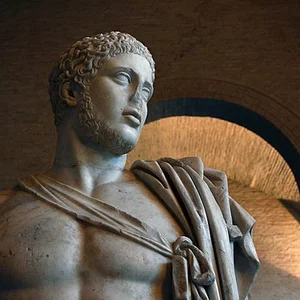

Hero of Greek mythology, king of Argos and son of Tydeus, Diomedes is one of the greatest Greek warriors of the Trojan War. Renowned for his exceptional bravery, he dared to wound the gods Ares and Aphrodite in battle.
Diomedes
Diomedes
9 min read
Frequently asked questions
Key Facts
- Son of Tydeus, one of the Seven Against Thebes, and Deipyle, daughter of Adrastus
- King of Argos, one of the most powerful cities in legendary Greece
- During the Trojan War, he wounds both Aphrodite and Ares — an extraordinarily rare feat for a mortal (Iliad, Book V)
- Protégé of Athena, who guides his hand and sight to allow him to perceive the gods
- Joins Odysseus in stealing the Palladium (Troy's sacred statue) and on the night raid against Rhesus
Works & Achievements
The primary source on Diomedes: Book V is almost entirely devoted to him (aristeia). He appears as the most valiant of the Greeks after Achilles, achieving the unique feat of wounding two Olympian gods.
An epic from the Trojan Cycle, now lost, whose ancient summaries attest that it recounted the theft of the Palladium by Diomedes and Odysseus — a decisive episode for the fall of Troy.
A victory ode in which Pindar evokes the exceptional fate of Diomedes, whom some traditions presented as having been granted immortality by Athena as a reward for his piety and his exploits.
Virgil portrays Diomedes as a veteran exiled in Italy who refuses to take up arms again against Aeneas's Trojans, symbolically reconciling Greeks and Trojans in the founding of Rome.
A mythological compilation gathering the traditions surrounding Diomedes: his genealogy, exploits at Troy, theft of the Palladium, difficult homecoming, and the founding of cities in Magna Graecia.
Anecdotes
During the great aristeia of Book V of the Iliad, Diomedes achieves an exploit unparalleled in all of Greek mythology: guided by the goddess Athena, he wounds Aphrodite herself — who was trying to protect Aeneas — and then attacks Ares, the god of war in person. This double affront to the gods illustrates his extraordinary valor and the divine favor he enjoyed.
During the Doloneia, the night mission recounted in Book X of the Iliad, Diomedes and Odysseus infiltrate the Trojan camp. They capture the spy Dolon, then slaughter Rhesus and his Thracians in their sleep, making off with their famous white horses — a night of exploits that would go down in the annals of the war.
Diomedes and Odysseus seized the Palladium, a sacred statue of Athena whose possession was said to guarantee Troy's invincibility. Without this relic, the city could not fall: their bold raid paved the way for its final destruction.
In Book VI of the Iliad, Diomedes encounters the Lycian Glaucus on the battlefield. Learning that they are bound by an ancient guest-friendship between their ancestors, the two warriors refuse to fight and exchange their armor — but Diomedes ends up with Glaucus's bronze armor in return for his own golden one. Homer comments with dry irony that he had taken leave of his senses.
Unlike many Greek heroes, Diomedes returned quickly from Troy, but found his kingdom of Argos in turmoil: his wife had been unfaithful and his enemies had seized power. He went into exile in Apulia (in present-day southern Italy), where he founded several cities, including Arpi, becoming the legendary founder of that region.
Primary Sources
Then Pallas Athena breathed strength and daring into Diomedes, son of Tydeus, so that he might distinguish himself above all the Argives and win undying glory. She made a tireless flame blaze from his helmet and shield, like the star of late summer that shines with incomparable brilliance after rising fresh from the Ocean.
Diomedes of the great war-cry leapt forward and struck off the head of Rhesus; dark blood poured into the earth. Odysseus untied the horses and led them out of the camp, striking them with his bow, since he had not thought to bring the shining whip.
Zeus, son of Cronus, had taken away the wits of Glaucus, who exchanged armor with Diomedes, son of Tydeus — gold for bronze, a hundred oxen's worth for nine.
Diomedes himself, from his exile in Apulia, bears witness: 'We have paid enough for our crime of raising arms against the gods. Even Priam would pity us. The storms of Pallas scattered us to the four corners of the world.'
Diomedes and Odysseus entered Troy by night and carried off the Palladium. Some say that Odysseus plotted to seize it for himself alone, but Diomedes got there first and brought the statue back to the Greek camp.
Key Places
The city of which Diomedes is king, heir to the throne of his father Tydeus. It is from here that he sets out to join the Greek coalition, and here he returns after Troy, only to find his kingdom usurped.
The fortress city in Asia Minor and the main stage for Diomedes' exploits. It is beneath its walls that he performs his legendary aristeia, wounds two gods, and infiltrates under cover of night to steal the Palladium.
The plain crossed by the Scamander river, at the foot of the Trojan walls, is the battlefield where Diomedes accomplished his greatest feats, wounding Ares and Aphrodite in the face of the Trojan warriors.
A city founded according to legend by Diomedes during his exile in what is now southern Italy. His hero cult was very much alive there in antiquity, and several cities in the region claimed his founding.
Home of the Greek gods, Olympus is indirectly linked to Diomedes: he was the only mortal in the Iliad to wound two Olympian deities, earning both the terror and the admiration of all Olympus.
Typical Objects

The primary weapon of the Greek warrior, the long ash-wood spear tipped with bronze is the instrument with which Diomedes wounds Aphrodite and then Ares. It symbolizes the hero's strength — a force that even the gods cannot extinguish.

The bronze helmet topped with a horsehair crest is the hallmark of Homeric heroes. During Diomedes' aristeia, Athena causes a divine flame to blaze from it, marking him before all as her chosen champion.

A large circular shield of leather and bronze decorated with geometric motifs. Homer describes the supernatural flame burning on Diomedes' shield during his great exploit in Book V, a dazzling sign of Athena's favor.

The sacred statue of Athena kept within the citadel of Troy, whose possession guaranteed the city's invincibility. Diomedes and Odysseus stole it during a perilous night mission, thereby making the fall of Troy possible.

A two-horse combat vehicle and mark of a great warrior's status in Homeric epic. Driven by his squire Sthenelus, Diomedes' chariot allows him to charge down upon the enemy — and to intercept the gods themselves.

During the exchange with the Lycian Glaucus, Diomedes receives armor worth a hundred oxen in return for his own, worth only nine. Homer wryly notes the unequal swap, attributing the hero's poor judgment to the will of the gods.
School Curriculum
Vocabulary & Tags
Key Vocabulary
Tags
Daily Life
Morning
Diomedes begins his day with libations and prayers to Athena, whose favorite he is among all the Greek heroes. He then inspects his Argive troops camped near the ships and holds council with Agamemnon, Odysseus, and the other kings to plan the day's fighting.
Afternoon
The afternoon is devoted to combat on the plains of Troy. Diomedes mounts his chariot, driven by his faithful squire Sthenelus, and charges into the fray in search of the finest Trojan warriors. Battle rages from morning until sunset, with neither side granting a truce.
Evening
In the evening, Diomedes returns to the Greek camp near the ships drawn up on the beach. He takes part in funeral rites for fallen comrades, joins in banquets of roasted meat and water-mixed wine, and sits in the deliberations of the council of kings, where his counsel is heard with respect.
Food
Like all Homeric heroes, Diomedes subsists mainly on beef or mutton roasted on iron spits over the embers, accompanied by barley bread and red wine mixed with water. Communal meals around the fire seal the bonds of camaraderie among warriors.
Clothing
Outside of battle, Diomedes wears a woolen tunic (chiton) and a cloak (chlamys) in the colors of Argive aristocracy. In combat, he dons his full bronze armor: greaves, breastplate, crested Corinthian helmet, and a warrior's cape fastened at the shoulders.
Housing
On the beach at Troy, Diomedes lives in a wooden hut (klisia) set up near his ships, where he stores his weapons and receives his companions. In Argos, he occupies a megaron palace — a great central hall with a circular hearth and royal throne — typical of Mycenaean Bronze Age architecture.
Historical Timeline
Period Vocabulary
Visual Style
Style inspiré des vases à figures rouges de la Grèce classique : Diomède en guerrier héroïque bardé de bronze incandescent, auréolé de la flamme divine d'Athéna, sur fond de plaine troyenne aux tons ocre et or.
Sound Ambience
L'ambiance sonore de Diomède mêle le fracas des armes de bronze, le grondement des chars de guerre et les cris de la mêlée troyenne, avec une resonance surnaturelle lorsque la déesse Athéna fait jaillir sa flamme divine sur l'armure du héros.
Liens externes & ressources
Références
Œuvres
Iliade (chants V, VI, X, XI) — Homère
VIIIe siècle av. J.-C.
La Petite Iliade — Leschès de Mytilène (fragments)
VIIe siècle av. J.-C.
Néméennes X — Pindare
Ve siècle av. J.-C.
Énéide, chant XI — Virgile
19 av. J.-C.
Bibliothèque (Épitomé) — Pseudo-Apollodore
Ier-IIe siècle ap. J.-C.