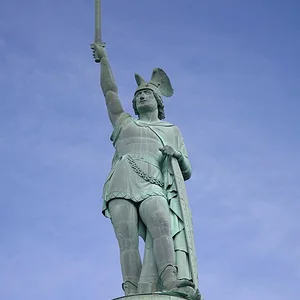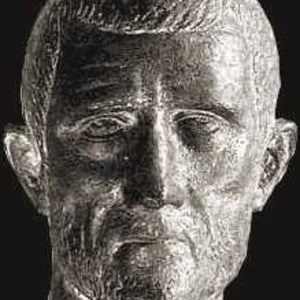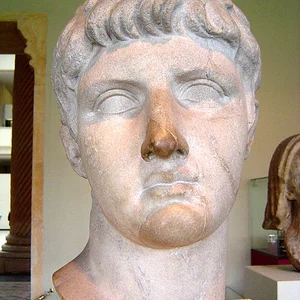

Roman general and statesman, son of Livia and stepson of Augustus. He led the campaigns of conquest in Germania as far as the Elbe before dying prematurely from the effects of a fall from his horse. He was the father of the emperor Claudius and of Germanicus.
Drusus(37 av. J.-C. — 8 av. J.-C.)
Nero Claudius Drusus
Rome antique
7 min read
Frequently asked questions
Key Facts
- Born in 38 BC, son of Livia Drusilla and stepson of the emperor Augustus
- Elected consul in 9 BC
- Led the military campaigns in Germania from 12 to 9 BC, reaching the river Elbe
- Father of the future emperor Claudius and of the general Germanicus
- Died in 9 BC in Germania from the effects of a fall from his horse, and honored with the posthumous surname “Germanicus”
Works & Achievements
Alongside his brother Tiberius, Drusus subdues the Alpine peoples, securing the routes between Italy and the Rhine. A first major campaign that reveals his military talents.
A canal linking the Rhine to the lakes and the North Sea, allowing the Roman fleet to bypass the Germanic tribes. An ambitious work of military engineering.
A series of four campaigns that lead the Roman legions from the Rhine all the way to the Elbe, subduing many tribes. The furthest-reaching attempt to conquer Germania.
Drusus has fortified camps built (such as Oberaden and Haltern) to anchor the Roman presence in Germanic territory. A logistical base for the future province he envisioned.
As governor of the Gauls, Drusus inaugurates the altar dedicated to Rome and Augustus at Lyon, a symbol of the imperial cult and of the unity of the three Gauls.
Posthumously, the Senate grants Drusus and his descendants the honorific title of Germanicus, in recognition of his victories. A legacy passed on to his son.
Anecdotes
Drusus was born barely three days before Augustus married his mother Livia, which led the Romans to joke that "lucky people have children in three months." Augustus left the child with his biological father, but took him back upon the father's death to raise him himself.
During his campaigns in Germania, Drusus is said to have had a great canal dug linking the Rhine to the North Sea, the *fossa Drusiana*, to allow his fleet to take the tribes from the rear. This work testifies to the scale of his ambitions for conquest beyond the river.
Legend has it that, as he marched toward the Elbe, Drusus met a woman of superhuman size, a Germanic figure, who ordered him to turn back, predicting that his end was near. Shortly afterward, he fell from his horse, breaking his leg, and died thirty days later.
When Drusus fell gravely ill in Germania, his brother Tiberius rode an extraordinary distance on horseback in record time to reach him and found him still alive. Tiberius then escorted the body back to Rome on foot, walking ahead of the funeral procession.
To honor his victories, the Senate granted Drusus and his descendants the hereditary surname "Germanicus." This title was borne with pride by his son, the famous general Germanicus, but the name remained attached to the memory of the conqueror who died too soon.
Primary Sources
Drusus, after holding the offices of quaestor and praetor, took command of the war in Raetia, and then of the one in Germania. He was the first Roman general to sail upon the northern ocean.
Drusus advanced as far as the Elbe, ravaging everything in his path; but he was unable to cross the river and, having raised trophies, he turned back. On the return journey, he died from a fall from his horse before reaching the Rhine.
Drusus, having subdued many Germanic nations, died of an illness brought on by a fracture caused by the fall of his horse, on the thirtieth day after the accident.
Drusus lies, torn from his homeland, in a foreign land, and the German soil keeps the man he had conquered. His mother weeps for a son whose glory matched his youth.
Key Places
Capital of the Empire where Drusus was born, was raised by Augustus, and held his magistracies (quaestorship, praetorship). His solemn funeral took place there.
Major Roman military base on the Rhine that served as the starting point for Drusus's campaigns in Germania. A funerary monument, the Drususstein, was erected there in his memory.
Capital of the Gauls where Drusus resided as governor and where his son, the future emperor Claudius, was born in 10 BC.
Eastern limit reached by Drusus in 9 BC, the furthest point ever reached by a Roman army in Germania. He raised trophies there before turning back.
The theater of Drusus's campaigns of conquest against the Germanic tribes (Sicambri, Cherusci, Chatti). It was on the return journey that he suffered the fatal fall from his horse.
Typical Objects

Short double-edged sword, the standard sidearm of the Roman legionary, designed for thrusting in close combat. Drusus, at the head of his legions, led troops equipped with this fearsome weapon.

Heavy javelin of the legionary, whose iron shank bent on impact to render enemy shields unusable. It was thrown in a volley before the lines clashed.

Body armour protecting the torso, worn by Roman officers and soldiers, often made of articulated iron plates or reinforced leather. Generals like Drusus wore an ornate cuirass (lorica musculata).

Victory monument raised on the battlefield with the weapons taken from the enemy. Drusus erected several to mark his advance as far as the Elbe.

Honorary insignia (embroidered toga, laurel crown, sceptre) granted to a victorious general in place of a full triumph. Drusus received them for his Germanic campaigns.

Sacred standard of silver or gold depicting an eagle, carried at the head of each legion. Losing the eagle was the worst dishonour a Roman army could suffer.
School Curriculum
Vocabulary & Tags
Key Vocabulary
Daily Life
Morning
On campaign, Drusus rose before dawn to receive the watchword from his officers and inspect the fortified camp. Like every Roman general, he consulted the auspices and offered a sacrifice to the gods before any important decision.
Afternoon
The afternoon was devoted to approach marches, the building of fortified camps, or military operations against the Germanic tribes. Drusus often shared the hardships of his soldiers, directing the maneuvers from the field.
Evening
In the evening, sheltered within the camp, he held council with his legates and studied the scouts' reports on enemy movements. In Rome or in Gaul, he took part in banquets and maintained his political network in the service of Augustus.
Food
The Roman soldier's diet was based on wheat turned into porridge or bread, supplemented with dried legumes, cheese, bacon, and wine cut with water. A general like Drusus had access to a richer table, yet he was praised precisely for his sobriety in sharing the ordinary fare of the troops.
Clothing
In battle, Drusus wore the ornate officer's cuirass (*lorica*), a plumed helmet, and the red cloak (*paludamentum*) marking his command. In a civilian setting in Rome, he donned the purple-bordered toga (*toga praetexta*) tied to his duties as a magistrate.
Housing
On campaign, he lodged in the general's great tent (*praetorium*) at the heart of the legionary camp. In Rome, as a member of the imperial family, he resided in a rich *domus* on the Palatine, close to Augustus and Livia.
Historical Timeline
Period Vocabulary
Liens externes & ressources
Références
Œuvres
Conquête des Alpes (Rhétie et Vindélicie)
15 av. J.-C.
Fossa Drusiana (canal de Drusus)
vers 12 av. J.-C.
Campagnes de Germanie
12-9 av. J.-C.
Établissement de forts sur le Rhin et la Lippe
11-9 av. J.-C.
Autel de Lugdunum (Ara trium Galliarum)
12 av. J.-C.
Obtention du surnom « Germanicus »
9 av. J.-C.