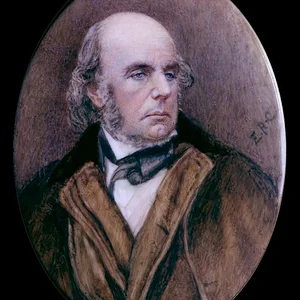

19th-century British poet and translator, celebrated for his free translation of the Rubaiyat of Omar Khayyam (1859), which achieved remarkable success across Europe and helped introduce Persian poetry to Western readers.
Edward FitzGerald(1809 — 1883)
Edward FitzGerald
Royaume-Uni, Royaume-Uni de Grande-Bretagne et d'Irlande
9 min read
Frequently asked questions
Famous Quotes
« A Book of Verses underneath the Bough, / A Jug of Wine, a Loaf of Bread—and Thou.»
« The Moving Finger writes; and, having writ, / Moves on.»
Key Facts
- Born in 1809 in Bredfield (Suffolk, England), died in 1883
- Published his translation of the Rubaiyat of Omar Khayyam anonymously in 1859
- His translation, initially overlooked, was rediscovered by Dante Gabriel Rossetti and the Pre-Raphaelites
- Friend of Tennyson and Thackeray, a prominent figure in Victorian literary circles
- Also translated plays by Calderón and works from ancient Greek
Works & Achievements
A free translation of the quatrains of the Persian poet Omar Khayyam. Initially ignored, the work became a worldwide bestseller after its rediscovery by the Pre-Raphaelites and profoundly influenced English-language literature in the late 19th century.
A philosophical dialogue inspired by the Platonic tradition, exploring questions of education, youth, and the English national character. It reveals FitzGerald's solid classical training and his taste for moral reflection.
An anthology of maxims and proverbs drawn from various authors, reflecting the practical wisdom FitzGerald admired. It bears witness to his wide learning and his fondness for aphoristic literature.
Free translations of six plays by the great Spanish dramatist Pedro Calderón de la Barca. These adaptations reveal FitzGerald's talent for making foreign texts his own and bringing them to life in the English language.
A translation of the Persian allegorical poem by Jami, and FitzGerald's first major engagement with Persian literature before the Rubaiyat. It attests to his study of Persian and his growing fascination with Eastern poetry.
A free translation of the celebrated Greek tragedy, showing the enduring interest FitzGerald maintained in classical texts throughout his career, alongside his work on Eastern poetry.
A collection of FitzGerald's correspondence with Tennyson, Thackeray, Cowell, and others. Regarded as a masterpiece of Victorian epistolary prose, the letters reveal an endearing personality and a sharp-eyed observer of his age.
Anecdotes
When FitzGerald published his translation of the Rubaiyat of Omar Khayyam in 1859, the book passed entirely unnoticed. The publisher Bernard Quaritch eventually sold off unsold copies for a penny each at a secondhand bookstall. It was there that the Pre-Raphaelite poet Dante Gabriel Rossetti stumbled upon it by chance and, captivated, circulated it through London's literary circles, sparking a genuine Orientalist craze across England.
FitzGerald was a man of painful shyness who shunned social life. He lived in Woodbridge, Suffolk, and spent entire days sailing his boat in the company of local fishermen whose plain-spoken candour he prized. This rustic way of life stood in striking contrast to his aristocratic upbringing and his friendships with celebrated figures such as Tennyson and Thackeray.
In 1856, FitzGerald married Lucy Barton, daughter of his friend the Quaker poet Bernard Barton, out of a sense of duty to the family of the recently deceased. The marriage was a complete disaster: the couple separated after only a few months. FitzGerald himself acknowledged in his letters that he had been a dreadful husband, with a self-deprecating wit that was thoroughly British.
It was the scholar Edward Cowell who opened Persian poetry to FitzGerald, teaching him the language and showing him a manuscript of Omar Khayyam's quatrains at the Bodleian Library in Oxford. FitzGerald never sought to produce a faithful translation: he freely reworked the quatrains, infusing them with his own melancholy, and created a work that belongs as much to himself as to Khayyam.
Despite the belated fame of his translation, FitzGerald steadfastly refused honours and social engagements. When admirers came to visit him in Woodbridge, he would advise them not to make the journey. He died in his sleep in 1883, never fully grasping how profoundly his Khayyam would go on to influence writers such as Oscar Wilde and whole generations of readers well into the twentieth century.
Primary Sources
Awake! for Morning in the Bowl of Night / Has flung the Stone that puts the Stars to Flight: / And Lo! the Hunter of the East has caught / The Sultan's Turret in a Noose of Light.
I take old Omar more as my property than as a version of anything: something to be proud of, and something to ask pardon for.
I am settled down into a very quiet and rather happy life here, doing nothing that the world calls great, but perhaps something that will amuse a few people hereafter.
We talked of the great world — of action and of ambition — and of those who fall short of both, who live and die unnoticed, and yet are not therefore to be pitied.
Key Places
A small port town in Suffolk where FitzGerald spent most of his adult life in voluntary retreat. It was here that he worked on his translations and led the existence of a solitary gentleman-scholar, far from the drawing rooms of London.
The university where FitzGerald studied between 1826 and 1830, forging friendships with Thackeray, Tennyson, and other future luminaries of Victorian literature. These formative years shaped his literary tastes and lifelong friendships.
It was in this library that Edward Cowell discovered and showed FitzGerald a manuscript of Omar Khayyam's quatrains, sparking the intellectual and poetic adventure that would bring the translator lasting fame.
A village in Suffolk where FitzGerald is buried in the parish churchyard. A rose bush planted on his grave grew from cuttings taken from a rose growing on Omar Khayyam's tomb in Nishapur, Iran — a symbol of the bond between the two poets across time.
FitzGerald loved sailing along the Suffolk coast and spent time among local fishermen, whose plain-spoken company he greatly enjoyed. These windswept maritime landscapes fed his melancholy and poetic sensibility.
Typical Objects

FitzGerald worked from copies of Omar Khayyam's quatrains obtained for him by Professor Cowell. These pages covered in Persian script were at the heart of his patient work of translation and reinterpretation.

A devoted tobacco enthusiast, FitzGerald smoked his pipe during long reading and writing sessions at his retreat in Suffolk. This typically Victorian habit accompanied his studious afternoons and evenings spent writing letters.

FitzGerald owned a sailing boat he had nicknamed 'Scandal', on which he sailed along the River Deben and the Suffolk coast. These trips out to sea provided him with the solitude and contemplation essential to his wellbeing.

FitzGerald was a prolific letter-writer, and his letters to Tennyson, Thackeray, and Cowell are considered masterpieces of the form. Thousands of preserved letters bear witness to his inner life and literary friendships.

To learn Persian under Cowell's guidance, FitzGerald equipped himself with grammars and dictionaries that were rare in England at the time. These philological tools were indispensable to the development of his translation of the Rubaiyat.

As a man of classical education, FitzGerald owned an extensive library of ancient authors. He translated Aeschylus's Agamemnon, among other works, revealing a passion for the foundational texts of Western civilization that coexisted with his orientalism.
School Curriculum
Vocabulary & Tags
Key Vocabulary
Tags
Daily Life
Morning
FitzGerald rose early and began his day with a long walk around Woodbridge or along the River Deben. He would then read the newspapers and his mail — a voluminous correspondence that served as his vital link to the intellectual world he had deliberately left behind.
Afternoon
Afternoons were devoted to translation work and reading in his study, surrounded by dictionaries and manuscripts. He would sometimes go sailing or visit the local fishermen, whose straightforward company he preferred to that of literary figures.
Evening
In the evenings, FitzGerald smoked his pipe, read English or Greek classics, and wrote his long letters to Tennyson, Thackeray, or Cowell. These letters, composed in a lively and ironic style, were his true personal diary and his nightly creative outlet.
Food
FitzGerald had simple tastes, close to those of the rural Suffolk inhabitants he spent time with. He enjoyed unpretentious meals, fresh fish from the coast, and plentiful tea — served without the stiff formality of Victorian society from which he kept his distance.
Clothing
FitzGerald dressed casually for a gentleman of his standing, favouring comfort over elegance. He wore plain English wool garments, often behind the London fashions of the day, which earned him affectionate teasing from his friends.
Housing
FitzGerald first lived at Boulge Cottage, a small thatched dwelling on the family estate, before settling in modest lodgings in Woodbridge. He always refused to occupy the grand manor of Boulge Hall, preferring a simple life without unnecessary servants.
Historical Timeline
Period Vocabulary
Visual Style
Le style visuel associe l'orientalisme victorien — lumières chaudes, enluminures persanes dorées, tapis aux motifs complexes — à l'atmosphère mélancolique et verdoyante du Suffolk, traduisant le dialogue intérieur entre deux mondes que FitzGerald incarna tout au long de sa vie.
Sound Ambience
L'ambiance sonore de FitzGerald mêle le silence studieux de sa retraite campagnarde du Suffolk aux bruits de la nature maritime environnante — une solitude choisie, ponctuée par le rythme tranquille d'une vie victorienne à l'écart du monde.
Liens externes & ressources
Références
Œuvres
Rubaiyat of Omar Khayyam
1859 (1re éd.), 1868, 1872, 1879
Euphranor: A Dialogue on Youth
1851
Polonius: A Collection of Wise Saws and Modern Instances
1852
Six Dramas of Calderon
1853
Salaman and Absal
1856
Agamemnon (d'après Eschyle)
1865
Letters of Edward FitzGerald
publiées posthumement, 1889