
Legendary king of Athens and father of Theseus. Believing his son dead after spotting the black sails on his ship returning from Crete, he threw himself into the sea that now bears his name.
Aegeus
Aegeus
8 min read
Frequently asked questions
Key Facts
- Son of Pandion II, legendary king of Athens
- Father of Theseus, the hero who slew the Minotaur
- Forced by Minos to send a tribute of seven young Athenian men and seven young Athenian women to Crete
- Threw himself into the sea believing Theseus was dead, giving the Aegean Sea its name
- Married Medea after the quest for the Golden Fleece, before she betrayed him
Works & Achievements
Aegeus ruled Athens during a period of great vulnerability for the city, dominated by the Cretan power of Minos. His reign directly precedes the great unifying reforms attributed to his son Theseus.
Forced by Minos following the death of his son Androgeus in Athens, Aegeus was compelled to send seven young men and seven maidens every nine years to feed the Minotaur, sealing Athens' submission to the Cretan thalassocracy.
By offering his protection to Medea after she was driven out of Corinth, Aegeus honored the sacred code of xenia. This episode is notably depicted in Euripides' tragedy Medea (431 BC).
By hiding the sword and sandals beneath a rock at Troezen, Aegeus devised a dynastic recognition ritual that tied proof of lineage to physical strength, thereby ensuring the legitimacy of his successor.
Anecdotes
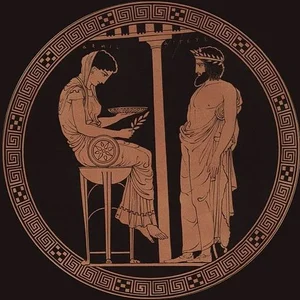
Before the birth of Theseus, Aegeus consulted the oracle at Delphi to learn whether he would have a son. The Pythia gave him a cryptic response: "Do not open the wineskin before you return to Athens." Unable to interpret this message, Aegeus stopped in Troezen at the court of King Pittheus, who deciphered the prophecy and arranged for him to meet his daughter Aethra — from that union, Theseus was born.
Before leaving Troezen, Aegeus hid his sword and sandals beneath an enormous rock. He told Aethra that when their son was strong enough to lift the stone, he should take these objects and travel to Athens to claim his birthright. Years later, the young Theseus lifted the rock with ease and recovered his father's legacy.
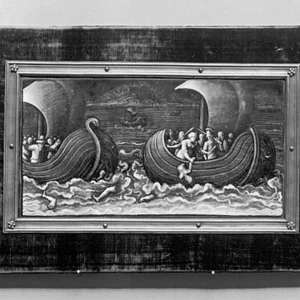
When Theseus decided to sail to Crete to face the Minotaur, the desperate Aegeus made him promise to hoist white sails on his return if he was alive, and leave the black sails if death had claimed him. Theseus, swept up in the joy of his victory, forgot this promise — and his father, catching sight of the black sails in the distance from Cape Sounion, threw himself into the sea.
Medea, after the catastrophe at Corinth, sought refuge with Aegeus in Athens. The king, who desperately longed for an heir, had once promised to take her in, in exchange for a cure for his infertility. When Theseus arrived at court, Medea tried to poison him — but Aegeus recognized his son's sword at the last moment and knocked away the fatal cup.
The Aegean Sea takes its name from the tragic death of the king of Athens. Since antiquity, the Greeks saw in these waters both a royal tomb and a monument to a father's love. This etymology, recorded by Diodorus Siculus and Plutarch, inscribed into the Mediterranean landscape the memory of a father who did not survive his grief.
Primary Sources
Aegeus slid his sword and sandals under a large rock and said to Aethra: "When our son is strong enough to lift this stone and take what I have hidden beneath it, send him to me." He also gave her black sails, saying to replace them with white ones if Theseus returned victorious.
Aegeus, having no children, consulted the Pythian oracle about offspring. The god told him not to loosen the mouth of the bulging wineskin before returning to Athens. Not understanding the oracle, he went to Pittheus at Troezen, who grasped its meaning and arranged for him to sleep with his daughter Aethra.
Aegeus: "I swear by the Earth, by the sacred Sun, and by all the gods, to receive you and protect you on my Athenian soil." Medea accepts his oath, seeing in him her only chance to escape the vengeance of Jason and Creon.
Some say that Aegeus gave his name to the sea by throwing himself from a cliff when he caught sight of the black sails, believing his son had perished in the battle against the Minotaur.
Medea, having come to Athens, prepared a subtle poison for Theseus; but Aegeus recognized the sword at the young man's side and knocked away the poisoned cup with a sweep of his hand, saving his son at the very last moment.
Key Places
Capital of Aegeus's legendary kingdom, the city of Athens was the heart of his reign. It was from its heights that he watched for the return of his son, who had gone to face the Minotaur in Crete.
A rocky promontory at the southern tip of Attica where Aegeus scanned the sea, waiting for Theseus to return. It was here that he is said to have thrown himself into the waves upon seeing the black sails of the ship.
A city in the Peloponnese where Aegeus stayed with King Pittheus and lay with Aethra. It was here that Theseus was born in secret, and where the sword was hidden beneath a great rock.
The sanctuary of Apollo where Aegeus consulted the oracle seeking an heir. The Pythia's cryptic answer indirectly shaped the entire destiny of the Athenian royal line.
The sea bordering Greece and Anatolia has borne the name of Aegeus since antiquity, in memory of his tragic death. It stands as a geographical monument to the memory of the king of Athens.
Typical Objects

A symbol of recognition and the transmission of power, this sword was placed by Aegeus under a rock at Troezen. It allowed Theseus to prove his royal identity when he brought it back to Athens.

Hidden alongside the sword beneath the rock at Troezen, the sandals formed the second token of dynastic recognition. They symbolize the journey ahead and the identity reclaimed.

Forgotten by Theseus on his victorious return from Crete, these mourning sails directly caused Aegeus's death. They symbolize the tragic misunderstanding between a father and his son.

Prepared by Medea to eliminate Theseus upon his arrival at court, the cup was knocked away at the last moment by Aegeus, who recognized his son. It embodies manipulation and the danger lurking at the heart of power.

The emblem of royal authority, it represents the dynastic legitimacy that Aegeus wished to pass on to an heir. His lack of a recognized child long undermined his hold over Athens.

Referenced in the Pythia's cryptic response, the wineskin symbolizes restraint and prudence. Not opening it before returning to Athens meant refraining from lying with a woman along the way — advice that Aegeus failed to understand.
School Curriculum
Vocabulary & Tags
Key Vocabulary
Daily Life
Morning
Aegeus begins his day with sacrifices and libations to the patron gods of Athens, especially Athena, protectress of the city. He then receives reports from his advisors on the state of the kingdom and the obligations owed to Minos of Crete — a constant concern throughout his reign.
Afternoon
The king presides over disputes and political decisions in the great megaron hall of his palace on the Acropolis. He may also receive foreign guests according to the sacred rules of xenia, the Greek code of hospitality, as was the case when Medea came seeking refuge.
Evening
In the evening, Aegeus withdraws to pour libations in honor of his ancestors and the heroes of his lineage. Growing old and without a recognized heir, he spends long hours watching the sea from the heights of the Acropolis, or consulting with seers about the oracles that promised him a son.
Food
Like all Greek kings of the mythic heroic age, Aegeus takes part in feasts of roasted meats — beef and mutton — at the ceremonial banquets that follow major sacrifices. His daily diet rests on the staples of ancient Greek eating: barley bread, olive oil, cheese, olives, and wine diluted with water.
Clothing
Aegeus wears the archaic Greek royal dress: a white linen chiton fastened at the shoulder, covered by a woolen himation dyed purple — a color reserved for persons of high rank. He wears strapped sandals and dons a diadem or leafy crown for religious ceremonies.
Housing
Aegeus lives in the Mycenaean palace on the Acropolis of Athens, a fortified stone residence built on the heights of the city. The central megaron — a great hall with a central hearth and columns — serves at once as throne room, banqueting hall, and place of worship; its walls are adorned with frescoes depicting mythological scenes and feats of war.
Historical Timeline
Period Vocabulary
Visual Style
Style céramique grecque à figures rouges : Égée en roi barbu sur les falaises surplombant la mer Égée, voiles noires à l'horizon, atmosphère tragique et solennelle d'une Grèce archaïque.
Sound Ambience
Ambiance côtière égéenne antique mêlant le fracas des vagues sur les falaises du cap Sounion, le vent marin, les sons du palais royal athénien et les échos lointains d'un port archaïque.
Liens externes & ressources
Références
Œuvres
Règne d'Athènes
Ère héroïque
Acceptation du tribut envers la Crète
Ère héroïque
Accueil de Médée à Athènes
Ère héroïque
Transmission des insignes royaux à Thésée
Ère héroïque