
Ehecatl is the Aztec god of wind, often identified with Quetzalcoatl in the composite form Ehecatl-Quetzalcoatl. He is regarded as the creative breath that set the world in motion and made the birth of the current sun possible.
Ehecatl
Ehecatl
9 min read
Frequently asked questions
Key Facts
- God of wind in the Aztec pantheon, often depicted wearing a duck-billed mask
- Frequently identified with Quetzalcoatl in the composite form Ehecatl-Quetzalcoatl
- Temples dedicated to him were built in a circular shape so as not to obstruct the wind
- In Aztec cosmogony, his breath was said to have set the sun and moon in motion after their creation
- Associated with the four cardinal directions and the winds that sweep across the world
Works & Achievements
A foundational cosmogonic act: Ehecatl blew upon the motionless sun and moon after their creation at Teotihuacan, setting them in motion for the first time. Without this decisive action, life on Earth would never have been possible.
According to the Annals of Cuauhtitlan, Ehecatl-Quetzalcoatl descended into the realm of the solar god Tonatiuh to bring back his musicians and their art. This heroic journey allowed humanity to receive music — a divine gift that lies at the foundation of all civilization.
As god of wind and breath, Ehecatl was also the one who breathed life into the first human beings. His role in the creation of humanity makes him a creator deity in the most fundamental sense.
In Aztec theology, Ehecatl systematically precedes the rain gods (the Tlaloque) by sweeping and preparing the celestial paths. His breath clears the way so that fertile clouds can reach the Earth.
Sacred architecture directly inspired by the god's nature: circular temples at Tenochtitlan, Calixtlahuaca, Cholula, and other sites were built in his honor, allowing the wind to circulate freely without being blocked by corners.
Anecdotes
During the creation of the fifth sun at Teotihuacan, the sun and the moon had just been lit but remained completely motionless in the sky. It was Ehecatl who, by blowing with all his might, managed to set them in motion. Without his powerful breath, the world would have remained frozen in eternal stillness.
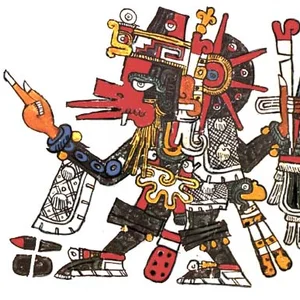
Ehecatl is recognizable among all Aztec gods by his red and black duck-beak mask, through which he blows the wind. This attribute appears on dozens of figurines and codex paintings preserved today in Mexican and European museums, making him immediately identifiable.
Temples dedicated to Ehecatl-Quetzalcoatl were circular in shape, unlike other Aztec temples which were pyramidal with right angles. This unique architecture allowed the wind to flow freely all around without being blocked by protruding corners — a building designed for its god that literally reflected his nature.
According to the Annals of Cuauhtitlan, it was Ehecatl-Quetzalcoatl who brought music to humanity by descending into the domain of the solar god to retrieve his musicians. He cleverly persuaded them to follow him and offer their songs to the world of the living, making him the founding god of the arts.
Ehecatl wore as a sacred ornament the ehecacozcatl, a marine shell pendant cut crosswise to reveal its inner spiral. This spiral, a universal symbol of wind and movement, was also associated with the conch shell, whose deep resonant sound imitated the voice of the wind during ritual ceremonies.
Primary Sources
The depictions of Ehecatl in the Codex Borgia show him with his duck-beak mask, his spiral pendant (ehecacozcatl), and his black ornaments — an active deity of breath and cosmic movement.
Ehecatl is the wind; he swept and cleared the roads, the paths for the rain gods (Tlaloque), so that they could come and bring the waters upon the earth.
And it is said that when the sun rose, it moved no more — it stood still in the sky. Then Ehecatl blew with all his force, and the sun was at last set in motion.
Quetzalcoatl, also known as Ehecatl, is the god of wind; it is he who sweeps the paths for the rain gods and who breathes life into living creatures.
Ehecatl-Quetzalcoatl appears in cosmogonic scenes as the active principle of creation: his breath animates the entire cosmos and precedes every founding act of the gods.
Key Places
Temple dedicated to Ehecatl whose remains were discovered beneath the present-day Centro Histórico of Mexico City. Its circular shape, unique in Aztec sacred architecture, was designed so as not to obstruct the passage of the wind.
Sacred city where, according to myth, the fifth sun was created. It is here that Ehecatl blew to set the sun and moon in motion, making this place the cosmogonic cradle of all Mesoamerican civilization.
Former Toltec capital where the cult of Quetzalcoatl-Ehecatl was deeply rooted. Its pyramids and sculptures bear witness to the importance of the wind god in this civilization from which the Aztecs claimed direct descent.
Major Mesoamerican religious center dedicated to Quetzalcoatl-Ehecatl, whose great pyramid — the largest in the world by volume — served as a key pilgrimage site for devotees of the wind god traveling from across the empire.
The original paradise of Nahuatl mythology and dwelling of the gods at the beginning of the world, associated with the western regions. Ehecatl is present there as a creative deity who breathed life into the first living creatures.
Typical Objects

A pendant shaped like a marine shell cut transversally to reveal its natural spiral, the distinctive sign of Ehecatl. This spiral symbolizes wind in motion and appears prominently in all his iconographic representations.

A protruding red and black mask in the shape of a curved beak, through which Ehecatl blows the cosmic wind. It is his most characteristic attribute, present in all sculptures and Aztec codex paintings depicting him.

A sacred wind instrument carved from a large shell, whose deep and powerful sound evokes the voice of the wind. Ehecatl's priests would blow into the conch during rituals to invoke the god and symbolize his creative breath.

A ceremonial scepter topped with a ring adorned with rattles, an attribute shared with Quetzalcoatl. It was shaken during rites to imitate the sound of wind through foliage and storms, signaling the divine presence.

A sacred resin extracted from tropical trees, burned as an offering during ceremonies dedicated to Ehecatl. The smoke rising in a spiral imitated the movement of the wind and formed a visible message sent to the god of the air.

A pointed head ornament covered in precious feathers, worn by Ehecatl in codex representations. This headdress evokes the upward whirl of the wind and reinforces his association with the ascending movement toward the heavens.
School Curriculum
Vocabulary & Tags
Key Vocabulary
Tags
Daily Life
Morning
In Aztec cosmology, Ehecatl awakens with the first breezes of dawn. The priests in charge of his temple lit copal at sunrise and blew into marine conch shells to summon him. The gentle morning wind was interpreted as his benevolent breath, heralding a day favorable for travel and trade.
Afternoon
At midday, the stronger winds animating Lake Texcoco and making the temple banners snap were perceived as the active manifestations of Ehecatl. Merchants and travelers offered him incense before setting out, for the wind could favor them or, conversely, turn a lake crossing into a mortal danger.
Evening
At dusk, the cold winds descending from the volcanoes (Popocatépetl, Iztaccíhuatl) were interpreted as Ehecatl's nocturnal voice. The priests concluded the day's ceremonies by reciting sacred chants and blowing one last time into the conch to respectfully dismiss the god and ensure his favor through the night.
Food
As a deity, Ehecatl does not consume ordinary food but feeds on ritual offerings: copal, fragrant flowers, quetzal feathers, and butterflies were all consecrated to him. Unlike warrior gods such as Huitzilopochtli, Ehecatl did not demand human sacrifices, content with these gentler, more symbolic offerings.
Clothing
Ehecatl is depicted with black or black-striped skin, wearing his famous red-and-black duck-bill mask. He sports the *ehecacozcatl* (spiral shell pendant), a conical feather headdress, and ornaments that link him to Quetzalcoatl, of whom he is a hypostasis: the wind god is the feathered serpent in his blowing form.
Housing
Ehecatl has no fixed abode: he dwells in the winds that traverse the world in every direction. His circular temples, built without angles so that air can pass freely through them, embody this nomadic, omnipresent nature. Heights — volcanoes, mountain ridges, summits — are his favored haunts, close to the sky he sets in motion.
Historical Timeline
Period Vocabulary
Liens externes & ressources
Références
Œuvres
La mise en mouvement du cinquième soleil
Ère mythologique (origine du monde actuel)
Le don de la musique aux hommes
Temps mythologiques
L'insufflation du souffle vital
Temps mythologiques (création des hommes)
L'ouverture des routes des pluies
Ère des rituels aztèques (XIVe-XVIe siècle)
Temples circulaires mésoaméricains
XIVe-XVIe siècle