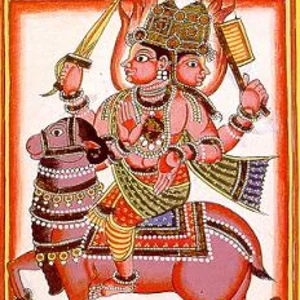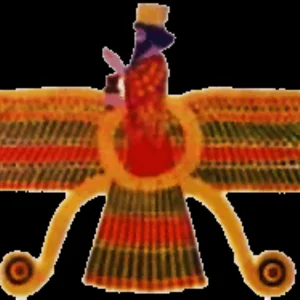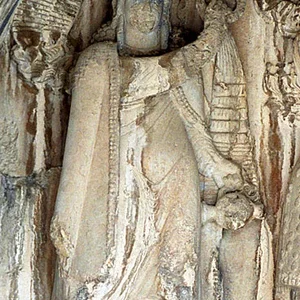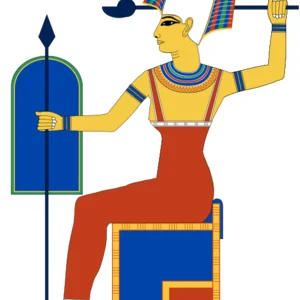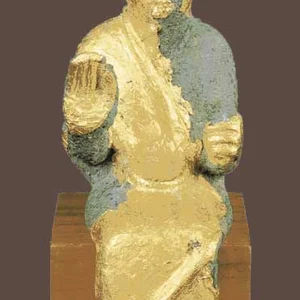

El is the supreme deity of the Canaanite and Ugaritic pantheon, father of gods and men. A creator god and divine judge, he presides over the council of the gods. His cult is attested throughout the ancient Semitic Near East.
El
El
8 min read
Frequently asked questions
Key Facts
- El is attested in the texts of Ugarit (present-day Syria) dating to the 14th–13th century BCE.
- His name simply means 'god' in ancient Hebrew, Aramaic, and Arabic.
- He is the father of Baal and many other deities of the Canaanite pantheon.
- The term El is directly related to Elohim, one of the names of God in the Hebrew Bible.
- His cult illustrates the gradual transition toward monotheism in Semitic societies.
Works & Achievements
A large Ugaritic mythological corpus in which El plays the role of sovereign father, granting or withholding royal power from the gods. It is the primary narrative source on his divine personality and his role as cosmic judge.
A Ugaritic ritual text in which El begets the gods of Dawn and Dusk. It illustrates El's function as creator and primordial father, progenitor of the entire Canaanite pantheon.
A Ugaritic text describing a divine banquet presided over by El, at which he becomes drunk and receives a ritual remedy. It reveals El's hospitable and festive side as the generous host of the divine assembly.
Ugaritic myths describing a banquet at El's dwelling attended by the spirits of ancient deceased kings. They attest to El's role as master of the fate of the dead and guardian of royal memory.
A Greek text preserving Phoenician myths in which El is equated with the Greek god Kronos. Philo recounts his divine genealogy, his wars, and his cosmic reign, forming a bridge between Semitic and Greco-Roman traditions.
Anecdotes
In the Baal Cycle, El presides over the council of the gods from his mythic dwelling, described as the “source of the two rivers, at the confluence of the two abysses.” It is there that the gods come to present their requests, and his word is law over the divine assembly. This image of a god as judge and absolute sovereign deeply influenced the conception of God in the monotheistic traditions that followed.
When Baal asks permission to build a palace on Mount Sapan, El responds favorably only after the intervention of Asherah, his divine consort. The scene reveals an El who is both all-powerful and responsive to pleading: he celebrates the good news by laughing, for Baal's victory ensures the fertility of the earth. This passage from the Ugaritic tablets illustrates the complex diplomacy that prevailed within the Canaanite pantheon.
When told of Baal's death, El performs spectacular mourning rites: he descends from his throne, sits in the dust, covers his head with earth, and tears his garments. This behavior, attested in the Ugaritic tablets (c. 1400–1200 BCE), shows that El is not a cold and distant god, but a father deeply affected by the death of his divine sons.
A Ugaritic text (KTU 1.114) describes El drunk at a great divine banquet, stumbling among the gods and unable to stand upright. Far from harming his prestige, this episode underscores his hospitable and festive side: El presides over legendary feasts to which the gods are invited to his table. This image contrasts with that of the austere judge, revealing the full complexity of the character.
The name 'El' is at the root of many divine and personal names throughout the ancient Near East: it appears in 'Israel' (meaning 'one who struggles with El'), in 'Michael' ('Who is like El?'), and in the Arabic word 'Allah.' This linguistic ubiquity testifies to the considerable influence of the supreme Canaanite god on the cultures and religions that followed him.
Primary Sources
El said: "I am wise, and my wisdom is with eternal wisdom… Let Yam reign over the gods!" Then, when Baal triumphs and Asherah intercedes, El grants his blessing and allows the construction of the divine palace.
El lies down on the seashore… and the two women cry out: "Father! Father!" El takes them as wives and begets Shahar and Shalim, the gods of Dawn and Dusk.
El presides over a great banquet and drinks until he is drunk. He stumbles and falls in his own mire. The gods support him and prepare a remedy for his hangover.
Cronus, whom the Phoenicians call El, reigned over the land… He bore four eyes upon his head, two open and two closed, a sign that he sees all things even in sleep. He had two wings, a symbol of his boundless wisdom.
And God said to Abraham: "I am El Shaddai; walk before me and be blameless." (Genesis 17:1). The name El, designating the supreme Canaanite deity, is one of the oldest names for God preserved in the biblical tradition.
Key Places
Phoenician city-state where cuneiform tablets containing the myths of El were discovered in 1929. This is the primary archaeological source for our knowledge of his cult and divine character.
El resides at the "source of the two rivers, at the confluence of the two deeps" according to the Ugaritic texts. This mythical place at the edge of the world symbolizes the origin of the primordial waters and the center of the universe.
The main geographical area where the cult of El is attested from the 2nd millennium BCE. His name and attributes directly influenced the emerging Israelite religion and the Hebrew Bible.
Ancient Phoenician city where the cult of El, assimilated to the Greek god Kronos, was observed. Philo of Byblos drew on Phoenician sources about El there, transmitting them to the Greco-Roman world.
Syrian city-state whose cuneiform archives (c. 2400 BCE) contain the earliest documented mentions of El as the supreme god of the Semitic pantheon, attesting to the antiquity of his cult.
Typical Objects

El is regularly invoked under the title 'Bull El' (Thoru El) in the Ugaritic texts. The bull symbolizes his virile power, his divine fertility, and his majesty as father of gods and men.

The royal attribute par excellence, El's scepter symbolizes his supreme authority over the assembly of the gods. He wields it to settle disputes between deities and to grant or refuse the requests of the gods.

In the banquet myth (KTU 1.114), El presides over the feast of the gods with a cup of wine. The cup is the symbol of his hospitality and divine generosity, qualities fundamental to the father of all gods.

El's dwelling is described not as a palace of stone but as a majestic tent erected at the source of the two cosmic rivers. This detail evokes the image of a nomadic and founding god, whose tent is the world's first sacred place.

A royal headdress adorned with two bull's horns, El's iconographic attribute in artistic representations from the ancient Near East. It signifies both his divine power and his symbolic identification with the bull.

El is the keeper of divine decrees inscribed on tablets: it is he who writes the fate of gods and men. This power of cosmic writing makes him the ultimate authority over the order of the world.
School Curriculum
Vocabulary & Tags
Key Vocabulary
Tags
Daily Life
Morning
El begins his day in his cosmic tent, at the source of the primordial waters. The gods — his sons — bring him news of the world and the requests of men. His legendary wisdom — he is called 'the Kindly and Compassionate' (Latipan) — allows him to settle great divine affairs at dawn, before the other gods have awakened.
Afternoon
El presides over the assembly of gods (the 'pukuru ilima', the circle of immortals), where conflicts between divinities are resolved. It is he who grants Baal or Yam supremacy over the cosmos, or who fixes the destiny of men and nations. His word is final and cannot be contested by any other divine power.
Evening
When night falls, El invites the gods to his table for great feasts. Wine flows abundantly, ritual songs rise up, and divine alliances are cemented around his cup. El is generous and jovial here, revealing a warmth concealed by his austere role as supreme judge of the cosmos.
Food
In the myths, El drinks wine at divine banquets, sometimes to the point of intoxication according to KTU 1.114. Canaanite temples offered him animal sacrifices, particularly bulls in his image. Divine food is symbolically perfect: it ensures the immortality and power of the gods who partake of it.
Clothing
El is depicted wearing a royal tiara adorned with two bull horns, the insignia of his divine kingship. He wears a long robe and a ceremonial cloak. His white beard, attested in iconography, symbolizes his eternal wisdom and great age: he is 'the Father of Years' (*ab shanima*), an immemorial god.
Housing
El resides in a mythical pavilion-tent described as sumptuous, erected at the source of the two great cosmic rivers. It is not a palace of stone: the tent recalls the nomadic origins of Semitic cultures and evokes a mobile divine presence, on the edge of the known world and the primordial abyss.
Historical Timeline
Period Vocabulary
Liens externes & ressources
Références
Œuvres
Cycle de Baal (KTU 1.1–1.6, tablettes d'Ugarit)
vers 1400–1200 av. J.-C.
Mythe de la naissance de Shahar et Shalim (KTU 1.23)
vers 1400–1200 av. J.-C.
Mythe du repas d'El (KTU 1.114)
vers 1400–1200 av. J.-C.
Textes des Rephaïm (KTU 1.20–1.22)
vers 1400–1200 av. J.-C.
Histoire phénicienne de Philon de Byblos (dans Eusèbe, Préparation évangélique)
Ier–IIe siècle apr. J.-C.