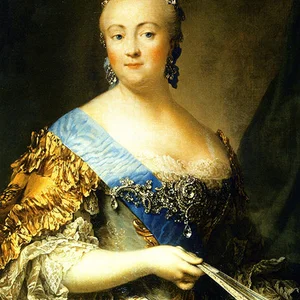

Daughter of Peter the Great, Elizabeth I ruled Russia from 1741 to 1762. Her reign was marked by a flourishing of culture, the founding of Moscow University, and Russia's victorious participation in the Seven Years' War.
Elizabeth I of Russia(1709 — 1762)
Elizabeth I of Russia
Empire russe, tsarat de Moscou
8 min read
Frequently asked questions
Key Facts
- 1709: born at Kolomenskoye, daughter of Peter the Great and Catherine I
- 1741: seized power in a coup against Ivan VI, backed by the Imperial Guard
- 1755: founded Moscow University, the first university in Russia
- 1756–1763: Russia's involvement in the Seven Years' War alongside France and Austria
- 1762: death of Elizabeth I; succeeded by Peter III, then Catherine the Great
Works & Achievements
Russia's first university open to commoners, established at the initiative of Mikhail Lomonosov and supported by Elizabeth. It stands as the defining intellectual legacy of her reign and remains a leading institution to this day.
Commissioned from architect Bartolomeo Rastrelli, this masterpiece of Russian Baroque would later house the Hermitage Museum. Elizabeth personally oversaw the construction but died before its completion.
The imperial summer residence completely redesigned by Rastrelli under Elizabeth's direction, including the legendary Amber Room gifted by Frederick William I of Prussia. A defining symbol of Elizabethan Baroque splendor.
An institution established to train Russian artists to European standards, reflecting Elizabeth's ambition to cultivate a national culture. It helped give rise to a distinctly Russian school of painting and sculpture.
A decree abolishing executions in Russia, making Elizabeth one of the first monarchs in Europe to adopt such a measure. Not a single execution took place during her twenty-year reign.
Elizabeth joined the Diplomatic Revolution of 1756 and committed Russia to the anti-Prussian coalition. Russian victories at Gross-Jägersdorf, Kunersdorf, and the capture of Berlin established Russia as a major military power.
Anecdotes
Elizabeth seized the throne in 1741 through a nocturnal coup: she went in person to the Preobrazhensky regiment's barracks, put on a military uniform, and rallied the soldiers. Without a single drop of blood being shed, the young Ivan VI was overthrown and Elizabeth was proclaimed Empress that very night.
A passionate fashion lover, Elizabeth owned more than fifteen thousand dresses at the time of her death. She issued decrees forbidding her ladies-in-waiting to wear the same hairstyle or the same colors as her, ensuring she would always stand out as the most striking figure at court balls and festivities.
Elizabeth abolished the death penalty in Russia in 1744, making her one of the first European monarchs to take such a step. Not a single execution took place during her twenty-year reign — a remarkable exception in Enlightenment-era Europe.
During the Seven Years' War, Russian armies defeated the Prussians at Zorndorf and Kunersdorf (1759), putting Frederick II in a desperate position. When Elizabeth died in January 1762, her successor Peter III — a great admirer of Frederick — immediately signed a peace treaty, saving Prussia at the last moment. Historians call this event the 'Miracle of the House of Brandenburg.'
The daughter of Peter the Great and a peasant woman who became tsarina, Elizabeth had received no formal education in governance. Yet on the advice of the scholar Mikhail Lomonosov, she founded Moscow University in 1755, opening higher education to commoners for the first time in Russia.
Primary Sources
We, Elizabeth, daughter of Peter the Great, have deigned to ascend the throne of Russia, as the rightful heir of our beloved father, for the salvation and prosperity of our Empire.
A university is hereby established in Moscow comprising three faculties — law, medicine, and philosophy — to educate learned subjects in the service of the Russian state, without distinction of birth.
Empress Elizabeth ruled with a natural majesty that few sovereigns possess. Her court rivaled Versailles in splendor, and no one could contest her place as the most commanding presence in any room.
Princess Elizabeth presented herself to the grenadiers in uniform, declaring that she had come to claim her father's throne. The soldiers acclaimed her unanimously, and the matter was settled before dawn.
The death of Empress Elizabeth saves me from certain ruin. Her armies had brought me to my knees; Providence alone has changed the course of this war.
Key Places
Elisabeth's main residence, rebuilt by Bartolomeo Rastrelli in the Elizabethan Baroque style between 1754 and 1762. This monumental palace, now home to the world-famous Hermitage Museum, is the enduring symbol of her magnificent reign.
The imperial summer residence expanded by Elisabeth, adorned with the famous Amber Room. This Baroque palace embodied Elisabeth's ambition to establish Russia as a major European cultural power.
Founded by Elisabeth in 1755 at the suggestion of the scholar Lomonosov, it was the first Russian university open to all social classes. It remains one of the most prestigious universities in the country to this day.
Elisabeth's birthplace in 1709, a former summer residence of the tsars on the outskirts of Moscow. It was here that Peter the Great received news of the victory at Poltava, the very year his daughter was born.
Site of the decisive Russo-Austrian victory on August 12, 1759 against Frederick II of Prussia during the Seven Years' War. This battle stands as a testament to Russia's military strength under Elisabeth.
Typical Objects

At her death, Elizabeth owned more than fifteen thousand dresses — a testament to her love of splendor and her authority over court dress codes. These lavish gowns were commissioned from the finest European and Russian craftsmen.

During the coup of 1741, Elizabeth donned a military uniform to rally the soldiers, a gesture that cast her as a warrior-empress in the eyes of her subjects. The uniform became a symbol of her dynastic legitimacy.

Court painters — most notably Ivan Vishniakov and Louis Tocqué — produced numerous portraits of Elizabeth to proclaim her imperial glory and spread her image across Europe. These works were presented as gifts to foreign ambassadors.

The ukase was the instrument of the tsarina's absolute power: it was through such documents that she founded Moscow University and abolished the death penalty. Each decree bore her personal seal and signature.

Elizabeth traveled in richly ornamented carriages, reflecting the Baroque magnificence she sought to establish in Russia after the model of Versailles. Her official processions through Saint Petersburg were spectacular public events.

A passionate lover of music and dance, Elizabeth hosted balls and concerts at court, inviting foreign musicians and composers. She played a key role in introducing Italian opera to Russia.
School Curriculum
Vocabulary & Tags
Key Vocabulary
Daily Life
Morning
Elisabeth rises late, often after ten o'clock, following nights of festivities and balls that stretch until dawn. Her morning routine is an elaborate ritual: dressing assisted by her ladies-in-waiting, careful selection of a gown from hundreds of options, powdered hair, and meticulous makeup before any audience.
Afternoon
The afternoon is devoted to affairs of state: audiences with foreign ambassadors, signing of ukases, meetings with her advisors (notably Count Shuvalov and Chancellor Bestuzhev-Ryumin). Elisabeth also enjoys horseback hunting in the imperial parks, a pastime she cherishes as much as the arts.
Evening
Evenings are dominated by court entertainments: masquerade balls, opera performances or French comedies, and lavish banquets. Elisabeth introduces 'transvestite balls' where men and women exchange costumes — an occasion she particularly enjoys, as it allows her to dress as a military officer.
Food
The imperial table is abundant and cosmopolitan: French sauced dishes, Volga sturgeon and caviar, and Russian black bread and vodka alongside French wines and elaborate desserts. Court banquets can feature dozens of courses and last several hours.
Clothing
Elisabeth establishes a fashion for hoop-skirted gowns in silk or brocade, richly embroidered with gold and silver, adorned with lace, ribbons, and precious stones. She forbids her ladies from wearing the same colors as her and constantly refreshes her wardrobe, importing the latest fashions from Paris.
Housing
Elisabeth resides primarily at the Winter Palace, then under construction in Saint Petersburg, and regularly stays at Tsarskoye Selo (her summer residence) and Peterhof Palace. These imperial residences, decorated by Rastrelli, rival the grandest palaces of Europe in splendor.
Historical Timeline
Period Vocabulary
Visual Style
Le style visuel d'Élisabeth Ire s'inscrit dans le baroque russe flamboyant : façades turquoise et or de Rastrelli, intérieurs surchargés de dorures, portraits d'apparat en robes de soie brodées, dans une palette de bleus impériaux, d'ors et de cramoisies.
Sound Ambience
L'atmosphère sonore du règne d'Élisabeth mêle la splendeur musicale d'une cour baroque inspirée de Versailles au fond sonore solennel de la Russie hivernale : cloches orthodoxes, traîneaux sur la neige et fastes des bals impériaux.
Liens externes & ressources
Références
Œuvres
Fondation de l'université de Moscou
1755
Construction du Palais d'Hiver (Saint-Pétersbourg)
1754–1762
Palais de Tsarskoïe Selo — Grand Palais Catherine
1752–1756
Création de l'Académie des beaux-arts de Saint-Pétersbourg
1757
Oukaze d'abolition de la peine de mort
1744
Alliance franco-austro-russe et entrée en guerre de Sept Ans
1756–1762