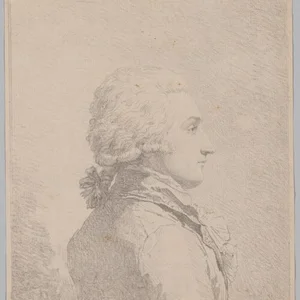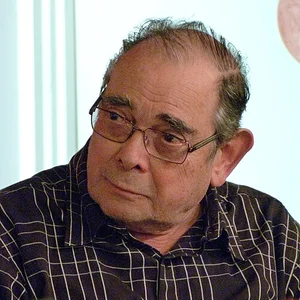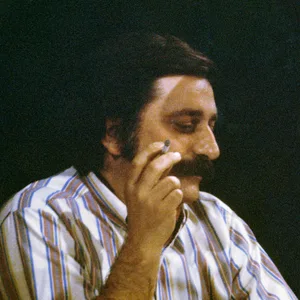

Fred, whose real name was Othon Aristidès, was a French cartoonist and comic-strip writer of Greek descent. A poet of drawing, he was the creator of Philémon, a dreamlike and surrealist series published in Pilote, and one of the founders of the satirical magazine Hara-Kiri.
Fred(1983 — ?)
Frederico Chaves Guedes
Brésil
5 min read
Frequently asked questions
Key Facts
- Born in 1931 in Paris to Greek parents, died in 2013
- Co-founder in 1960 of the satirical magazine Hara-Kiri with Professor Choron and Cavanna
- Created the series Philémon in the magazine Pilote in 1965
- Received the Grand Prix of the city of Angoulême in 1980
- Published the final Philémon album, “Le Train où vont les choses,” in 2013
Works & Achievements
Satirical newspaper — “dumb and nasty” — that reinvented the French humor press and gave rise to Charlie Hebdo.
Fred's flagship series, a dreamlike and surrealist masterpiece of comics, published in Pilote and then as albums by Dargaud.
The first Philémon album, which sets up the principle of the letter-islands of the Atlantic Ocean.
A Philémon album praised for its graphic inventiveness and its poetic humor.
A tender and melancholic tale, one of Fred's most personal works outside of Philémon.
The return of Philémon after a long hiatus, hailing the still-intact imagination of its author.
Official recognition of Fred's entire body of work through the highest distinction in French-language comics.
Anecdotes
Fred, whose real name was Othon Aristidès, was born in Paris in 1931 to a Greek father. As a child, he devoured cartoons and American comics, and signed his first gags with a short, punchy pen name, “Fred,” to hide a family name he found too complicated.
In 1960, Fred co-founded, together with the writer François Cavanna and Professor Choron, the magazine Hara-Kiri, which proclaimed itself “dumb and nasty.” The publication's ferocious and absurd humor would earn it several bans from the censors, but also a place as a pioneer of the French satirical press.
His most famous series, Philémon, rests on a dizzying idea: the letters of the words “ATLANTIC OCEAN” written across geography maps are in fact islands where one can go ashore. There his hero lives dreamlike adventures, chatting with a shipwrecked well-digger and a learned donkey.
Fred worked very slowly and suffered long periods of doubt: Philémon went through several interruptions lasting several years. He said he drew “the way one dreams,” letting the story build itself at the tip of the pen rather than following a preset plan.
A great admirer of poetry and wordplay, Fred slipped visual puns and logical paradoxes worthy of Lewis Carroll into his pages. René Goscinny, who published him in Pilote, saw in him one of the most singular authors of French comics.
Primary Sources
The letters written on the maps of the oceans are real islands where you can come ashore — that is the secret Philémon will discover in spite of himself.
Hara-Kiri, a stupid and nasty magazine.
I never know where I'm going; I draw the way one dreams, and the story unfolds all by itself beneath the pen.
Key Places
Fred's birthplace and the heart of his career: it is here that he was born in 1931, created his works, and died in 2013.
Where the satirical magazine was founded in 1960, a hub of the irreverent post-war humour press.
Headquarters of the magazine run by René Goscinny, where Fred brought Philémon to life alongside the great names of Franco-Belgian comics.
The homeland of Fred's father, the source of part of his identity and of his taste for mythological and poetic worlds.
Typical Objects

Fred's favorite tool, whose supple, nervous line gave the pages of Philémon their quality of a drawn dream.

A large sheet of card stock on which Fred composed his panels by hand. The material support of Philémon's imaginary world.

A central object in the world of Philémon: the letters of the words “ATLANTIC OCEAN” become inhabited islands, turning a schoolroom teaching aid into a doorway to adventure.

In Philémon, the farm's well serves as a secret passage to the letter-islands of the Atlantic, a symbol of the leap into a dreamlike elsewhere.

The printed satirical magazine “dumb and nasty” that Fred helped found, embodying the irreverence of postwar humor journalism.

The comics magazine edited by René Goscinny in which Fred published Philémon, a showcase of the golden age of Franco-Belgian comics.
School Curriculum
Vocabulary & Tags
Key Vocabulary
Tags
Daily Life
Morning
Fred often got up late, his nighttime creating spilling over into his mornings. He liked to start the day without any set plan, letting the day's idea emerge in front of the blank page.
Afternoon
The afternoon was spent at his drawing table, pen and India ink in hand, slowly composing his pages. His workdays were broken up by long daydreams that fed the world of Philémon.
Evening
In the evening, Fred frequented Parisian cafés and editorial offices, catching up with the writers of Pilote and the Hara-Kiri team. These lively, funny exchanges fueled his taste for puns and the absurd.
Food
Like many Parisian artists of his generation, Fred took his meals in the neighborhood bistros, between a daily special and a strong coffee. The conviviality of the table mattered as much as the food.
Clothing
Fred adopted the plain, unfussy attire of press cartoonists: a shirt and a jacket often stained with ink, far from any ostentatious elegance.
Housing
He lived and worked in Paris, in a studio apartment cluttered with drawings, books, and geographical maps that inspired his stories.
Historical Timeline
Period Vocabulary
Liens externes & ressources
Références
Œuvres
Hara-Kiri (co-fondation)
1960
Philémon
1965-2013
Le Naufragé du A
1972
Le Piano sauvage
1973
Le Petit Cirque
1973
Le Train où vont les choses
2008
Grand Prix du festival d'Angoulême
1987