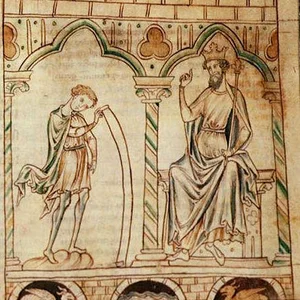

Geoffrey of Monmouth is a 12th-century Welsh cleric and chronicler, famous for his *Historia regum Britanniae* (c. 1136). This work, blending history and legend, popularized the figures of King Arthur and the enchanter Merlin, durably shaping the Matter of Britain.
Geoffrey of Monmouth(1100 — 1155)
Geoffrey of Monmouth
royaume d'Angleterre, Royaume de Glywysing
9 min read
Frequently asked questions
Key Facts
- Born around 1100, probably in Monmouth, Wales, in an Anglo-Norman context
- Wrote around 1135 the *Prophetiae Merlini* (Prophecies of Merlin), later incorporated into his great work
- Completed around 1136 the *Historia regum Britanniae*, a legendary history of the kings of Britain that founded the Arthurian myth
- Composed around 1150 the *Vita Merlini*, a Latin poem dedicated to the character of Merlin
- Consecrated bishop of St Asaph in 1152, died around 1155
Works & Achievements
Geoffrey's masterpiece, this Latin chronicle recounts the legendary history of Britain from Brutus of Troy to the kings of the 7th century. It constitutes the primary source of the Arthurian legend and was one of the most widely copied Latin texts of the Middle Ages, with over 200 surviving manuscripts.
A text of prophecies attributed to Merlin, written before the *Historia* and later incorporated into it. These cryptic and metaphorical prophecies were taken very seriously by contemporaries, some seeing in them real political predictions about the future of Christian kingdoms.
A long Latin poem that expands the figure of Merlin, showing him as a Welsh bard driven mad after a bloody battle and retreating to the Caledonian forest. This work reveals Merlin's deep Celtic roots and his dual nature — prophet and man broken by war.
Anecdotes
Geoffrey of Monmouth claims to have translated his *Historia Regum Britanniae* from a "very ancient book in the Breton language" given to him by Archdeacon Walter of Oxford. No historian has ever found this mysterious volume, and most medievalists today believe it never existed — it was a classic literary ruse to lend an air of authenticity to a largely invented work.
Merlin as we know him is largely Geoffrey's invention. He drew on a Welsh figure named Myrddin, a mad bard living in the forest, and gave him a new identity: the wise enchanter who orchestrates Arthur's conception at Tintagel and predicts the destiny of Britain. Geoffrey even Latinized the name to Merlinus to avoid a vulgar connotation in Latin.
When Geoffrey published his *Prophetiae Merlini* around 1134, the text circulated as if it were real prophecies revealed to an enchanter. Clerics, kings, and even prelates sought to decipher Europe's future in it. Yet these "prophecies" are a clever literary fiction, proof that Geoffrey knew how to manipulate the beliefs of his time with formidable skill.
The chronicler William of Newburgh bluntly calls Geoffrey a liar: "He invented fabulous absurdities about an Arthur whom he promotes far beyond what the truth deserves." Despite these harsh criticisms, the *Historia Regum Britanniae* was a resounding success and one of the most copied Latin texts of the Middle Ages, with over 200 surviving manuscripts.
Appointed bishop of St Asaph in 1152, Geoffrey never set foot in his Welsh diocese, too preoccupied by the civil wars ravaging England. This detail perfectly illustrates the gap between this churchman's real life and the legendary Breton world he built in his books — a mythmaker caught up in History.
Primary Sources
Britain, the best of islands, situated in the western ocean between Gaul and Ireland, extending eight hundred miles in length and two hundred in width, supplies whatever is useful to mortals with unfailing fertility.
The lineage of Arthur shall cease, and the fertility of his seed shall grow old. Afterwards, from Cornwall shall come one who will prepare a snare for his successor.
When Merlin saw so great a crowd gathering, he wished to hide, he longed to go to the remote woods, and having entered the grove rejoiced, he refused to leave, nor to have any care for himself.
Arthur the king, who did well, lord of Britain, conquered Normandy, Anjou, Gascony, Poitou, Auvergne, and Burgundy.
For it is clear that this man, by a certain art of absurd fables which he invented about Arthur and his successors, embellished the deeds of the Britons for greater renown than truth required.
Key Places
Probable birthplace of Geoffrey, on the border between England and Wales. This march territory, where Norman, Anglo-Saxon, and Welsh cultures mingled, nourished his imagination and interest in Celtic and Breton traditions.
Intellectual center where Geoffrey served as a canon for many years. It was here that he wrote his major works and associated with Walter, Archdeacon of Oxford, to whom he fictitiously attributed the delivery of the legendary "British book".
According to the *Historia*, it was in this inaccessible castle that Merlin enabled Uther Pendragon to conceive Arthur. This real location on the Cornish coast became, thanks to Geoffrey, the mythical birthplace of King Arthur — an Arthurian pilgrimage site still visited today.
Ancient Roman town chosen by Geoffrey as Camelot avant la lettre — the lavish court of King Arthur, a place of tournaments and chivalry. This choice of a real Roman city anchored the Arthurian legend in a credible geography.
Abbey associated since Geoffrey with the Isle of Avalon, where Arthur is taken after his final battle. In 1191, the monks of Glastonbury claimed to have found Arthur's tomb, a direct exploitation of the myth that Geoffrey had sown fifty years earlier.
Bishopric to which Geoffrey was appointed in 1152, a few years before his death. This Welsh town marks the final stage of an ecclesiastical career conducted in the shadow of books and legends.
Typical Objects

An essential tool of the medieval chronicler, the carved goose quill and sheepskin parchment are the instruments with which Geoffrey set down the Breton legends in writing. Each copy of his works was a costly artisanal labor, which did not prevent the *Historia* from being reproduced throughout Europe.

Geoffrey claimed to have translated his *Historia* from a "very old book in the Breton language" given to him by Walter of Oxford. This phantom work, never found, became the very symbol of medieval literary mystification — a legendary object that guaranteed the fictional authority of the entire work.

In the tradition of Celtic enchanters from which Merlin springs, the hazel wood wand is the divinatory instrument par excellence. Geoffrey gave Merlin prophetic powers that were associated with these objects in the medieval popular imagination.

One of the central symbols of the *Historia Regum Britanniae*, Arthur's golden crown embodies the legendary kingship of the Britons. Geoffrey describes it at Arthur's lavish coronations at Caerleon, creating a monarchical ideal that would influence centuries of political thought.

The Middle Ages associated prophecies with astronomy: Merlin reads the stars to predict the future of kings. In the *Vita Merlini*, Geoffrey describes an astronomer Merlin, reflecting the interest of the clerics of his time in translations of Arabic treatises on the stars.

Appointed Bishop of St Asaph in 1152, Geoffrey used an official seal to authenticate his ecclesiastical acts. Two charters signed by him have survived, concrete testimonies to his historical existence behind the figure of the great legend-teller.
School Curriculum
Vocabulary & Tags
Key Vocabulary
Tags
Daily Life
Morning
Geoffrey rises at dawn for the prayers of Lauds with the other canons of Oxford. After a reading of the Scriptures, he makes his way to the scriptorium as soon as daylight is sufficient to work. He begins by revising the passages written the day before, correcting with a quill the parchment folios laid out on his slanted desk.
Afternoon
The afternoon is devoted to research and composition. Geoffrey consults the available chronicles — Bede, Gildas, Nennius — and the oral tales of the Welsh bards, which he reinterprets and weaves into his own Latin narrative. He sometimes discusses questions of history, chronology, and theology with his fellow clerics.
Evening
In the evening, after Vespers and the communal meal in the refectory, Geoffrey may receive learned visitors or exchange letters with correspondents from England and Normandy. He takes advantage of the last light to correct his copies and annotate his sources, before heading to the chapel for Compline.
Food
As a regular canon, Geoffrey follows the dietary rules of his community: no meat on lean days (Wednesday, Friday, and Lent), a diet based on bread, cheese, vegetables, and fish. On feast days, poultry and watered wine are added.
Clothing
Geoffrey wears the dark robe of the regular canons, in coarse wool both summer and winter, with a hood for the offices. In the scriptorium, he removes the outer cloak to work more freely. His hands are often stained with ink made of carbon or oak gall.
Housing
Geoffrey lodges in the canonical buildings of Oxford, probably in a modest individual cell with a chest for his books and manuscripts. The room is cold, lit by a small mullioned window overlooking the cloister. He may own a few volumes himself — a rare luxury for the time.
Historical Timeline
Period Vocabulary
Visual Style
Style enluminure anglo-normande du XIIe siècle : pigments outremer et vermillon sur vélin crème, rehauts d'or, encadrements romans et entrelacs celtiques évoquant la frontière entre monde normand et traditions galloises ancestrales.
Sound Ambience
L'univers sonore de Geoffroy mêle le silence studieux du scriptorium médiéval — plumes qui grattent, chants grégoriens lointains, crépitement de chandelles — aux sonorités galloises du dehors, cloches et corbeaux sur les remparts de Monmouth.
Liens externes & ressources
Références
Œuvres
Historia Regum Britanniae
vers 1136
Prophetiae Merlini
vers 1134
Vita Merlini
vers 1150