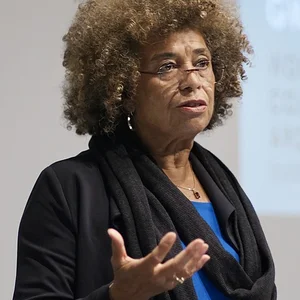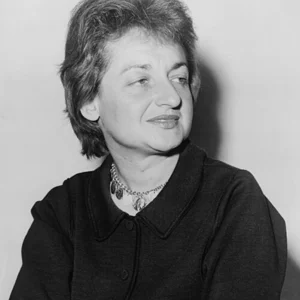

An American journalist and feminist activist, Gloria Steinem is one of the iconic figures of the women's movement of the 1960s and 1970s. Co-founder of Ms. magazine in 1972, she dedicated her life to defending gender equality and civil rights.
Gloria Steinem(1934 — ?)
Gloria Steinem
États-Unis
8 min read
Frequently asked questions
Famous Quotes
« A woman needs a man like a fish needs a bicycle.»
« The truth will set you free, but first it will piss you off.»
Key Facts
- Born in 1934 in Toledo, Ohio
- Co-founded Ms. magazine in 1972, the first mainstream feminist magazine in the United States
- Actively campaigned for the Equal Rights Amendment (ERA) in the 1970s
- Co-founded the National Women's Political Caucus in 1971 with Bella Abzug and Betty Friedan
- Published the essay collection Outrageous Acts and Everyday Rebellions in 1983
Works & Achievements
An undercover investigation published in Show Magazine in which Steinem got hired as a waitress at a Playboy Club to expose the working conditions of its employees. A founding piece of feminist investigative journalism.
The first mainstream feminist magazine in the United States, co-founded with Dorothy Pitman Hughes. Steinem led its editorial team for decades and made it the essential platform of the women's movement.
A collection of essays bringing together twenty years of journalism and activism. The book consolidates her feminist thinking and became a landmark text for the women's movement around the world.
An essay exploring the connection between self-esteem and political emancipation, which became an international bestseller. Steinem argues that inner liberation is the indispensable prerequisite for collective liberation.
A collection of critical essays on popular culture and the representation of women in the media, illustrating the continuity of her journalistic and theoretical commitment.
Memoirs tracing her decades of itinerant activism across the United States. Praised for their vivid style, they offer an inside look at the history of American feminism.
Anecdotes
In 1963, Gloria Steinem gets herself hired undercover as a “Bunny” waitress at a New York Playboy Club. In her article “A Bunny’s Tale,” she exposes the meager wages, harassment, and humiliating working conditions endured by the staff. This undercover investigation, a pioneer of gonzo journalism, earns her national fame — but also the label of “the journalist who undressed for a story,” a tag it would take her years to shake off.
On August 26, 1970, for the 50th anniversary of women’s suffrage in the United States, Steinem marches in New York in the Women’s Strike for Equality alongside tens of thousands of demonstrators. This march, organized notably by Betty Friedan and Dorothy Height, is one of the largest feminist demonstrations in American history. Steinem delivers a speech that definitively establishes her as a spokesperson for the movement.
When she co-founds Ms. magazine in 1972 with Dorothy Pitman Hughes, no one believes a mainstream feminist magazine can succeed. The launch issue, put on newsstands in January 1972, sells out in eight days — 300,000 copies sold. The editorial team receives 26,000 letters from readers within a few weeks, proof that a vast audience had been waiting for this platform.
Known for her elegant style and long round glasses, Steinem long suffered from being reduced to her physical appearance in the male-dominated media. When a journalist wrote that she “didn’t look like a feminist,” she replied: “This is what a feminist looks like.” That line became a rallying cry taken up by generations of activists.
In 2013, Barack Obama presented her with the Presidential Medal of Freedom, the highest civilian honor in the United States. At 79, Steinem remains an active activist: she participated in the Women’s March in Washington on January 21, 2017, the day after Donald Trump’s inauguration, before a crowd estimated at 500,000 people.
Primary Sources
The Playboy Club is not a restaurant. It is not a nightclub. It is a massive and lush tribute to all-male supremacy... The Bunnies are supposed to be sexy, and to inspire that feeling in the patrons, but they are not supposed to feel sexy themselves.
Women's liberation is finally being taken seriously... The women's movement is not just a white middle-class phenomenon; it speaks to the lives of all women, of every class and race.
Wonder Woman for President... We need to take her seriously again because the current female image is a backlash against women's power, an attempt to make us believe we are less than we are.
I have met brave women who are exploring the outer edge of human possibility, with no real role models to follow out there in the frontier... and courage is often just stubbornness in disguise.
This is no simple reform. It really is a revolution. Sex and race, because they are easy visible differences, have been the primary ways of organizing human beings into superior and inferior groups.
Key Places
Gloria Steinem's birthplace, born on March 25, 1934. A childhood marked by poverty and a semi-nomadic father who sold antiques gave her a deep sense of independence from a very early age.
A prestigious women's college where Steinem earned her degree in political science in 1956, magna cum laude. It was here that she sharpened her intellectual and political convictions.
The hub of her journalistic and activist career: it was in New York that she worked for *New York Magazine*, co-founded *Ms. Magazine*, and helped drive the second-wave feminist movement.
The stage for her major political battles: the Women's Strike for Equality, the Equal Rights Amendment hearings, and the 2017 Women's March, where she addressed a crowd of 500,000.
After graduating, Steinem spent two years in India (1957–1959) on a Chester Bowles Fellowship. The experience brought her face to face with systemic poverty and gender inequality on a global scale, shaping her internationalist vision of feminism.
Typical Objects

The everyday tool of her work as a reporter for New York Magazine and Show Magazine, the notebook is the instrument with which Steinem recorded her field investigations and activist observations.

Founded in 1972, this magazine co-created by Steinem became her primary instrument of activism and for spreading feminist ideas to the American general public.

Her instantly recognizable visual signature, these glasses have accompanied every one of her public appearances since the 1960s and have become a symbol of her activist identity.

During the Women's Strike for Equality (1970) and the many marches she took part in, the hand-painted sign was the quintessential collective tool of feminist street mobilization.

The traveling companion of journalists in the 1960s–70s, it allowed Steinem to write her articles and essays from anywhere in the United States during her activist tours.

Steinem regularly distributed copies of her speeches at university appearances and feminist rallies, so that local activists could take up and spread her arguments.
School Curriculum
Vocabulary & Tags
Key Vocabulary
Tags
Daily Life
Morning
In the 1970s, Steinem often began her day very early, going through newspapers and letters from readers sent to *Ms.* Magazine. She wrote editorials and speeches on her typewriter in her New York City apartment — often still in her pajamas — before moving on to phone calls with activists in other states.
Afternoon
Afternoons were devoted to *Ms.* editorial meetings, appointments with political figures and labor leaders, and preparing for her many lectures at American universities. Steinem traveled constantly by plane or car to join local consciousness-raising groups and support feminist electoral campaigns.
Evening
Evenings were rarely restful: fundraising dinners for the ERA or NOW, television debates, public readings, or strategy meetings with figures like Bella Abzug or Shirley Chisholm. Steinem often came home late and prepared the next day's remarks before going to sleep.
Food
Pragmatic and often on the road, Steinem ate simply: sandwiches and coffee during long days at the office, dinners shared with fellow activists in friends' apartments across the country. She gave little thought to formal meals, preferring the informal warmth of activist gatherings.
Clothing
Her style remained consistent for decades: jeans, a structured blazer, and her iconic round glasses. She favored practical outfits suited to constant travel, deliberately rejecting the "seductive" feminine dress codes that the press sometimes criticized her for ignoring.
Housing
Steinem lived in a Manhattan apartment in the Upper East Side, which she shared for a time with roommates. Her home was known to be warm but modest — overrun with books, files, and activist correspondence — more a campaign office than a comfortable middle-class residence.
Historical Timeline
Period Vocabulary
Liens externes & ressources
Références
Œuvres
A Bunny's Tale
1963
Ms. Magazine (cofondation)
1972
Outrageous Acts and Everyday Rebellions
1983
Revolution from Within: A Book of Self-Esteem
1992
Moving Beyond Words
1994
My Life on the Road
2015