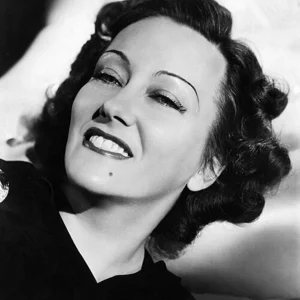

An iconic American actress of the silent cinema era in the 1920s, Gloria Swanson was one of Hollywood's greatest stars. Her role as Norma Desmond in *Sunset Boulevard* (1950) remains one of the most memorable performances in cinema history.
Gloria Swanson(1899 — 1983)
Gloria Swanson
États-Unis
8 min read
Frequently asked questions
Key Facts
- 1899: Born in Chicago, Illinois
- 1920s: Becomes one of Hollywood's highest-paid actresses under contract with Paramount
- 1929: First Oscar nomination for *The Trespasser*, one of her earliest sound film performances
- 1950: Plays Norma Desmond in Billy Wilder's *Sunset Boulevard*, the defining role of her career
- 1983: Dies in New York at the age of 84
Works & Achievements
Silent film directed by Cecil B. DeMille, adapted from the play *The Admirable Crichton*. This film introduced Gloria Swanson to American and international audiences, launching her career as Paramount's absolute top star.
A dramatic comedy directed by Cecil B. DeMille in which Swanson plays a sophisticated woman. The film cemented her status as Hollywood's number one star and showcased her mastery of the expressive acting style of the silent era.
A film in which she plays a department store salesgirl dreaming of a better life — a more grounded, relatable role that earned her enormous affection from American audiences across all social classes.
An adaptation of a Somerset Maugham short story that Gloria Swanson produced herself through Gloria Productions. Her performance earned her her first Academy Award nomination for Best Actress, proving she could also portray morally ambiguous characters.
An unfinished film by director Erich von Stroheim, produced by Gloria Swanson, whose production descended into financial and artistic disaster. Footage from this film appears symbolically in *Sunset Boulevard* twenty years later.
Billy Wilder's masterpiece in which Gloria Swanson plays Norma Desmond, a former silent film star unable to accept being forgotten. Considered one of the greatest films in cinema history, it earned her her third Academy Award nomination.
Anecdotes
In the 1920s, Gloria Swanson was so famous that crowds of thousands of fans would wait for her outside the Paramount studios. Management had a secret entrance built so she could reach the set without triggering riots. She received more than ten thousand fan letters a week — an absolute record for the era.
A passionate fashion devotee, Gloria Swanson was the first Hollywood actress to regularly commission her on-screen costumes from leading Parisian couturiers, most notably Coco Chanel for the film *Tonight or Never* (1931). She turned every public appearance into a genuine manifesto of elegance, shaping international women's fashion far beyond the silver screen.
In 1926, dissatisfied with the creative control the studios allowed her, Gloria Swanson founded her own production company, **Gloria Productions**. It was an extraordinarily rare move for a woman in Hollywood: she produced *The Love of Sunya* (1927) herself and negotiated her own contracts, paving the way for independent female producers.
To embody Norma Desmond in *Sunset Boulevard* (1950), Billy Wilder asked Gloria Swanson to revive the expressive performance style of silent cinema — precisely the style she had practiced twenty years earlier. This unsettling hall-of-mirrors effect between the real actress and her fictional character helped make the film a psychological masterpiece. She received an Oscar nomination for the role.
A pioneer of wellness long before the trend took hold, Gloria Swanson adopted an organic, macrobiotic diet in the 1950s, rejecting processed foods and refined sugar. She publicly campaigned against industrial junk food and wrote on the subject, astonishing an era that still regarded such choices as eccentric.
Primary Sources
I've always been a woman who takes risks. When I left Paramount, everyone said I was mad. But I knew that if I didn't control my own destiny, no one would do it for me.
Miss Gloria Swanson is engaged for a minimum of six annual productions, with a guaranteed consultation on the choice of her roles and directors.
The public wants glamour and I intend to give it to them. When I walk onto a set, I bring everything — the clothes, the jewels, the gesture. That is what the audience pays to see.
Gloria is perfect. She IS Norma Desmond. The tragedy is that she must play a woman who could have been her — and she does it without flinching.
We are poisoning our children with processed food. I chose years ago to eat real, eat healthy. This is not vanity — it is survival.
Key Places
Gloria Swanson's birthplace, born on March 27, 1899. She spent her childhood here before joining the Essanay Film Company studios for her first steps in cinema around 1915.
The central stage of Gloria Swanson's career in the 1920s, where she made around ten films under the direction of Cecil B. DeMille and became one of the highest-paid stars in the world. Located in Hollywood, these studios symbolize the golden age of American silent cinema.
Gloria Swanson's favorite destination for fashion stays, where she commissioned her costumes from top couturiers. She also filmed the opening scenes of *The Love of Sunya* here and forged lasting ties with Parisian high society in the 1920s.
The city where Gloria Swanson spent much of her adult life, away from the Hollywood spotlight, and where she passed away on April 4, 1983. She led an active social life there and championed her cause for healthy eating.
The legendary stretch of Hollywood Boulevard where Gloria Swanson's star was unveiled in 1960, cementing her place in the pantheon of American cinema.
Typical Objects

A large mechanical camera on a tripod, hand-cranked, used on every Hollywood set in the 1910s and 1920s. It filmed at a variable frame rate, giving silent films their characteristic jerky appearance when projected at modern speed.

A lavish bespoke outfit created by Parisian couturiers or Hollywood costume workshops, worn both on screen and at Gloria Swanson's public appearances. These garments helped build the star image and directly influenced women's popular fashion worldwide.

A 35 mm silver-based film strip wound onto a metal reel — the physical medium of every silent film of the era. Highly flammable due to its cellulose nitrate base, it caused numerous cinema fires and contributed to the destruction of a large part of the silent film heritage.

A filmed text panel inserted between scenes in silent films to explain the action, transcribe dialogue, or indicate place and time. A fundamental narrative element of silent cinema, it disappeared with the advent of sound film in 1927.

A powerful electric arc lamp used to artificially light film sets, especially indoors. Noisy, intensely hot, and blinding for actors, it required extremely heavy makeup — white foundation and heavily lined eyes — so that facial features would register properly on orthochromatic film stock.

A legal document binding an actress to a studio for several years, setting out her fees, filming obligations, and rights over her image. These contracts gave studios near-total control over the public — and sometimes private — lives of actresses, something Gloria Swanson challenged by founding her own production company.
School Curriculum
Vocabulary & Tags
Key Vocabulary
Tags
Daily Life
Morning
In the 1920s, Gloria Swanson rose early to reach the studios before dawn. The makeup session lasted over an hour: very pale foundation, heavily kohl-lined eyes, reshaped lips — a mask demanded by orthochromatic film stock, which was insensitive to red tones. A stylist would then adjust her haute couture costume before filming began.
Afternoon
Afternoons were entirely devoted to shooting on set, under electric arc lamps that gave off intense heat. Scenes were repeated until the director was satisfied, with no possibility of hearing dialogue — everything had to come through facial expression, gesture, and gaze. Between takes, she would review her performance with her director.
Evening
Gloria Swanson's evenings were both social and strategic: dinners at producers' homes, film premieres, receptions at Beverly Hills villas. She treated every public appearance as a performance, dressed in couture gowns and draped in jewels. These evenings were as much leisure as investment in her career and star image.
Food
During her Hollywood years, Swanson followed a strict studio-imposed diet to maintain her figure — low sugar, high protein, with weight gain strictly forbidden. From the 1950s onward, she voluntarily adopted a macrobiotic and organic diet, eliminating processed foods and refined sugar, and became an advocate for healthy nutrition long before it was fashionable.
Clothing
Gloria Swanson was obsessed with clothing as a tool of power and seduction. On screen, her costumes were created by the top Hollywood ateliers or commissioned from Paris. In private life, she wore impeccably elegant outfits, often Chanel or Schiaparelli. Her fashion choices directly influenced women's style in the 1920s, amplified by millions of magazines.
Housing
At the height of her fame, Gloria Swanson lived in a sumptuous Beverly Hills villa, surrounded by a staff of servants, secretaries, and personal assistants. The interiors were furnished with baroque luxury, reflecting her taste for grandeur. After gradually withdrawing from Hollywood, she settled in New York in a chic Manhattan apartment — a quieter, urban setting that suited her new life away from the studios.
Historical Timeline
Period Vocabulary
Liens externes & ressources
Références
Œuvres
Sadie Thompson
1928